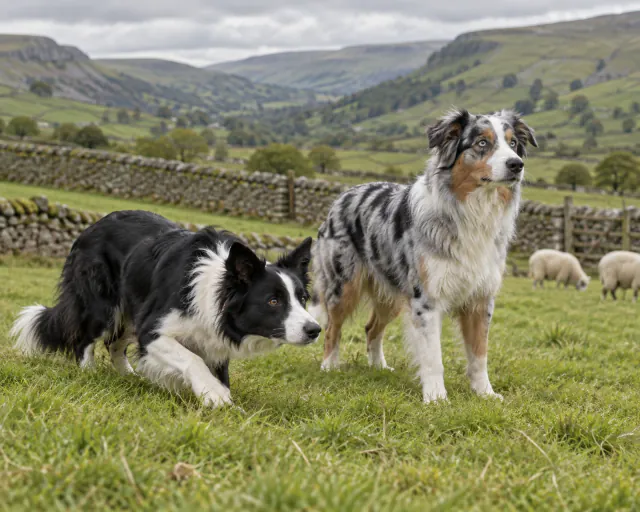
Active families researching a highly trainable, high energy dog for sports, running or serious daily structure land on the Border Collie and the Australian Shepherd again and again, often choosing between them on looks alone. Both are herding breeds bred for intense concentration and stamina, both are frequently seen at agility and obedience competitions, and both are commonly bought for a lifestyle their owners hope to build around the dog rather than one they already have. The comparison matters because the two breeds, despite looking similar in silhouette and often sharing merle colouring, come from different working traditions and differ in coat, size and how their drive shows up day to day.
Comparison at a glance
| Trait | Border Collie | Australian Shepherd |
|---|---|---|
| Size | Medium, males 48 to 56 cm, 14 to 20 kg | Medium, males 51 to 58 cm, 25 to 32 kg |
| Exercise needs | At least 2 hours plus structured mental work | At least 2 hours a day plus structured training |
| Grooming and shedding | Low grooming need despite high shedding, weekly brushing | High grooming need, regular brushing with heavy seasonal shedding |
| Trainability | Needs an experienced handler | Needs an experienced handler, though learns very quickly |
| Temperament | Alert, responsive and intensely work-focused | Energetic, biddable and watchful with strangers |
| Good with children | Can be good with experienced supervision | Often good, once herding of running children is managed |
| Good for first-time owners | Experienced owner preferred | Experienced owner preferred |
| Time alone | Limited tolerance | Limited tolerance |
| Typical lifespan | 12 to 15 years | 12 to 15 years |
| Indicative monthly cost | £80 to £150 | £90 to £160 |
Temperament and personality differences
Both breeds are intensely alert and work-focused, but the Border Collie’s profile leans further towards single-minded fixation. It was selected purely for the ability to gather sheep at distance and move stock by presence and eye, and a Collie with nothing to gather will typically find a substitute, whether that is cars, bicycles, children or shadows, and the crouch, fixed stare and circling behaviour are the job rather than a learned habit. The Australian Shepherd’s temperament is described as biddable and watchful with strangers rather than singularly fixated, though it shares the herding instinct closely, showing up as circling, nudging and following running children or cyclists. Both breeds need early management of that instinct around children, who should never be allowed to run in ways that invite chasing or be allowed to chase or corner either dog.
Exercise and energy differences
The two breeds are rated almost identically here, both needing at least two hours of daily activity that includes real mental work rather than physical exercise alone. Constant ball throwing is specifically flagged as a problem for the Border Collie, since it can create extreme arousal without teaching the dog to switch off, and the same principle applies to the Australian Shepherd, which becomes fitter and more frantic rather than calmer when exercised only by chasing. Both breeds do well with agility, obedience, scent work or a structured dog sport, and both can continue working past sensible fatigue, so owners of either breed need to manage rest and recovery deliberately rather than trust the dog to stop.
Grooming and coat differences
This is one of the clearer points of difference. The Border Collie is rated as having a low grooming need despite shedding heavily, needing weekly brushing with more required for the longer-coated rough variety, and its coat sheds seasonally rather than demanding constant attention. The Australian Shepherd is rated as needing high grooming, with a medium-length double coat that includes feathering on the legs and a fuller ruff, needing regular brushing focused on the trousers, behind the ears and under the elbows where mats build unnoticed, and shedding that rises sharply twice a year. Neither breed should be clipped to reduce shedding, since the coat insulates against heat as well as cold in both cases, and both need checking for grass seeds after walks through long grass or stubble.
Training and trainability differences
Both breeds are rated as needing an experienced handler, and both are highly capable learners, but each brings a different challenge. The Border Collie’s intelligence is paired with an intensity that means training must give the dog a genuine job or outlet, since more frantic exercise is not the answer to unwanted behaviour, and disengagement from moving objects is a specific, named training priority. The Australian Shepherd is described as learning quickly and enjoying the training process itself, which cuts both ways, since unwanted habits stick just as fast as wanted ones, making an early, deliberately taught settle on a mat just as important as any other cue. Recall around livestock needs to be dependable in both breeds before any off-lead work in open countryside.
Health and lifespan differences
Both breeds share a comparatively long typical lifespan of 12 to 15 years, better than many breeds of similar size. Recognised screening themes overlap closely: both need hip and eye testing documented for breeding stock, and DNA tests exist for various inherited conditions in each breed, which a responsible breeder can specify. The Australian Shepherd carries one distinct genetic consideration not shared with the Border Collie, the MDR1 mutation, which affects how a dog processes several common veterinary drugs, and any dog carrying it needs that result recorded at its veterinary practice. The Australian Shepherd’s guide also notes that merle to merle matings can produce puppies with serious sight and hearing defects, so the colour of both parents is worth asking about specifically. Both breeds can hide discomfort while engaged in work, so changes in stride, reluctance to jump or unusual sensitivity in either dog deserve veterinary attention rather than being put down to a rest day.
Cost and space differences
Costs are close, with the Border Collie’s indicative £80 to £150 a month against the Australian Shepherd’s slightly higher £90 to £160, reflecting the larger size and heavier grooming needs of the Australian Shepherd. Neither breed needs a rural address specifically, and a large house standing empty from morning until evening suits neither breed regardless of its size, while a flat can work for either dog provided it leaves several times a day with real work to do. Both need secure, reasonably high fencing and a car with room for a crate, and both benefit from a calm resting area indoors that gets as much deliberate attention as outdoor exercise.
Which one suits you?
If you want the more intensely focused working dog, are prepared to give it a genuine job rather than just exercise, and can manage a coat that sheds heavily but needs comparatively little routine grooming, the Border Collie fits that profile. If you are equally committed to daily training and structured activity but would rather manage a heavier grooming routine than an intensely fixated working drive, and you want a dog rated as biddable alongside its watchfulness, the Australian Shepherd is the closer match. Neither breed suits a first-time owner without real commitment to training, a household choosing on looks, or anyone hoping one long walk will settle the matter for the next thirteen years.
The breed comparison tool is useful if you want to weigh either dog against a calmer herding breed or a different working type altogether, and the breed finder is worth trying if your household’s actual daily routine, rather than your aspirations for it, points somewhere else entirely.