A dog who cannot switch off is exhausting to live with. They follow you from room to room, stand up whenever you do, pace during the evening, bring you a toy every twenty minutes and stare while you eat. The usual assumption is that they need more exercise, and for a good number of dogs the opposite is true.
Settling is a trainable skill, not a personality trait. This guide covers the conditions that make calm possible, how to build a mat cue from nothing, how to add duration and household noise, and how to take it into a cafe or a waiting room.
Understand what you are training
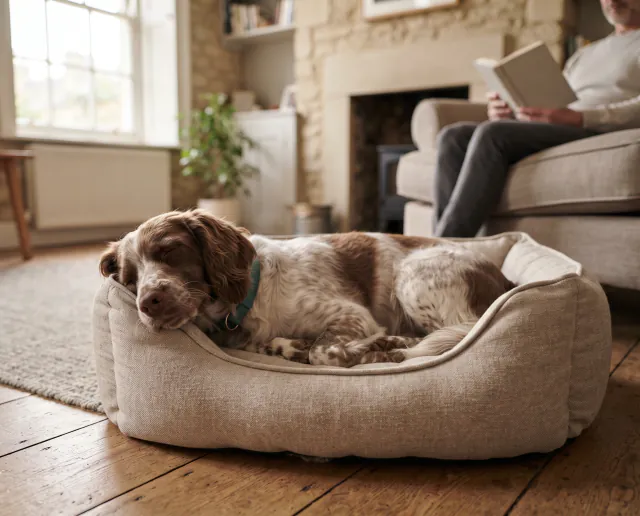
A settle is not a long down stay. A stay is a held position that takes concentration and ends the moment you release it. A settle is a dog lying on their side or hip, with loose muscles, a resting head and a slow breathing rate, who has genuinely disengaged from what you are doing.
You cannot instruct relaxation, you can only make it likely and then reward it when it happens. That difference shapes everything below: you will spend most of your time arranging the conditions and paying calm behaviour, and very little time giving cues.
The realistic target for a fit adult dog is somewhere around half an hour of settling on a mat while you get on with something, plus the ability to settle in a moderately interesting place for the length of a coffee.
Deal with the reasons a dog cannot settle
Work through the obvious causes before training anything. Pain is the first, and a dog who repeatedly gets up, changes position or will not lie on one side should see a vet. Restlessness that appears suddenly in an older or previously settled dog is a veterinary question, not a training one.
Then look at the day. Chronic under-sleeping produces the same wired, jumpy behaviour as over-exercise, and both are common. Most dogs need a large amount of sleep and will not take it in a room with children, a television and people coming and going.
Give the dog outlets that lower arousal rather than raise it. Sniffing on a long line, chewing something appropriate, licking, foraging for scattered food and slow searching games all shift a dog towards calm. Repetitive ball throwing, chase games and high-speed play with other dogs all push the other way, and a dog who has spent an hour chasing a ball often comes home less able to settle, not more.
Build the mat
Use a defined bed or mat that only comes out for this. Put it down, and the moment the dog looks at it, drop a piece of food onto it. Do this repeatedly without saying anything. The dog will start standing on it, then sitting, then lying down.
Feed slowly and low, placing each piece between the dog’s front paws rather than tossing it. Delivery speed sets arousal, so a piece every few seconds, delivered quietly, teaches something very different from rapid excited feeding.
Wait for the dog to shift a hip to one side before you add any duration. That hip roll is the first honest sign of relaxation. Only once they are lying down easily should you add a quiet cue as they do it, such as settle, said once.
Add duration, then activity
Extend the time between food deliveries in an uneven pattern: five seconds, ten, four, fifteen, eight. Predictable increases teach a dog to watch the clock. Give something long-lasting to chew or lick on the mat for part of each session, since both activities settle a dog physiologically.
When the dog holds for a few minutes, start moving. Stand up and sit down. Walk to the kitchen and back. Make a cup of tea, unload the dishwasher, put the television on. Return and pay while the dog is still down rather than calling them to you.
Release deliberately with a word such as off you go, so the dog knows when the session has ended. If the dog gets up early, say nothing, wait, and reward the next time they lie down. Getting up is information that the last step was too big.
Practise in the rooms you actually use, especially wherever you eat and wherever you work. A Border Collie or any other dog bred to stay switched on will usually need more sessions than a naturally low-key dog, and the same is true of adolescents between roughly six and eighteen months.
Take the mat out with you
Once settling works at home in the evening, take the mat somewhere mildly interesting: the car boot with the door open, a bench in a quiet park, a friend’s kitchen. Use the same routine every time, put the mat down, feed a few pieces onto it, then settle in beside it.
Build up to a pub or a cafe at a quiet hour, and bring something to chew. Sit with your back to the room and the dog tucked beside or behind your chair, out of the walkway. Keep the first visit to ten minutes and leave while the dog is still doing well. Vet waiting rooms are worth a practice run for the same reason.
Take the mat to the vet, to the holiday cottage and to anywhere new. A familiar surface in a strange place does a lot of the work for you.
When settling does not come
Some dogs are not restless, they are anxious, and the difference matters. A dog who paces, pants when the house is cool, cannot be in a different room from you, drools, or becomes distressed at the sight of you picking up keys is showing something training a mat will not solve.
Start with a vet appointment to rule out pain, gastrointestinal discomfort and other medical causes, then work with a qualified reward-based trainer or a clinical animal behaviourist. Distress at being alone in particular needs a proper assessment and a graded plan rather than more practice at holding still.
In the meantime, avoid anything punitive. Shouting at a dog for getting up, confining them as a consequence or using startle devices adds fear to a situation that already has too much of it.
For a structured, session-by-session version of this skill with progression criteria, see teaching a puppy to settle on a mat or settle on cue for an older dog new to training.