- Session length
- 5 to 8 minutes, once or twice a day
- Skill
- Recall
- Suits
- Any age
What you need
- A long line of five to ten metres (about sixteen to thirty three feet), fabric or biothane, without a handle loop
- A well-fitted Y-shaped harness, never a collar, for line attachment
- Small soft food rewards the dog will work for, cut to pea size
- A pouch or pocket you can reach without fumbling
- Gloves if you are handling a line in wet weather
A recall is a habit built from hundreds of small repetitions in which coming back paid better than whatever the dog was already doing. A long line makes that possible outdoors without gambling on a dog who is not yet ready to be loose, and it keeps the practice honest, because the dog never gets the chance to rehearse ignoring you.
Purpose
By the end of this lesson the dog should turn and come back on one cue, from about ten metres (thirty three feet), in a familiar quiet space, while attached to a long line. It is not yet an off-lead recall, and treating it as one is the most common way owners lose the behaviour they have just built.
Prerequisites
- The dog eats readily from your hand outside the house.
- You can fit a harness comfortably, with two fingers sliding under every strap.
- Choose a recall word that has not already been used and ignored for months. If the old cue is worn out, pick a fresh word and use only that one.
Equipment
Use a long line of five to ten metres (about sixteen to thirty three feet), clipped to the back or chest ring of a Y-shaped harness. Avoid retractable leads, which keep constant tension and teach a dog to lean forward. Cut food into pea-sized pieces so you can pay several in a row.
Method
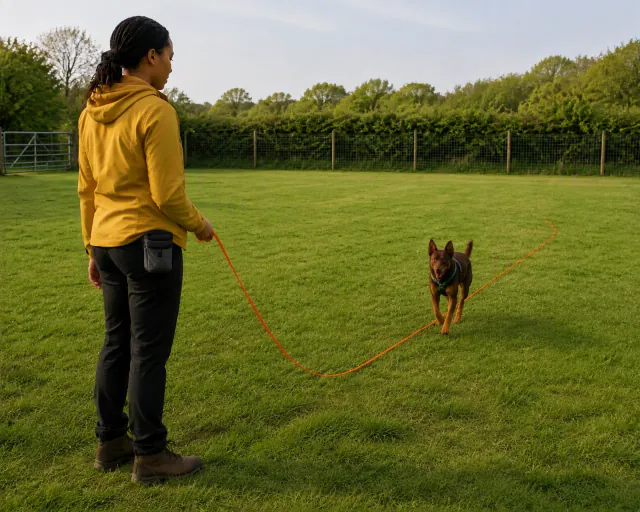
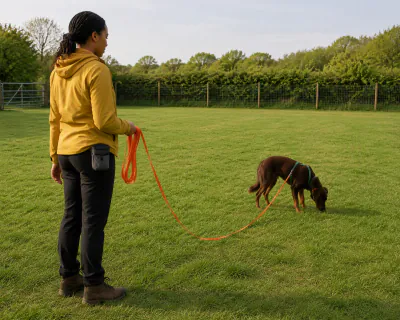
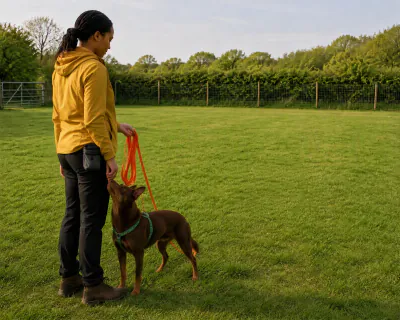
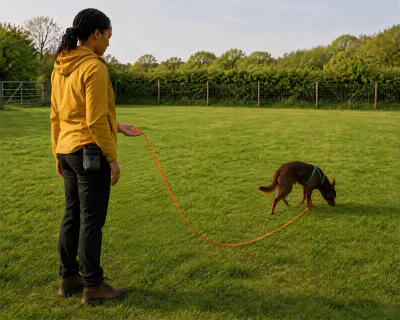
- Stand in a quiet, familiar outdoor space and clip the long line to the harness. Let the dog wander to the end of the line and sniff for a minute so the environment is old news.
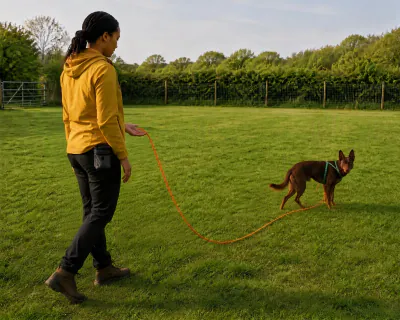
- With the dog about two metres (six feet) away and facing away from you, say the recall cue once, clearly and warmly. Say it once only.
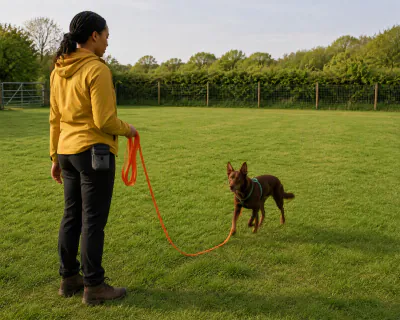
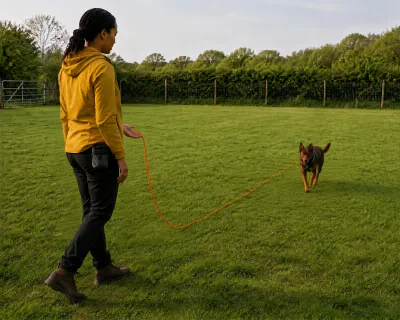
- The instant the dog turns towards you, start feeding the moment they arrive. Deliver three or four pieces one after another, at the seam of your trousers, so the dog is paid at your legs rather than in front of you.
- Release the dog with a word such as off you go, and let them return to sniffing. The freedom to leave again is part of the payment.
- Repeat five to eight times at two metres (six feet) until the dog turns before you have finished saying the word.
- Extend duration first. Wait two or three seconds longer before calling, so the dog is properly engaged elsewhere when you cue. Keep the distance at two metres (six feet).
- Now extend distance, and only distance. Move out to five metres (sixteen feet) and repeat steps two to five. Keep the same quiet place and the same low level of activity around you.
- If the dog does not respond within about three seconds, do not repeat the cue. Take up the slack gently, walk backwards to create movement, and pay the dog on arrival. Make the next repetition easier.
- Extend distance again to ten metres (thirty three feet), keeping duration and distraction as they were.
- Only when ten metres (thirty three feet) is solid, add distraction. Return to two metres (six feet) and practise in a slightly busier corner of the same space, then build the distance back up over several sessions.
- Finish every session while the dog is still keen.
Session length
Five to eight minutes, once or twice a day, is enough. Eight to twelve repetitions in a session beats forty.
Progression criteria
Move on when you get nine out of ten returns on a single cue, from ten metres (thirty three feet), across three separate sessions in two different places. Count them honestly: a repetition where you called twice, or reeled the dog in, does not count as a return. If you cannot reach nine out of ten, drop back to the last distance where you could and rebuild from there.
Common mistakes
Calling more than once teaches the dog that the first cue is optional. Calling only when the walk is ending teaches the dog that the word predicts the end of the fun, so call several times per outing and release the dog again most times. Paying one small piece of food makes coming back a poor deal against a hedge full of scent. Reaching for the harness as the dog arrives makes many dogs stop just out of range, so feed first and take hold second.
Troubleshooting
If the dog comes most of the way then veers off, you are probably reaching forward. Stand up, keep your hands low and feed at your legs. If the dog ignores you in one particular field, the distraction is too high for the current stage, so go back to a quieter place. Some dogs bred for independent hunting, including many terriers and scent hounds, take longer to build reliable distance work, though that is a tendency rather than a rule.
Safety and when to stop
Stop if the dog is limping, panting heavily, reluctant to move, or turning away when they were engaged five minutes earlier. A sudden change in willingness to move or respond can have a physical cause, and that belongs with your vet rather than a training plan. If the dog shows real fear of the environment, freezes, or reacts to people or dogs in a way that worries you, stop and speak to a qualified behaviourist working alongside your vet. Never use a check chain, prong collar or any tool that works by startle or discomfort to enforce a recall.
Next lesson
Continue with loose lead walking, which gives the dog a clear picture of where to be when the line is short.
Useful tool
The dog exercise planner helps you work out how much free running and sniffing time your dog needs each week, which matters here because a dog who rarely gets to explore will find recall practice far harder to win.