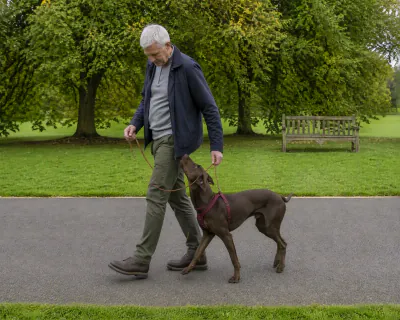
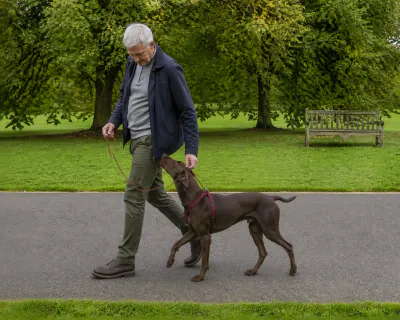
- Session length
- 3 to 5 minutes, two or three times a day
- Skill
- Loose-lead walking
- Suits
- Any age
What you need
- A well-fitted harness and the fixed lead already used for loose-lead walking
- Small soft food rewards, or a favourite toy for dogs who work better for play
- A quiet street or path with room to turn around comfortably
Loose lead walking gives a dog a clear picture of where to be. The U-turn cue gives the handler a clear way to change that picture before something ahead becomes a problem, turning both of you around and moving off in a new direction while the dog is still comfortable enough to be rewarded for it. It is one of the most useful skills in this pathway precisely because it is used early, calmly and often, long before anything difficult is actually happening.
Purpose
By the end of this lesson the dog should turn with you and take several steps in a new direction within a second or two of hearing the cue, on a loose lead, in a quiet setting. The value of this skill is entirely in its timing. Used the moment you notice something ahead, before the dog has fixated on it, a U-turn moves you both away smoothly and keeps the walk pleasant. Used after the dog is already barking or straining at the end of the lead, it is too late to teach anything, and that is a different problem needing different help.
Prerequisites
- Loose-lead walking already holds for a short stretch on a quiet street, from the previous lesson.
- A cue word or short phrase that the dog has not heard used for anything else, so it carries no old associations.
- Basic comfort turning on lead, which most dogs already have from ordinary walking.
Equipment
Use the same harness and fixed lead already fitted and practised in the loose-lead walking lesson. Carry the food or toy the dog currently finds most rewarding on a walk, since the first few steps in the new direction need to be worth the dog’s while. Choose a street or path wide enough to turn around in without stepping into traffic or into another pedestrian’s path.
Method
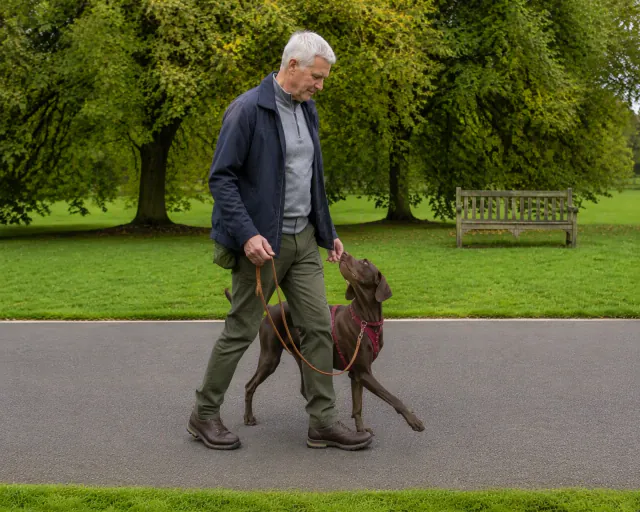
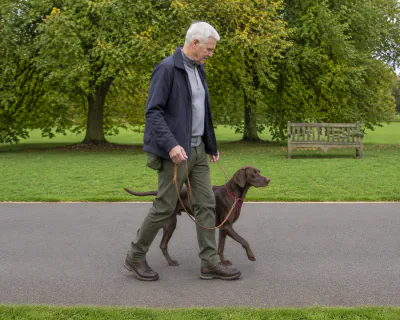
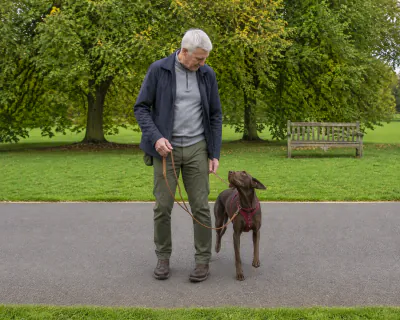
- Start in a quiet, familiar place with the dog walking beside you on a loose lead, well away from anything genuinely distracting.
- Say your chosen cue once, in an upbeat, ordinary tone, as though you were simply announcing a change of plan rather than reacting to anything.
- Turn your own body first, rotating away from the direction you were walking. Your body turning is the clearest signal you can give, clearer than the lead or your voice alone.
- Pat your leg or make a light kissy noise as you turn, to draw the dog’s attention and movement with you rather than relying on the lead to physically redirect them.
- Take three or four steps in the new direction and reward heavily as soon as the dog is moving with you, feeding at your leg the same way you did when first teaching a loose lead.
- Repeat this six to eight times per session in different quiet spots, always somewhere genuinely boring, so the dog learns the pattern without having anything difficult to turn away from.
- Once the dog turns and moves with you promptly on the first cue, extend duration first: keep walking in the new direction for eight or ten steps before rewarding, rather than stopping after three or four.
- Then extend distance by practising the cue further from home, in a slightly less familiar quiet street, keeping the number of steps you ask for the same as before.
- Only once the cue is fast and reliable in several boring places should you begin practising near very mild distractions, such as a parked car with someone loading shopping, always at a distance where the dog can still respond easily and still be rewarded.
- Continue practising the cue in easy situations indefinitely, even once it works well. A cue used only in hard moments becomes associated with hard moments, and using it regularly in ordinary walks keeps it a light, upbeat signal rather than a warning.
Session length
Three to five minutes, two or three times a day, fits easily into normal walks once the dog is used to the pattern. There is no need for a dedicated training walk once the cue is established, since a few U-turns folded into an ordinary route keep it fresh.
Progression criteria
Move on when the dog turns and walks with you for at least eight consecutive steps on the first cue, on a loose lead, in four out of five attempts, across three sessions in two different quiet locations. If the dog hesitates, needs the cue repeated, or the lead goes tight during the turn, count that repetition as a fail and go back to shorter distances and quieter surroundings before trying again. Once that standard is met in easy settings, raise difficulty in this order: duration of the walk in the new direction, then distance from home or from anything mildly interesting, then distraction, always changing one of these at a time.
Common mistakes
Saving the cue for moments when a distraction has already caught the dog’s attention teaches the dog that the word predicts a struggle, which makes it less effective, not more. Turning slowly or half-heartedly gives the dog time to plant their feet and lean the other way, so commit to the turn with your whole body. Forgetting to reward the first few steps in the new direction removes the main reason the dog has to keep choosing to come with you rather than pull back towards whatever caught their eye.
Troubleshooting
If the dog does not turn with you at all, the cue may not yet be well practised enough in easy settings, so return to very short, well-rewarded repetitions in a boring space before trying it anywhere more demanding. If the dog turns but then strains to look back over their shoulder, keep walking briskly in the new direction and reward attention forward rather than stopping to let them stare. If a real distraction appears before you have had a chance to use the cue calmly, it is better to simply increase distance on the spot, using extra space and food, than to force a cue the dog is not yet ready for.
Safety and when to stop
Stop and reassess if turning away consistently fails to reduce the dog’s arousal, or if the dog barks, lunges or freezes regardless of distance. That pattern points to a reactivity issue rather than a simple attention gap, and a qualified behaviourist working alongside your vet can help build a proper plan around it. Keep an eye on your footing and your surroundings every time you turn, since a sudden change of direction on a lead can catch out an unaware passer-by or vehicle if you are not paying attention to the wider scene as well as the dog.
Next lesson
Move on to emergency stop foundations, which builds a related but separate skill: stopping the dog in place rather than redirecting them.
Related reading
For more detail on why dogs pull and how the underlying habit forms, see how to stop a dog pulling on the lead, which covers the wider picture this cue fits into.