
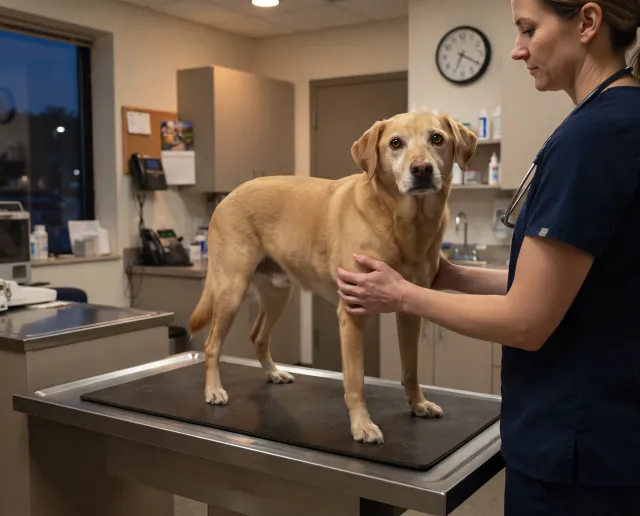
When a dog suddenly seems unwell, the most useful question an owner can ask themselves is not “what is wrong with my dog”, but “how quickly does my dog need to be seen.” Working that out does not require diagnosing anything. It requires recognising a pattern of signs and knowing what level of urgency it typically calls for, then letting a vet do the actual diagnosis.
This guide is organised as a reference list rather than an article to read start to finish. It separates signs that mean immediate emergency care, right now, from signs that are genuinely concerning and warrant a same-day or next-available call but are less immediately life-threatening. Nothing here is a diagnosis or a treatment plan. If in doubt about which category something falls into, treat it as the more urgent one and call your vet or emergency service to talk it through.
Emergency: seek immediate veterinary care
These signs need immediate attention, meaning a call to an emergency or out-of-hours veterinary service straight away, not a wait to see if things improve.
- Collapse or inability to stand. A dog that suddenly cannot get up, or drops to the ground, may be experiencing a serious cardiovascular, neurological or internal problem. This is always urgent regardless of how quickly the dog seems to recover.
- Seizure. A seizure, whether it is the dog’s first or one of several, needs prompt veterinary contact, particularly if it lasts more than a couple of minutes, if there are repeated seizures close together, or if the dog does not seem to fully recover afterwards.
- Difficulty breathing. Laboured, noisy, rapid or open-mouthed breathing that is not explained by heat, exercise or excitement is a genuine emergency, since a dog struggling to breathe can deteriorate very quickly.
- A swollen, distended or tight abdomen with unproductive retching. A dog trying repeatedly to vomit with little or nothing coming up, especially alongside restlessness, pacing and a visibly swollen belly, needs emergency assessment immediately. This pattern can indicate a rapidly life-threatening condition and time matters enormously.
- Severe or prolonged bleeding. Bleeding that does not stop with firm direct pressure within several minutes, or bleeding from a significant wound, needs emergency care.
- Suspected poisoning or ingestion of something toxic. If you know or strongly suspect the dog has eaten something toxic, including certain foods, plants, chemicals or medications, contact a vet or a poisons information service immediately, even if the dog currently seems fine, since some toxic effects are delayed.
- Straining to urinate with little or no urine produced. A dog repeatedly attempting to urinate and producing little or nothing, particularly a male dog, can indicate a blockage, which is a genuine emergency that can become life-threatening within a short time.
- Extreme pain. Signs such as constant crying, an unwillingness to be touched, a hunched posture that does not resolve, or a dog that will not settle in any position, warrant urgent assessment.
- Eye injury or sudden severe eye pain. A visibly injured, protruding, or suddenly very painful and swollen eye needs prompt attention, since delays can affect the outcome for the eye itself.
- Signs of heatstroke. Heavy panting that does not settle, collapse, vomiting, disorientation or very red gums after heat exposure or exertion, particularly in hot weather, need emergency cooling and veterinary attention together, not one without the other.
- Suspected broken bone or inability to bear weight after trauma, such as being hit by a vehicle or falling from height, even if the dog is otherwise moving around.
- Ongoing choking, or something visibly stuck in the throat.
If any of these apply, do not wait for a routine appointment. Call your emergency veterinary provider immediately and follow their instructions on whether to bring the dog straight in.
Concerning: seek same-day or next-available veterinary advice
These signs are genuinely worth acting on promptly, but they do not usually require an emergency call in the middle of the night unless they are severe, prolonged or combined with other signs from the emergency list above. Call your vet the same day, or as soon as the practice opens, to describe what you are seeing and get guidance on timing.
- Persistent vomiting or diarrhoea. An isolated, mild episode is common and often resolves on its own, but repeated vomiting, diarrhoea lasting more than a day, or either alongside blood, lethargy or loss of appetite, needs a same-day call.
- Sudden lameness. A dog suddenly not putting weight on a leg, without an obvious minor cause such as a small cut you have already checked, is worth having assessed promptly, sooner if the dog seems distressed by it.
- Lethargy. A dog that is noticeably quieter, less interested in normal activities, or reluctant to move for more than a short period is worth a call, especially if it is a sudden change rather than a gradual one.
- Appetite loss. Skipping a single meal is common and often not significant, but a dog refusing food for more than a day, or showing a marked and sudden drop in appetite, warrants veterinary advice.
- Mild but persistent coughing, particularly if it is new, worsening, or happening after exercise or excitement.
- Increased thirst or urination that has developed and persisted over days, without an obvious explanation such as hot weather or increased exercise.
- A wound that is not bleeding heavily but looks infected, such as swelling, discharge or a bad smell developing over a day or two.
None of these should be ignored on the assumption they will pass, particularly in puppies, senior dogs, or dogs with existing health conditions, where the same sign can escalate faster than in an otherwise healthy adult dog. When in doubt, a phone call to the practice costs nothing and a vet or veterinary nurse can help judge urgency over the phone far better than guesswork at home.
What this list is not
This is a triage aid, not a diagnostic tool. It exists to help decide how quickly to seek veterinary care, not what is causing a sign, what treatment is needed, or how serious the underlying cause will turn out to be. The same sign can have causes ranging from trivial to serious, and only a vet examining the dog, and where needed running tests, can tell the difference. Do not use this list, or any list like it, to rule a serious cause in or out yourself, and do not delay a call while trying to work out a cause on your own.
It is also not exhaustive. Trust your own judgement about your own dog. An owner who knows their dog well often notices that something is simply not right before it fits neatly into any list, and that instinct is a legitimate reason to call a vet.
Know your emergency arrangements before you need them
Out-of-hours and emergency veterinary arrangements vary enormously, not just between countries but between individual practices within the same area. Some practices run their own out-of-hours service, some use a shared regional emergency service, and some direct all after-hours calls to a separate emergency-only clinic that may be some distance away.
Find out now, before an emergency happens, what your practice’s arrangements are: the number to call outside normal hours, whether that connects you to your usual vet or a different emergency provider, and where you would need to travel to if your dog needed to be seen immediately overnight or at a weekend. Save this information somewhere you can find it quickly, such as in your phone, and check it again if you move house, change practice, or your practice changes its arrangements. In a genuine emergency, knowing where to go without having to search for it can matter as much as recognising that the situation is urgent in the first place.