Two everyday risks account for a large share of urgent calls to vets and poison-control services: an owner giving a dog something from the human medicine cabinet in good faith, and a dog finding and eating something it should not have while nobody was watching. Both are largely preventable, and both are worth taking seriously precisely because the early signs can look mild while real harm is developing internally.
This guide covers why human medication should never be given to a dog without explicit veterinary instruction, the categories of food, plant and household substance that commonly cause problems, what to do in the first few minutes if you suspect ingestion, and the storage habits that stop most of these situations happening in the first place. It does not list specific toxic doses or thresholds, because that kind of precision depends on the individual dog, the exact substance and the amount involved, and is a judgement for a vet or poison-control service to make, not something to estimate at home.
Human medication is never a safe substitute
Do not give a dog any human medication, including something as ordinary as a painkiller from the bathroom cabinet, unless a vet has specifically instructed you to and told you the exact product, amount and timing for your dog. Ibuprofen and similar anti-inflammatory painkillers made for people are dangerous to dogs, and paracetamol, which a vet sometimes prescribes in a specific form and amount for a specific dog, can cause serious harm when given without that instruction. Problems often start because an owner assumed that a medicine safe for humans in small amounts must be safe for a dog in an even smaller amount. That assumption is wrong, and it applies to many other over-the-counter and prescription human medications as well, not only painkillers. If your dog is in pain or unwell, the safe path is always a call to your vet rather than reaching for what is in your own cabinet.
Common toxic foods worth knowing about
Several everyday foods are dangerous to dogs even in amounts that look small to a person. Chocolate, particularly dark and cooking chocolate, contains compounds dogs process far less efficiently than humans do. Grapes and raisins, including in foods like fruit cake and some breakfast cereals, have caused serious problems in some dogs even in modest quantities, and there is no reliably safe amount established. Xylitol, an artificial sweetener increasingly found in sugar-free gum, some peanut butters, baked goods and toothpaste, is highly dangerous to dogs and worth checking for on ingredient labels. Onions, garlic and other alliums, whether raw, cooked or in powdered form within a stock cube or sauce, are also toxic to dogs in sufficient quantity. Keep all of these, and dishes containing them, well out of reach rather than assuming a dog will not bother.
Plants and household chemicals
A number of common houseplants and garden plants are toxic to dogs if chewed or eaten, and toxicity varies considerably between species and between the specific part of the plant involved, so it is worth checking any plant you bring into a home with a dog against a reliable source before assuming it is safe. Household chemicals, including cleaning products, antifreeze, rodent bait and garden chemicals such as slug pellets, are another significant category of risk and should be stored exactly as their own packaging instructs, sealed and out of reach, with particular care around antifreeze, which some dogs find palatable and which is dangerous in small amounts.
If you suspect your dog has eaten something dangerous
Contact your vet or a poison-control service immediately if you know or suspect your dog has eaten something dangerous, even if your dog seems fine at that moment, since some substances take hours to produce visible signs. Have the packaging, the plant, or a sample of what was eaten to hand if you can safely gather it, along with an estimate of how much and when, since this information genuinely changes what the vet or poison-control service recommends. The guide on what to record before calling your vet covers how to note down a developing situation clearly and quickly under pressure, which is exactly the skill needed here. If your dog collapses, has a fit or is struggling to breathe, go straight to your vet or the nearest out-of-hours veterinary service.
Why inducing vomiting yourself can make things worse
Do not try to make your dog vomit unless a vet or poison-control service has specifically told you to and explained how, because some substances cause more harm coming back up than staying down, particularly anything corrosive, sharp, or petroleum-based, and the right response genuinely depends on what was eaten. Acting on your own guess here can turn a manageable situation into a more serious one. The professional you call will tell you whether vomiting should be induced, whether you need to bring your dog in immediately, or whether monitoring at home is appropriate for that specific substance and amount.
Safe storage habits that prevent the problem
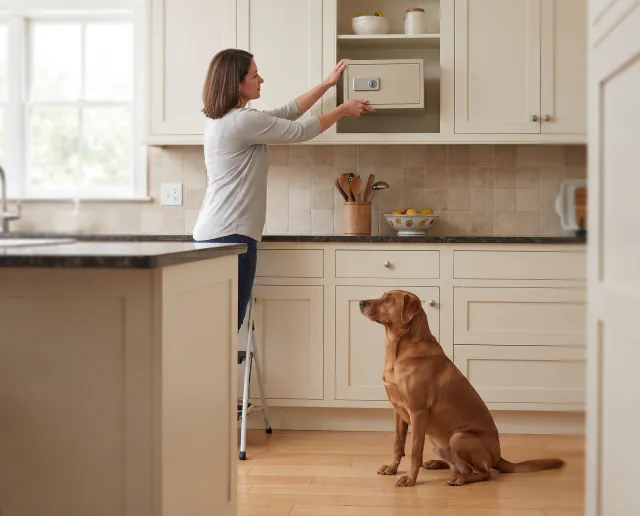
Store all medication, human and canine, in a closed cupboard or container a dog cannot reach or chew into, and keep your dog’s own medication clearly separate and labelled from anyone else’s in the household to avoid mix-ups, particularly in households with several pets on different treatments. Keep bags, coat pockets and bedside tables in mind, since many accidental ingestions involve medication carried by a visitor rather than anything kept in the house normally; a simple habit of asking guests to keep bags off the floor or out of reach closes a surprisingly common gap. Store household chemicals and garden products on a high shelf or in a locked cabinet rather than under a sink a determined dog can access, and dispose of unused or expired medication properly rather than leaving it in a bin a dog can get into.