- Session length
- 5 minutes, once or twice a day
- Skill
- Settle and calmness
- Suits
- Any age
What you need
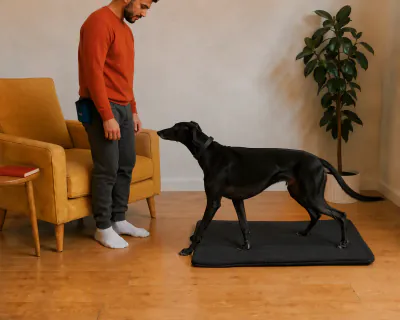
- A non-slip mat, folded blanket or flat bed used only for this
- Soft food rewards that can be dropped without bouncing away
- A long-lasting chew or a stuffed food toy for the longer stages
- A house line or lead if you need to stop the dog wandering off in a new place
Most dogs are never taught to do nothing. They learn to sit, to wait and to come, then they are expected to switch off in a cafe or under a table with no idea how. A settle is that missing skill, and it is easier to build than it looks: the training attaches a place, a cue and a payment to something dogs already do every day.
Purpose
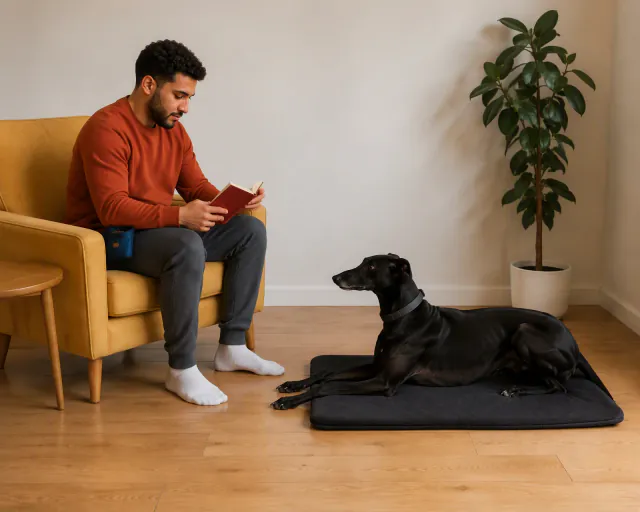
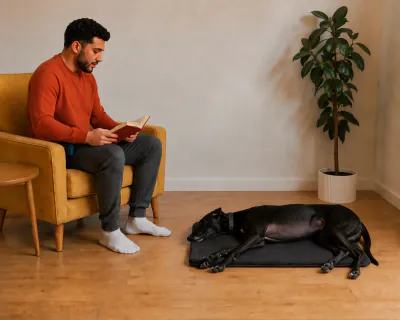
By the end of this lesson the dog should go to a mat on one cue and stay lying there, relaxed rather than poised, for five minutes while you sit nearby in a quiet room. Relaxed matters more than position. A dog holding a rigid sphinx pose and watching your hands is waiting, not settling, and that state does not last.
Prerequisites
- The dog takes food gently from your hand.
- The dog lies down of their own accord somewhere in the house each day.
- You have five minutes when nobody is coming through the room.
Equipment
Use one mat and keep it for this purpose so it comes to mean something. A folded blanket is fine if it is flat, non-slip and big enough for the dog to stretch out on. Keep the food soft and low value, because exciting rewards raise arousal, which is the opposite of the point. A long-lasting chew is useful once you are extending duration.
Method
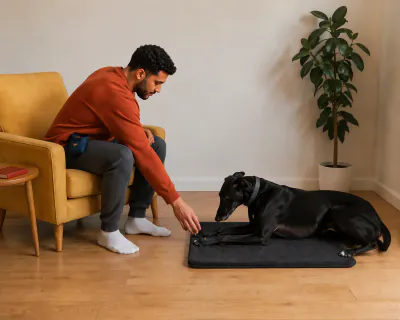
- Put the mat in a quiet corner, out of any walkway, and sit nearby with a handful of food. Say nothing.
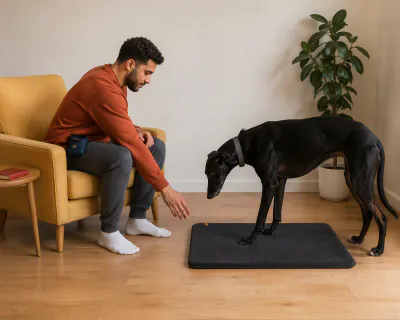
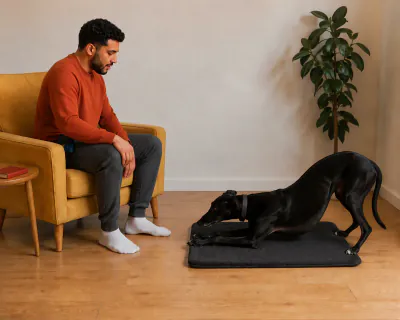
- Every time the dog moves towards the mat or steps on it, drop one piece of food onto the mat. Do not lure or point.
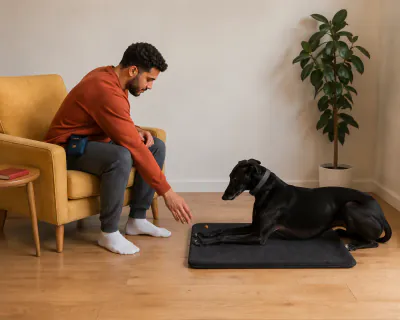
- When the dog lies down, drop three or four pieces one at a time between their front paws, several seconds apart. Feeding on the mat is what keeps them there.
- Watch for the dog rolling onto one hip or lowering their chin, and reward those moments specifically. You are paying relaxation, not position.
- Once the dog offers a down on the mat within a few seconds of it appearing, add your cue. Say settle quietly just as they begin to lie down, then feed.
- Extend duration first, and only duration. Increase the gap between food from five seconds to ten, then twenty, then thirty. Stay in the same chair and the same room while you do it.
- Build to five minutes of quiet lying with occasional food. Give a chew or stuffed toy in some sessions so the dog has something to do as duration grows.
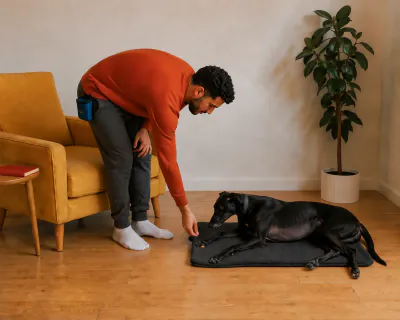
- Now add distance, keeping duration modest. Stand up, step away, return and feed on the mat. Then two steps, then across the room. Always return to the dog rather than calling them off the mat.
- Add a release word such as all done before the dog gets up. The settle ends when you say so, not when the dog decides.
- Only when duration and distance are both comfortable, add distraction. Repeat step three onwards in a different room, then with the television on, then with a family member walking through. Shorten the duration each time the environment changes.
- Move the mat to new places gradually: a friend’s house, a quiet cafe garden, the boot of the car. The picture stays familiar because the mat travels.
Session length
Five minutes, once or twice a day, is enough at first. Later sessions can be longer because the dog is resting rather than working. Practise when the dog is naturally winding down, such as after a walk, rather than when they have just woken up.
Progression criteria
Move on when the dog goes to the mat on one cue and stays lying down for five minutes, with no more than two pieces of food, in three sessions across two different rooms. The dog should be rolled onto a hip or flat for most of that period. If they get up more than once, drop back to three minutes and rebuild.
Common mistakes
Rewarding an alert, upright down builds a dog who waits rather than rests, so hold out for the hip roll and the lowered head. An excited tone of voice or fast hand movements pulls the dog straight out of the state you want. Asking for a settle in a busy kitchen on day one is too much distraction too soon.
Troubleshooting
If the dog will not lie down at all, they are probably too active, so try again after exercise. If the dog springs up when you reach for food, slow your hand down and drop the food rather than presenting it. If the dog settles at home but not in public, the environment has jumped several steps at once, so go back to a quiet outdoor spot with no passing traffic. Dogs bred for constant working alertness, including many collies, often need more early repetitions, though this varies more between individuals than between breeds.
Safety and when to stop
Stop if the dog seems uncomfortable lying down, shifts constantly, or is reluctant to lower themselves onto the mat. Difficulty settling can have a physical cause, and that is a question for your vet rather than something to solve with more repetitions. If the dog pants, paces, whines or becomes distressed when you leave the room, that is not a settle problem and should not be trained through: speak to a qualified behaviourist working alongside your vet. Never restrain a dog to force stillness, and never use a spray, shock or noise device.
Next lesson
Continue with building duration, distance and distraction, which sets out how to raise the difficulty of this settle, and of every other beginner skill, one variable at a time.
Useful tool
The dog exercise planner is useful here because a dog who is under-exercised or over-aroused will find settling almost impossible, and it helps you see whether the day’s activity is set up for a calm evening.