British summers are unpredictable enough that hot weather often arrives before anyone has adjusted their routine. The walk that suits a mild spring morning can be unsuitable by mid morning in a heatwave, and dogs do not regulate their body temperature the way people do. Heat-related illness in dogs is a serious emergency, and the sensible approach is to avoid the situations that cause it rather than to judge how a dog is coping while out on a walk.
This guide covers how to plan around the weather, how to check the ground, which dogs need the most caution, and the point at which you stop managing the situation yourself and ring the vet.
Plan the walk around the day
Move walks to the early morning and the late evening during warm spells, and treat the middle of the day as time for rest indoors. Early morning is usually the better of the two, because pavements, sand and tarmac hold heat well into the evening after a hot afternoon.
Check the forecast the night before rather than looking out of the window. Humidity matters as much as air temperature, since a humid, still day makes panting less effective, and a cloudy muggy morning can be harder work for a dog than a bright breezy one. Wind, shade and the surface underfoot all change how a route feels.
Shorten the walk, choose a shaded woodland or riverside route over open fields and pavements, and accept that on some days the right decision is no walk at all. A day of sniffing games, chews and training indoors is not a failure. A dog that misses one walk is fine.
Check the ground before you set off
Pavements, roads, artificial grass, sand, decking and metal drain covers can become far hotter than the air. Paw pads burn, and the damage is often not obvious until hours later.
Place the back of your hand flat on the surface and hold it there for a few seconds. If it is uncomfortable for your hand, it is too hot for the dog’s feet, and no amount of walking briskly makes it acceptable. Check again on the way home, since a route that was fine at eight in the morning may not be at ten.
Where you cannot avoid a hot surface, walk on grass, keep to the shaded side of the street and cross earlier than you normally would. If the dog starts lifting feet, stopping, limping or trying to sit down, get them off the surface and onto grass or into shade straight away, and contact your vet if the pads look red, pale, blistered or peeling.
Know which dogs need more caution
Some dogs cope far less well with heat than others. Flat-faced breeds such as the French Bulldog, pugs and bulldogs have restricted airways and lose heat inefficiently. Thick-coated and double-coated dogs, large and heavy dogs, very young and elderly dogs, and dogs carrying extra weight all struggle sooner.
Dogs with heart or airway conditions, dogs recovering from illness and dogs on certain medications may also be more affected, and any dog who has previously had a heat-related episode is at greater risk again. Ask your vet what precautions suit your individual dog, particularly if any of these apply.
Exercise itself generates a great deal of heat. Most cases of heat-related illness in dogs in this country follow activity rather than being left somewhere hot, so it is the running, the ball throwing and the long walk that need cutting, not just the sunbathing.
Adjust the walk itself
Swap distance and pace for sniffing and slow exploration. Skip ball launchers, repetitive fetch and games that keep a dog running flat out, since many dogs will keep going well past the point where they should stop. Dogs with a strong drive to chase or retrieve rarely self-regulate.
Take frequent breaks in shade. Watch for the dog slowing down, lagging behind, seeking shade, lying down or panting harder than the effort warrants, and treat any of these as a reason to end the walk calmly and head home by the shortest shaded route.
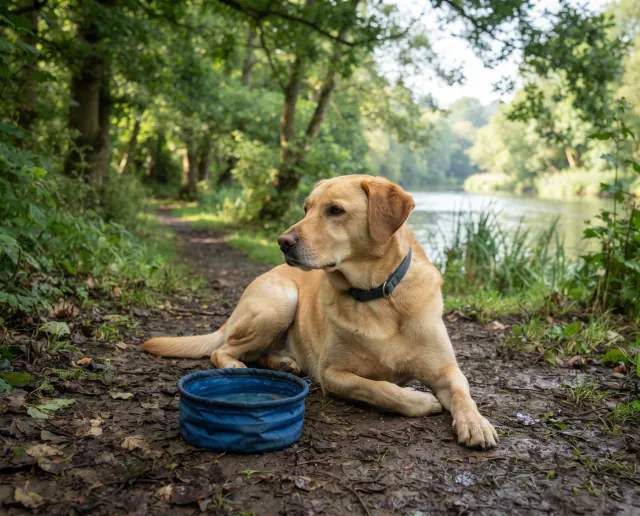
Carry water on every warm-weather walk and offer it regularly rather than waiting for signs of thirst. Standing water, ponds and slow-moving water can carry blue-green algae in warm conditions, so let dogs drink and swim only where the water is clean, moving and free of warning signs.
Manage the rest of the day
Never leave a dog in a parked car, even briefly, with windows open or in shade. The same applies to conservatories, caravans, greenhouses and vans. Cars heat up quickly on days that do not feel especially hot.
At home, give the dog a cool, shaded, well ventilated place to rest with water always available, and let them choose it. Hard floors, a damp towel to lie on if they want it and a fan for air movement all help. Keep grooming up to date, since a matted coat traps heat, and ask a groomer or your vet before clipping a double-coated breed such as a German Shepherd, because the coat has a role in insulation.
Travel needs the same planning as walks. Move journeys to cooler parts of the day, use sun shades, keep air moving through the vehicle and build in stops.
When to ring the vet
Heat-related illness can progress quickly and can be fatal, so it is treated as an emergency rather than something to watch and see. Contact your vet or the out of hours service immediately if a dog becomes distressed by heat, is panting heavily and does not settle when rested in the shade, seems wobbly, disorientated, unusually quiet or unresponsive, collapses, vomits, has diarrhoea, or if you are simply worried about how they are coping.
Ring while you are moving the dog somewhere cooler and let the practice tell you what to do next. Veterinary teams would far rather take a call that turns out to be nothing than see a dog that was brought in an hour later than it should have been. Do not wait to see whether the dog improves on its own, and do not attempt home treatment based on advice found online.
For more on which dogs run the highest heat risk and how the body struggles to cool itself, see temperature and heat-risk awareness.