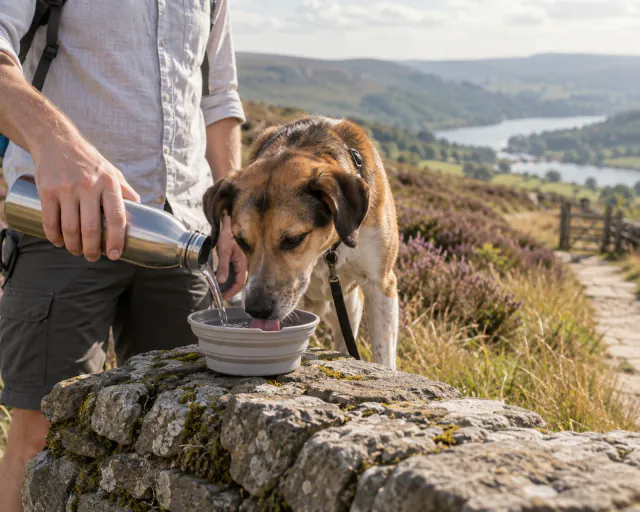
Carrying water is one of those things that seems optional until the day it is not: a longer walk than planned, a hot car park, a stretch of coast path with nothing but salt water. The PDSA puts the case bluntly in its guidance on blue-green algae, advising owners to carry water for the dog to drink instead of letting it drink from open water. That single sentence is the strongest reason to own something on this page, and it applies in autumn as much as in July.
How products are chosen
Canine Origin has not tested these bottles and bowls hands-on. Each one was chosen from the maker’s published details and a UK listing, checked against the criteria below, and every specification on the product cards names the page it came from and the date it was read. The criteria are published capacity in millilitres, published dimensions and weight where the maker gives them, the material, whether the maker states the item is free of BPA and PVC, whether it can go in a dishwasher or has to be washed by hand, and how the drinking part actually works. How a seal behaves after a year in a rucksack, and whether a silicone bowl holds its shape once a dog has stood in it, are questions only long use answers, so no claim is made about them.
How to choose
Work backwards from the walk. For an hour on local paths with a dog that drinks at home before and after, a collapsible bowl and a bottle from your own bag is the lightest and cheapest answer. For a long day out, a summer walk, or a car journey where you want water in the boot without a spill, a dedicated bottle with a built-in drinking surface is worth the bulk because it is one item to remember rather than two.
Then size it to the dog. Capacity on this page runs from around 300 ml, which is a top-up for a small dog, to 750 ml, which is a genuine drink for a larger one plus something in reserve. Bigger is not automatically better: a full 750 ml steel bottle is a noticeable weight on a belt clip, and water you carry and pour away is water you carried for nothing. Our guide to hydration and water intake covers how much a dog actually needs across a day, which is the useful figure to size against.
Bottles, bottle-and-bowl designs and collapsible bowls
There are three designs here and they suit different people.
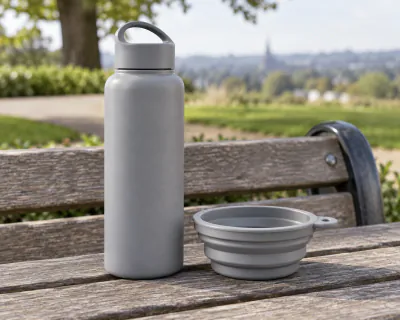
A bottle with an attached cup is the most self-contained. The Kurgo Gourd is the clearest example: the bowl is a plastic cup that snaps onto the bottom of the bottle, so there is nothing separate to lose, and you pour from the bottle into the cup. It is bulky in a pocket and better suited to a rucksack side pocket or a car door bin.
A bottle with a lid or flap that becomes the bowl is the compact version of the same idea. The Trixie steel bottle uses the shape of its screw lid as the drinking bowl, and the Henry Wag bottle flips a flexible silicone leaf out from the side of the bottle so water can be squeezed into it. Both take up less room than a bottle plus a cup, and both mean the part the dog drinks from is also the part that seals the bottle, so it needs washing properly rather than a rinse.
A collapsible bowl carries no water at all. It packs flat, clips to a lead or a bag, and is filled from whatever bottle you were already carrying. It is the lightest option by a wide margin and the one most likely to actually be with you, which counts for more than any specification. It is also the only design that works when the water source is a tap at a campsite or a cafe rather than something you brought.
Capacity, weight and how you carry it
Weight is published inconsistently across this category, which makes comparison harder than it should be. Where a maker does give it, use it: a steel 750 ml bottle weighs more than twice its 300 ml sibling before any water goes in. Steel keeps water cooler for longer and survives being dropped on a car park; plastic and silicone are lighter and cheaper. Silicone bowls collapse to a couple of centimetres and can live permanently in a coat pocket.
Look at how the thing attaches. A metal snap hook or a lanyard is the difference between a bottle that comes on every walk and one that stays in a drawer. If you are carrying it in the car rather than on your person, decide where it will sit when the car is moving, because a loose bottle in a footwell is one more thing rolling around; our guide to travel restraint principles covers the wider point about loose objects in a car with a dog in it.
Cleaning and materials
This is where the designs separate. Both Kurgo items are described by their maker as dishwasher safe on the top rack and free of PVC and BPA. The Henry Wag bottle’s own instructions are to rinse the bottle and wash the flexible leaf bowl by hand, then air dry. The Trixie bottle is stainless steel with a plastic lid and its maker publishes no dishwasher guidance, so hand washing is the safe default.
Whatever you buy, wash it properly and often. A bottle that lives in a warm car and gets a rinse under a tap once a fortnight is a container of stagnant water, which rather defeats the point of not letting the dog drink from a pond. Empty it after each outing rather than topping it up, and let it dry with the lid off.
Safety: open water, heat and the cold water myth
The reason to carry your own water is mostly about what the dog would drink otherwise. The PDSA describes blue-green algae as growing in stagnant or slow flowing water such as ponds, lakes, streams and flooded areas, advises checking water before letting a dog swim in it even somewhere familiar, and says never to let a dog drink from or swim in water with dead fish in it. Salt water is its own problem on coastal walks. Carrying a litre of tap water removes the argument entirely.
In hot weather, water in a bowl is not a substitute for shade and sensible timing. Dogs Trust advises making sure a dog has access to shade and plenty of fresh water throughout the day, and treats an overheating dog as an emergency: cool first, transport second, and ring the vet urgently. Our guides to temperature and heat risk and walking a dog safely in hot weather set out when the walk should not happen at all.
One myth is worth retiring while you are here. The RSPCA lists the idea that cold water causes shock in an overheated dog as false, and says that dousing or immersing an overheated dog in cold water is vital to its recovery, and that any water cooler than the dog’s body temperature helps. It also says offering ice cubes or frozen treats can be done safely when supervised, because of the choking risk rather than any cooling danger. So chilled water from a steel bottle is not a hazard, and there is no reason to carry lukewarm water on principle.
When to replace one, and questions to ask
Replace a bottle once the seal no longer holds when it is inverted, once a silicone bowl or leaf splits or holds a smell that washing does not shift, or once a plastic cup is cracked, because a crack is where bacteria sit and a split silicone rim will not hold water when it matters. Steel bottles usually outlast their lids, and a lid that doubles as a bowl takes the most wear.
Before buying, ask: how far do I actually walk before the dog wants a drink, will I carry a second item or does it need to be one, can this go in the dishwasher or am I realistically going to hand wash it, and where will it clip. Our guide to what to carry on a dog walk puts it alongside everything else that has to fit in the same pocket, and for water at home rather than on the move the dog bowls guide is the better starting point.