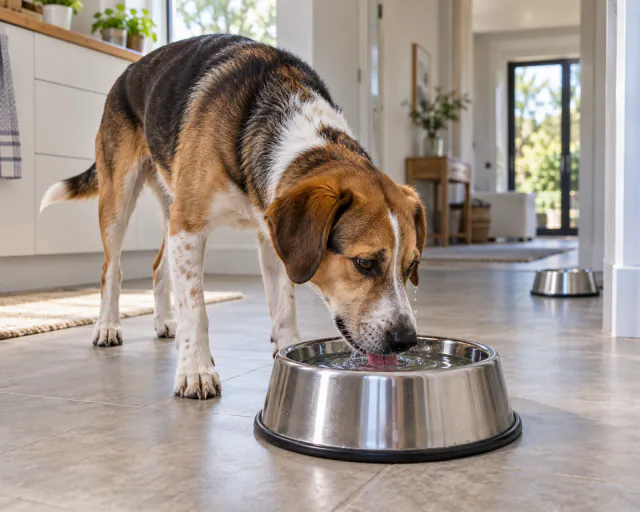
Water gets far less attention than food in most conversations about feeding a dog, yet it is the one nutrient a dog needs constantly and cannot store up in advance. A dog can survive a missed meal without much consequence, but going without water for even a day or two, particularly in heat or after exercise, causes real harm. Fresh, clean water available at all times is one of the simplest welfare basics, and it is easy to assume it is being met when a bowl is technically present but rarely checked.
This guide covers roughly how much dogs typically drink and why that figure moves around so much, situations that genuinely increase water needs, why changes in drinking habits deserve attention rather than assumption, and some practical habits that make good hydration easier to maintain day to day.
How much a dog typically drinks, and why it varies
There is no single number that applies sensibly to every dog, because water intake depends on body size, activity level, ambient temperature, and crucially, what the dog eats. A dog fed mainly or entirely on dry food needs to drink noticeably more than a dog on a wet or tinned diet, simply because wet food already contains a large proportion of water as part of the food itself, while dry kibble contains very little. Two dogs of similar size on different diets can have quite different bowl consumption and both be perfectly well hydrated.
Rather than fixing on a precise universal target, the more useful approach is to get a rough sense of what is normal for an individual dog, on their usual diet, in typical conditions, and to notice meaningful change from that baseline. A vet can advise on what would be a reasonable range for a specific dog if there is ever a concern, taking into account size, diet, health status and life stage.
What increases the need for water
Heat is the most obvious driver. Dogs regulate their temperature largely through panting rather than sweating, and panting uses up moisture quickly, so hot weather, exercise in warm conditions, and travel in a warm vehicle all increase how much a dog needs to drink to keep up. The guide on walking a dog safely in hot weather covers the wider precautions worth taking alongside hydration during warmer conditions.
Exercise itself increases water needs regardless of temperature, since active muscles and faster breathing both use up fluid. Certain life stages also shift the picture: growing puppies, and pregnant or nursing females, generally have higher water needs alongside their higher energy needs. Warmer climates and centrally heated homes in winter can both quietly increase baseline water loss compared with a cooler, more humid environment, even without obvious exercise or visible heat.
Why a change in drinking habits is worth mentioning to a vet
A sudden increase in how much a dog drinks is one of those signs that owners often notice but talk themselves out of reporting, assuming it is just the weather or a change in food. Increased thirst can be an early or ongoing sign of a number of health conditions, and while many of the possible explanations are manageable once identified, working out which one applies needs veterinary examination and appropriate tests rather than a guess based on symptoms alone. This guide cannot diagnose the cause of increased thirst in a specific dog, and does not attempt to list conditions here, precisely because doing so tends to encourage self-diagnosis rather than a proper veterinary assessment.
A sudden decrease in drinking, or a dog that seems reluctant to drink at all, deserves the same attention rather than being read as a good sign. It can reflect anything from mouth or dental pain making drinking uncomfortable, to nausea, to a change in the food’s moisture content that has gone unnoticed, to something more significant that needs investigating. The general principle worth keeping in mind is that a marked, sustained change in either direction, without an obvious explanation such as a change in weather or activity, is a reasonable reason to contact a vet rather than to wait and see indefinitely.
Water stations and access around the home
In homes with more than one dog, or a home spread across multiple floors, relying on a single bowl can leave a dog going longer between drinks than seems obvious, particularly if access is blocked by another dog or the bowl is simply on a different level to where the dog spends most of the day. Placing a second or third water station in commonly used rooms, and on each floor of a multi-level home, makes it far more likely a dog drinks when they need to rather than when it happens to be convenient.
Wash bowls regularly rather than only refilling them, since a slimy residue can build up on the inside of a bowl and put some dogs off drinking as much as they otherwise would. Stainless steel or ceramic bowls are easier to keep properly clean than some plastic bowls, which can develop scratches that harbour residue over time.
Water on the move
Carry water on walks longer than a short local loop, and always carry it in warm weather regardless of the walk’s length, since a dog cannot always signal thirst clearly until it has already become a problem. A collapsible bowl or bottle designed for dogs makes this straightforward, and offering water at intervals during a longer or hotter walk is more effective than waiting until the dog seems obviously tired or is showing signs of struggling.
Ice cubes can make a pleasant, cooling treat in warm weather for dogs that enjoy them, and some owners freeze a little diluted stock or a small amount of wet food into cubes as a variation. This is a supplementary enrichment idea rather than a hydration strategy on its own, and it should not replace a full bowl of fresh water that is easy for the dog to access and drink from freely at any time.
Building the habit
Checking, cleaning and refreshing water bowls can easily become an afterthought squeezed in around mealtimes, but it deserves the same routine attention as feeding itself. A quick daily check that bowls are full, clean and accessible, alongside a general sense of how much a particular dog usually drinks, gives an owner the best chance of noticing a genuine change early and acting on it appropriately rather than after the fact.