
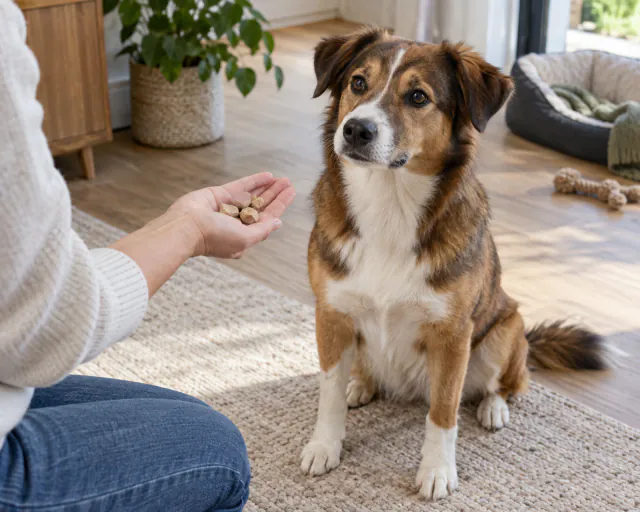
Treats rarely feel like “real” food, which is exactly why they cause so much unplanned weight gain. A measured bowl of kibble twice a day looks controlled and deliberate. A handful of training treats scattered through a walk, a dental chew after dinner, a biscuit at the vet, and a piece of toast crust from a child at the table do not feel like they belong on the same ledger, but they draw on the same daily energy budget as everything else the dog eats.
This guide covers the general principle of keeping treats to a sensible share of a dog’s total daily intake, and some practical ways to do that without giving up the real training value that treats provide.
Treats should be a modest share of the day, not the main event
The general principle worth holding onto is that treats and extras should make up a modest share of a dog’s total daily calories, with the main measured diet supplying the rest. This is a widely discussed guideline rather than a precise figure that applies identically to every dog, and it exists because commercial diets are formulated to be complete and balanced at a given feeding amount. Once treats start displacing a meaningful portion of that measured amount, the overall diet can drift away from the balance the food was designed to provide, on top of simply adding extra calories.
None of this means treats are a problem in themselves. They are a genuinely useful training tool and a normal part of most dogs’ lives. The issue is proportion, and proportion is easy to lose track of because treats are usually given in small individual moments rather than measured out as a total for the day. The Dog Food and Calorie Calculator can help build a picture of a dog’s estimated daily energy needs, which makes it easier to judge roughly how much room treats reasonably have within that total, rather than guessing.
Small pieces go a long way in training
Dogs respond to the number of rewards delivered more than the size of each one, which means treats can be broken down considerably smaller than most packets suggest without losing training effectiveness. A treat the size of a fingernail is often just as motivating as a whole biscuit, delivered more often. For a training session involving dozens of repetitions, this difference between treat sizes adds up to a meaningful amount of saved calories over a session, and over a week.
Choosing lower-calorie treat options where a dog finds them equally rewarding, and reserving richer, higher-value treats for situations that genuinely need extra motivation such as recall around distractions, keeps the average calorie cost of training down without making training itself less effective.
Use part of the normal meal as a training reward
One of the simplest ways to keep treat calories under control is to set aside a portion of the dog’s normal daily food allowance and use it as training reward through the day, rather than adding treats entirely on top of a full measured meal. A dog training with plain kibble from its own ration, perhaps saved from breakfast for a training session later in the day, gets the same training benefit without any extra calories at all.
This works particularly well for dogs that are highly food motivated by their ordinary diet, and less well for a dog that only really responds to something more exciting. In that case, a reasonable middle ground is using part of the normal ration for lower-stakes training moments and reserving genuine treats for the situations that need stronger motivation.
Be honest about treats from more than one source
Households with more than one person feeding or interacting with a dog are especially prone to unplanned treat totals, because each person’s small contribution looks harmless in isolation. A partner giving a treat when leaving for work, a child sharing a biscuit after school, a dog walker carrying their own supply, and a grandparent who always keeps something in a coat pocket can together add up to a genuinely significant daily total, without any single person feeling responsible for overfeeding the dog.
Agreeing a shared rule across the household, such as treats only coming from one labelled container with a rough daily limit, or treats only given as part of deliberate training rather than casually, closes this gap more effectively than asking everyone individually to “cut back a bit.” Visitors and dog walkers are worth including in this conversation explicitly, since they are the most likely to be unaware that anyone else is giving the dog anything at all that day.
Watch for the pattern, not just the day
A single generous day of treats, at a birthday, a long training session, or a visit from family, rarely matters on its own. The pattern that leads to weight gain is a treat habit repeated daily over weeks and months without anyone noticing the running total. Reviewing roughly what a dog has eaten over a typical week, treats included, from time to time is a useful check, particularly if body condition seems to be drifting even though the main measured meals have not changed.
If a dog’s weight or body condition is moving in the wrong direction and treats have not been considered as part of the picture, they are one of the first places worth looking, precisely because they are the part of the diet least likely to be weighed, recorded or remembered accurately. Adjusting treat habits is often a lower-friction first step than reducing the size of measured main meals, and it addresses a genuine and common contributor to unplanned weight gain rather than a minor detail.