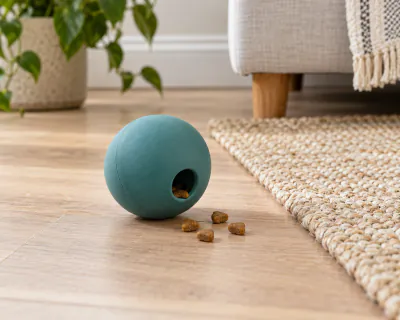
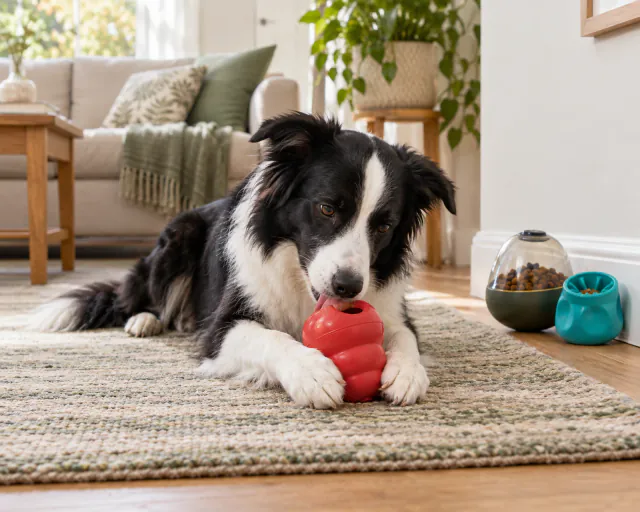
A food-dispensing toy makes a dog work for part of its food: licking it out of a hollow rubber toy, nudging a weighted dispenser until kibble falls out, or solving a puzzle to uncover treats. For many dogs that is a satisfying way to spend ten or twenty minutes, and it gives an owner something calm to offer while they cook, work or settle a dog in a crate. The right toy depends on the dog’s size, how hard it chews and what kind of work it enjoys. This guide sets out what to check. For the wider picture of how enrichment fits into a dog’s week, see enrichment and boredom.
How products are chosen
Canine Origin has not tested these toys hands-on. Each one was chosen from the maker’s published details and a UK stockist’s listing, checked against the criteria below, and every specification on the product cards names its source. The criteria are published sizes and the dog weights they are intended for, the material, how the toy is filled and cleaned, the chewing strength the maker designs it for, the maker’s supervision and safety warnings, and UK availability. How long a particular dog stays interested, and how a toy stands up to that dog’s chewing, can only be judged in use, so no claim is made about them.
How to choose
Decide first what kind of work suits the dog. Stuffable toys are licked and chewed, which is calming for many dogs. Dispensers are pushed and rolled, which suits dogs that like to move. Puzzles are solved with nose and paws, which suits dogs that enjoy a problem. Then choose the size from the maker’s guide, allow for how hard the dog chews, and think about what you will put in it and how you will clean it afterwards. Start with an easy toy and make it harder over time; a dog that fails at a toy on the first try often learns to ignore it.
Size and chewing strength
Size is a safety decision. A toy that is small enough to fit wholly inside the dog’s mouth can be swallowed or become lodged, so choose a size that is clearly too big for that, and go up a size if you are between two. Several makers publish their size guides by weight in pounds: 20 lb is about 9 kg, 35 lb about 16 kg and 65 lb about 29 kg. Chewing strength matters as much as size. Makers design toys for a stated level of chewing, and a toy built for moderate chewers will not last with a dog that destroys everything. One maker here advises going up one or two sizes, or choosing a tougher version, for strong chewers.
Stuffable, dispensing and puzzle toys
A hollow rubber toy can take almost any filling: kibble, soaked kibble, soft food, or a mix, and it can be frozen for a longer challenge. A weighted dispenser is filled with dry kibble or small treats and releases them as the dog nudges it, so it can replace a bowl for a dry meal. A flexible treat cup sits between the two: soft enough to squash, with inner ridges that hold food in place. A board puzzle hides treats under sliders, lids or removable pieces, and asks the dog to solve rather than chew. Board puzzles are for supervised sessions only, because the pieces are not made to be chewed.
Filling it without overfeeding
Food that goes into a toy is part of the day’s food, not an extra. Take it from the dog’s daily ration, and if you use richer fillings such as cheese or meat paste, cut back elsewhere. Our guide to treats and daily energy intake explains how. Make the first fillings easy: loosely packed kibble that falls out with a little effort. Once the dog empties the toy confidently, pack it more firmly, add soft food to bind it, or freeze it. Our guide to slow feeders and enrichment feeding covers building food work into meals, and for dogs who gulp from a bowl, our slow feeder bowl guide compares the options.
Puppies, older dogs and first-timers
For a puppy, choose the smallest size that is still clearly too big to swallow, in a version made for young teeth where the maker offers one, and keep fillings simple and part of the day’s meals. A dog that has never used a food toy needs early wins: fill it loosely so food falls out at the first nudge, and stay close to encourage it. An older dog with worn teeth or stiff joints may prefer licking to chewing or rolling, so a flexible cup or a stuffable toy with soft food often suits better than a dispenser that has to be pushed around the floor. If a dog shows no interest at all, try a more strongly scented filling, or a smaller piece of its usual food, before giving up on the idea.
Safety, supervision and more than one dog
Every maker here says its toy is for supervised use. Stay nearby, especially with a new toy, and take it away once it is empty or if the dog starts chewing pieces off. In a home with more than one dog, give food toys in separate rooms or behind a baby gate, because high-value food can cause tension even between dogs that normally get on. If a dog stiffens, growls or guards a food toy, stop using them around other dogs and people, and speak to a qualified behaviour professional. Our guide to chewing explains the difference between normal chewing and destructive chewing that needs a different approach.
Cleaning
Clean food toys after every use, particularly when they have held wet food. Several of the toys here are dishwasher safe, usually on the top rack; others need hand washing with warm, soapy water. A bottle brush helps with hollow toys, and soaking loosens dried food. Dry toys fully before storing them.
When to replace it and questions to ask
Replace a food toy as soon as it is cracked, torn or missing pieces, or once a piece could be bitten off and swallowed. Check rubber toys for splits around the opening, and puzzles for loose or chewed parts. Before buying, ask: is this size clearly too large to swallow for my dog, is it made for how hard my dog chews, will my dog enjoy licking, nudging or solving most, and can I clean it easily after the fillings I plan to use.