- Session length
- 5 to 10 minutes per play session
- Skill
- Impulse control
- Suits
- Any age
What you need
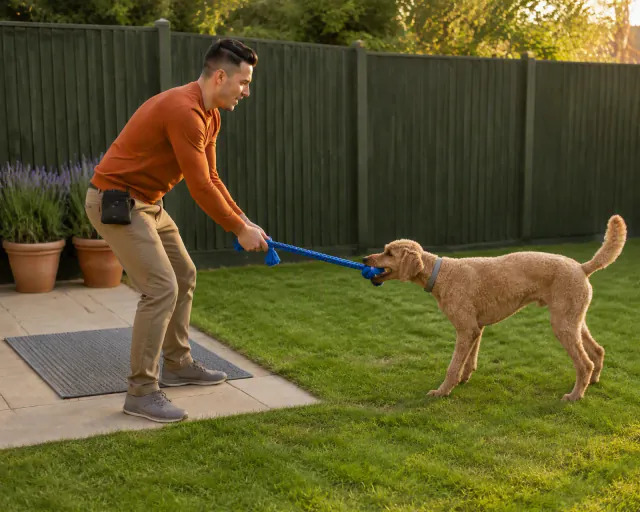
- A tug toy long enough to keep hands well away from the dog's mouth
- One or two fetch toys sized appropriately for the dog's mouth and body size
- A quiet, clear space free of trip hazards for fetch and tug
- A high value chew or toy kept aside for supervised sessions only
Play is one of the easiest parts of dog ownership to get wrong without noticing, because it feels informal and it is genuinely enjoyable for both of you. A game with no rules usually still works most of the time, until a birthday party, a visiting child, or a second dog turns up and the same game goes wrong quickly. This lesson is not about making play stiff or overly controlled. It sets a few simple boundaries so tug and fetch stay a source of fun rather than a source of pushiness, mouthing or a game nobody quite knows how to stop.
Purpose
By the end of this lesson the dog should start and stop games on a cue, release a tug toy without a fight, and settle down again shortly after play ends rather than staying wound up. Structured play like this gives a dog a legitimate outlet for chasing, grabbing and mouthing, which reduces how much of that behaviour turns up in the wrong context, such as on people’s hands or clothing.
Prerequisites
- A reliable drop cue with a valued toy, built in the earlier lesson on that skill. Tug in particular depends on being able to end the game cleanly.
- No specific equipment is required beyond what is listed below, but a settled, non-slippery space makes both fetch and tug safer.
Equipment
Pick toys the dog’s mouth is comfortably sized for. A tug toy needs enough length that your hands sit well clear of the dog’s mouth even during an enthusiastic pull. Fetch toys should be robust enough not to shred into small pieces after a handful of throws. Keep one higher value toy, particularly anything squeaky, aside for sessions you are actively supervising rather than left down as a permanent fixture, since both its appeal and its safety hold up better that way.
Method
- Choose a start cue and a release cue for tug, separate from any other cue you already use, such as ready and drop.
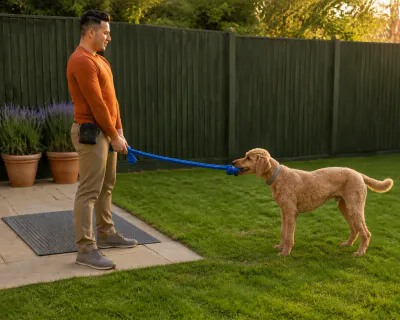
- Begin tug gently. Offer the toy, say the start word, and let the dog take hold. Keep the game low intensity to start, without whipping the toy from side to side.
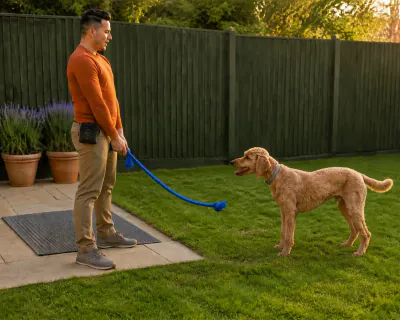
- Pause the game every few seconds by holding still, rather than continuing to pull. A dog who keeps tugging into a still toy is starting to learn self-control within the game itself.
- Ask for a drop partway through, using the cue from the earlier lesson. If the dog releases cleanly, resume the game as the reward, rather than always ending play the moment they let go.
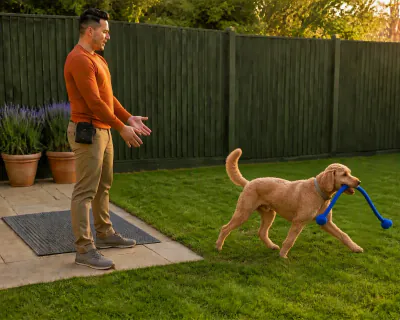
- Let the dog win sometimes. Release your grip and let them carry the toy off for a moment before restarting, since a game the dog can never win becomes frustrating rather than fun.
- Watch for teeth touching skin. If it happens, stop immediately, say nothing dramatic, and restart a calmer, slower version of the game after a short pause rather than ending on a telling-off.
- For fetch, throw to a clear space and reward retrieval with more play or a swap for a second toy, rather than a prolonged struggle to get the item back.
- Read rising arousal as play continues: faster, harder grabbing, a stiffer body, or barking during the game are all signs to pause rather than signs to push through for a bigger reaction.
- Build in short breaks every minute or two, even mid-session, cueing a brief sit or settle before resuming, which keeps the dog thinking rather than purely reacting.
- If children are involved, keep an adult within arm’s reach throughout, and teach children not to run while holding a toy the dog is chasing, since running triggers a chase response that a game of catch does not need.
- Where dogs of different sizes play together, supervise closely enough to separate them the moment play looks one-sided, rather than waiting to see whether it settles on its own.
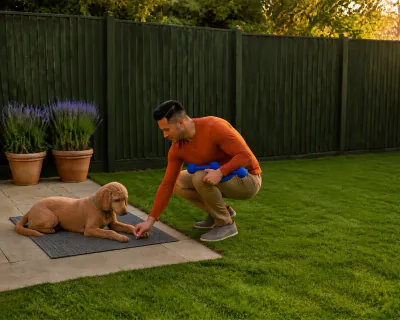
- Finish sessions with a calm activity, such as a brief settle on a mat, so the dog comes down from the game’s arousal before being left alone or moving into a quieter part of the day.
Session length
Five to ten minutes is enough for most dogs, ending while the dog is still keen rather than running the game until interest fades. Several short sessions across a day generally work better than one long one, particularly for a dog who struggles to switch off once excited.
Progression criteria
Move on when the dog reliably releases the tug toy on cue without a struggle in at least nine repetitions out of ten, and settles within a minute or two of play ending rather than staying wound up around the house. Extend duration first, allowing slightly longer bouts of tug or fetch before the first pause. Add distance next, playing fetch across a larger space or tug with a longer approach before the dog takes hold. Add distraction last, practising with another familiar dog nearby, a second person present, or in a new location, one change at a time.
Common mistakes
Encouraging a dog to grab a toy directly from a person’s hand rather than presenting it clearly teaches a habit that is hard to separate from grabbing at hands themselves. Playing at full intensity throughout, with no pauses, tends to produce a dog who cannot come down from arousal easily, since the game never asks for anything but more. Ending every single tug game on a drop, with no chance to win the toy back, gradually makes a dog less willing to let go, since letting go always means the fun stops.
Troubleshooting
If a dog will not release the tug toy, the drop cue itself needs more practice away from the excitement of the game, using the method from the earlier lesson before returning to tug. If play regularly ends in mouthing on hands or clothing, the game has usually run too long or too fast, so shorten sessions and add pauses earlier, before arousal climbs. Dogs who guard toys from other dogs or people, shown by stiffening or growling when someone approaches during play, need that specific pattern assessed on its own rather than folded into ordinary play practice.
Safety and when to stop
Stop the game and step back if teeth touch skin, if a dog’s body language turns from loose and bouncy to stiff and fixated, or if play between two dogs stops looking mutual, meaning one dog is trying to disengage and cannot. Do not restart tug with a dog who has just resource-guarded a toy from another dog or a person without addressing that separately, ideally with a qualified behaviourist working with your vet. Keep an eye on toy condition over time and remove anything that has started to fray, split or shed small pieces, since a familiar toy can become a hazard gradually rather than all at once.
Next lesson
Continue with handling for grooming, which builds the same calm cooperation into brushing, ear checks and nail care.
Useful tool
The dog exercise planner is a useful companion here, since structured play like this counts towards a dog’s daily mental and physical activity, and knowing roughly how much a dog needs helps judge whether a game is a welcome outlet or simply adding to an already overstimulated day.