Most harness problems are sizing problems. A harness that is too tight rubs the armpits and shortens the dog’s stride, and one that is too loose rotates, slips sideways and can be reversed out of on a busy pavement. Weight-based sizing on the packaging causes much of the trouble, because two dogs of identical weight can have very different chest depths and shoulder widths.
This guide covers the measurements to take, how to use them against a manufacturer’s chart, the checks to run before the first walk, and how to tell whether a poor fit is a size issue or a shape issue.
Take the measurements before you buy
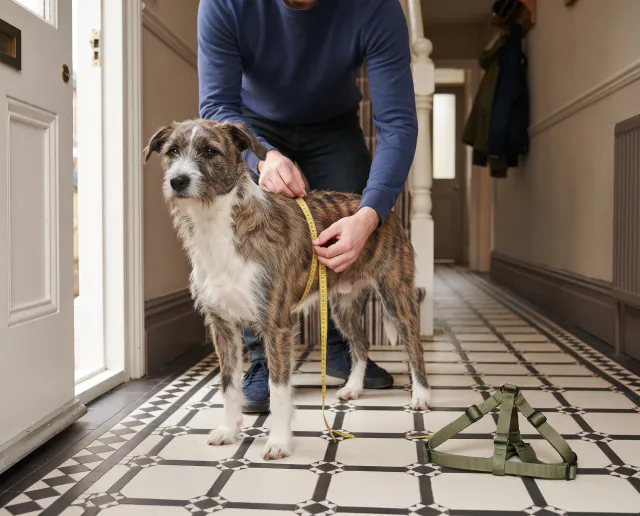
Measure the dog standing squarely on a level floor with the head up, not sitting and not leaning against your leg. Use a soft tailor’s tape. If you only have a rigid tape, run a piece of string around the dog, mark it and measure the string afterwards. A second person keeping the dog still with a few pieces of food speeds the job up.
Take these three figures and write them down:
- Girth. The distance right around the deepest part of the chest, just behind the front legs.
- Neck or lower neck. The distance around the base of the neck where it meets the shoulders, not up near the ears.
- Chest to shoulder length. From the point of the breastbone at the front of the chest up to the top of the shoulder blades, which tells you whether a Y-front will sit clear of the throat.
Measure snugly against the coat without compressing it, then take each measurement twice. If the two readings differ by more than a centimetre, take a third. Note the dog’s weight too, since some charts use it as a secondary check.
Use the maker’s own chart
Sizes are not standardised. A medium from one manufacturer can be smaller than another maker’s small, so ignore the letter on the label and work from the numbers on the chart for the exact model you are buying. Charts for a step-in design and an overhead design from the same maker often differ as well.
If your girth measurement falls near the top of one size range, look at where the neck measurement lands before deciding. Where the two point to different sizes, choose the size that fits the girth and check whether the neck section adjusts. Girth straps usually have a generous adjustment range, whereas a fixed neck opening is far harder to work around.
For a dog whose measurements sit awkwardly between sizes on every chart, look for models with adjustment on three or four points rather than buying the nearest size and hoping. Buy from a retailer with a clear returns policy so an unworn harness can go back.
Fit it properly the first time
Put the harness on indoors and adjust every strap before you attach a lead. Work from the front backwards. The chest piece should sit on the breastbone, in front of the shoulder joint, and stay clear of the windpipe when the dog lowers the head to sniff.
Then run these checks with the dog standing:
- Two flat fingers should slide under each strap without stretching the webbing and without leaving a gap you could push a fist into.
- The girth strap should sit two or three finger widths behind the elbow, not tucked into the armpit.
- Straps should not cross the point of the shoulder blade, which needs to swing freely.
- Buckles and rings should not press against a bony point or sit under the dog when they lie down.
- Nothing should be twisted, and both sides should be adjusted to the same length so the back strap runs along the spine rather than off to one side.
Escape testing matters as much as comfort. Hold the lead and let the dog walk to the end and turn back towards you. A dog with a narrow head and a deep chest, such as a Dachshund or a whippet-type dog, can reverse out of a two-strap harness that measures correctly, and those dogs usually need a three-strap design.
Watch the dog move
Numbers only tell you so much. Walk the dog in the garden or along a quiet stretch of pavement for a few minutes, then look at the stride. The front legs should reach forward as far as they do without the harness. Shortened steps, a bunny-hopping trot, sideways swinging of a front leg or a reluctance to move at all point to a harness restricting the shoulder.
Take it off after ten minutes and look at the coat and skin underneath. Flattened fur is normal. Pink or broken skin, hair loss at the armpit or the elbow, or the dog scratching at a particular spot means something is rubbing. Check whether the strap can be lengthened or repositioned before you decide the harness is wrong.
Recheck once more after the first proper walk. Wet fur, a thick winter coat and a settled-in harness all change how the straps sit, and a fit that seemed correct in the hallway can loosen by the end of a wet field walk.
Recheck as the dog changes
Puppies need refitting every couple of weeks through their fastest growth, and a harness bought with room to grow is a harness that does not fit now. Buy an inexpensive one that fits today and replace it as the measurements change.
Adult dogs need rechecking too. A dog gaining or losing condition, a coat clipped for summer, a thick undercoat coming in for winter and a change in muscle after an injury all shift the numbers. Set a habit of checking the strap positions once a month, along with the stitching, clips and rings, and adjust rather than assuming the settings are still correct.
When size is not the problem
Some dogs never sit comfortably in a particular pattern regardless of the size chosen. Broad-chested and short-legged dogs often need a different shape rather than a different size, and a straight horizontal chest strap sits across the shoulder on many dogs no matter how it is adjusted. Try a Y-front design, or a model with a shorter chest panel, before concluding that the dog dislikes harnesses.
Ask your vet for advice if the dog has a history of neck, back, shoulder or breathing problems, or if the fitting process itself causes obvious discomfort. Deciding between a harness and a collar for the walk itself is a separate question, covered in the guide on harnesses and flat collars.
Try the tool
Harness Size Helper
Turn your dog’s girth and neck measurements into a likely size band and a fit checklist.
Your result