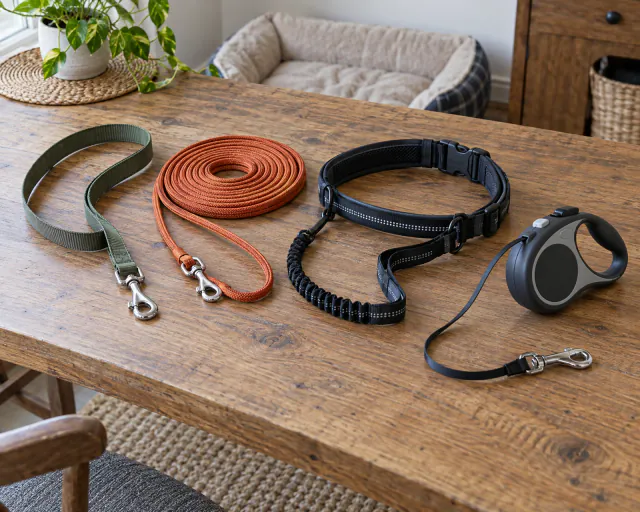
Walk into any pet shop and the wall of leads looks more complicated than it needs to be. Most of the choice comes down to a handful of genuinely different designs, each suited to a different kind of walk, and picking the wrong one for the situation is where most of the frustration comes from rather than any fault in the lead itself.
This guide compares standard fixed-length leads, long lines, hands-free and waist leads, and retractable leads, along with the material and comfort details that affect how a lead feels to use over a full walk. Rules on maximum lead length in public spaces, and where a dog must be on a lead at all, vary by country and even by local authority, so check the regulations that apply to where you actually walk.
Standard fixed-length leads
A fixed-length lead, typically somewhere around one to two metres, is the default for good reason. The length does not change, so the dog’s distance from you is predictable at every point in the walk, which makes it far easier to teach loose-lead walking, manage greetings with other dogs, and cross roads safely. Almost all obedience and loose-lead training assumes this kind of lead, since a length that can suddenly shorten or lengthen works against consistent handling.
A basic fixed lead with a secure clip and comfortable handle covers the overwhelming majority of walking needs. It is also the easiest lead to replace or carry a spare of, since there is nothing mechanical to fail beyond the clip and the stitching.
Long lines
A long line extends the same idea to several metres or more, giving a dog room to range, sniff and explore while you retain a physical connection. Long lines suit recall training and supervised freedom in open spaces where full off-lead access is not appropriate yet, and they are used through a dedicated stage of recall training at beginner recall on a long line and in the broader guide to teaching reliable recall.
Because a long line brings its own handling technique, attachment point and safety considerations that go well beyond a simple length comparison, those details are covered fully in a dedicated guide on using a long line safely rather than repeated here. The short version for choosing one over a fixed lead is: pick a long line when you specifically need extra range in an open, low-hazard space, not as an everyday walking lead.
Hands-free and waist leads
A hands-free lead clips around the waist or across the body, freeing both hands for running, hiking, using poles or simply carrying things. For a dog that already walks well without pulling, this can make an active walk far more comfortable than holding a lead the whole way.
The trade-off is control. Because the lead is anchored to your body rather than held in your hand, you lose the ability to quickly shorten it, drop it, or adjust your grip the way you could with a handheld lead. Most waist leads include a quick-release buckle at the waist for exactly this reason, and it is worth practising using it before you need it in a hurry. Hands-free leads suit a settled, predictable dog on a familiar route more than a dog still learning loose-lead skills, or a walk in an area with unpredictable traffic, livestock or other dogs.
Retractable leads
Retractable leads let a dog range out to several metres and reel back in via a spring-loaded mechanism in the handle. They are popular, and for some situations, such as a quiet, open space with a calm dog and no other lead users nearby, they can work reasonably well.
They also carry some real and specific concerns worth being honest about rather than dismissing outright.
- Sudden tension. If a dog reaches the end of the extended cord at speed, the stop is abrupt rather than gradual, which can jar the dog’s neck if the lead is clipped to a collar, and can also pull the handle out of a loosely held hand.
- Cord burns and cuts. The thin cord type of retractable lead can cause a serious friction burn or even a deep cut to a hand, leg or ankle, whether the handler’s or another person’s, if it runs quickly across skin under tension. This is one of the more commonly reported injuries linked to this lead type.
- Reduced close control. Because the mechanism is built to extend, keeping a dog close in a hurry, such as when another dog or a cyclist appears suddenly, is slower and less certain than simply shortening a fixed lead in your hand.
- Awareness of the dog’s position. At full extension a dog can be several metres away and out of easy sight around a corner or parked vehicle, which reduces the handler’s ability to react to what the dog is walking into.
For these reasons, a retractable lead is generally discouraged on busy pavements, near traffic, in crowds, and in any setting where you might need to shorten the dog’s range instantly. It is not that the design is never appropriate, but that it needs a genuinely open, quiet, low-risk setting to be used safely, and many everyday walking routes do not meet that description for most of their length.
Material and comfort
Beyond the category of lead, a few physical details affect how comfortable and durable a lead is over regular use.
- Handle padding. A padded handle spreads grip pressure across the hand, which matters more on a lead that regularly takes a firm pull, such as one used with a strong or still-training dog.
- Reflective strips or piping. Genuinely useful for visibility during dawn, dusk or winter walks, covered in more depth in the guide on walking in low light.
- Weight and width. A lead should be proportionate to the dog. A heavy lead on a small dog adds unnecessary weight to what the dog feels at the collar or harness end, while a very light lead on a large, strong dog may not hold up to sustained pulling.
- Material. Webbing is common, durable and easy to clean. Leather softens with use and can be comfortable to hold but needs occasional conditioning. Biothane, a coated webbing, sheds mud and water well and does not absorb odour the way fabric can, which suits muddy or wet routes.
Choosing for the walk you actually do
Most owners are better served by owning two or three lead types rather than one lead for everything: a fixed lead for the majority of daily walks and training, a long line for supervised off-lead style practice in open spaces, and perhaps a hands-free lead for runs or hikes once the dog’s lead manners are reliable. Match the lead to the walk rather than the walk to whatever lead happens to be by the door, and check the specific length and lead rules that apply in the country or region where you are walking before assuming a lead you already own is compliant everywhere.