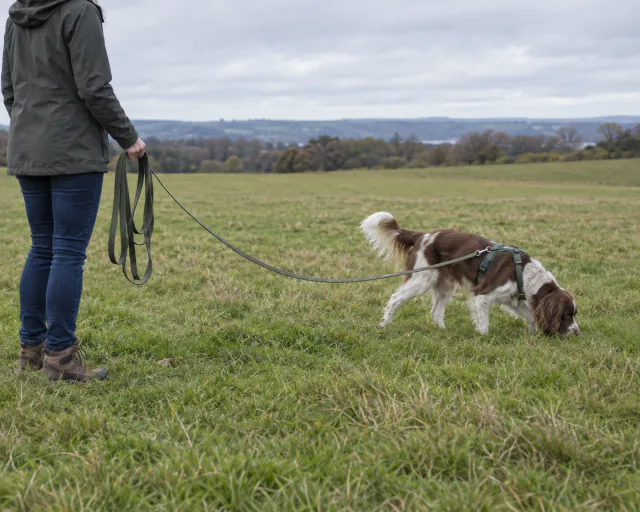
A long line gives a dog room to sniff, explore and range further than a standard lead allows, while keeping a physical connection between dog and handler. It is a genuinely useful piece of equipment for recall training and supervised freedom, and it is used through several stages of recall work, including beginner recall on a long line. It also causes more accidental injuries than most other walking equipment, almost always through handling mistakes rather than any fault in the line itself.
This guide covers how to choose an appropriate length and material, why the line should attach to a harness rather than a collar, the handling technique that avoids tangles and rope burns, and how to judge whether a space is actually suitable for using one at all.
Choosing length and material
Long lines commonly run from around five metres up to fifteen or more. A shorter line is easier to manage and gather, and suits early training stages or a smaller or lower-energy space. A longer line gives more range for a confident dog in a genuinely open area, but it is proportionally harder to keep tidy and takes longer to gather in when you need the dog closer quickly. Start shorter than you think you need and extend the length as your handling skill and the dog’s reliability grow, rather than starting with the longest line available. The long line buying guide compares lengths, weights and clips.
Material matters as much as length. Flat webbing and biothane, a coated webbing material, are generally easier to handle than round cord or paracord-style lines, because a flat line grips a gloved or bare hand more securely and does not bite into skin the way a thin round line can. A round cord line under sudden tension can cause a serious rope burn or even a cut to a hand, leg or ankle, whether the handler’s own or a passer-by’s, if it runs across skin at speed. A thicker, flatter line is a safer default for anyone still building handling confidence.
Attach to a harness, not a collar
A long line should clip to a well-fitted harness rather than a flat collar. The reason is straightforward: a dog on a long line can build up real speed before reaching the end of the available slack, and the sudden stop that follows puts significant force through whatever the line is attached to. A harness spreads that force across the chest and shoulders. A collar concentrates the same force into a narrow band around the neck and throat, which is a genuine risk to the airway and spine if the stop is hard enough. Fitting a harness correctly is covered in full in the guide on choosing the correct harness size, and that fit matters even more once a long line is added, since a harness that a dog can twist out of under lighter conditions is more likely to fail under a sudden hard pull.
Handling technique
Most long line injuries come from poor handling rather than the equipment itself, and a few habits prevent nearly all of them.
- Never wrap the line around a hand, wrist or fingers. If the dog suddenly bolts, a wrapped line tightens under load and can cause a serious injury, from rope burn to a broken finger, and it also removes your ability to let go if letting go becomes the safer option. Hold the line with an open grip instead.
- Gather slack into loose loops, not coils around the hand. As the dog moves closer, take up the extra line in relaxed loops held in your palm, ready to be released one loop at a time as the dog moves away again. Never let a loop close around a finger.
- Keep slack off the ground when other people, dogs or hazards are nearby. A long line trailing loosely underfoot is a trip hazard for you, for the dog, and for anyone else walking through the same space, including other dogs who can become tangled in it.
- Watch the line’s path, not just the dog. A long line can loop around a tree, a fence post, another person’s legs or another dog’s body as your dog moves around an obstacle. Keep track of where the line is running, not only where the dog currently is.
- Wear gloves if you are new to handling a long line, particularly with a stronger or less predictable dog, until your technique and the dog’s response to reaching the end of the line are both familiar.
Choosing the right space
A long line only adds safe freedom in a space that suits it. Look for open ground with a clear line of sight, free from other dogs being walked off lead, livestock, fast-moving cyclists or joggers, road access, deep water, and obvious ground hazards such as holes, broken glass or dense bramble that the line could snag on. A field edge, a large open park at a quiet time, or a beach away from other lead-free dogs are typical suitable spaces. A narrow path, a crowded park, or anywhere with blind corners is generally a poor fit for a long line, since you cannot see far enough ahead to manage the dog’s approach to something unexpected.
Weather and ground condition matter too. Wet grass, mud and long vegetation all make a trailing line harder to see and easier to trip over, both for you and for anyone else nearby.
A long line is not a substitute for a secure boundary
A long line keeps a dog physically connected to you, but it does not replace a genuinely secure boundary in a location where an off-lead or free-ranging dog would be unsafe. Do not use a long line as your only safeguard near a busy road, alongside livestock, at height, or near open water with a current, on the assumption that you can always reel the dog back in time. Lines can be dropped, can tangle, can slip through a hand, or can simply run out at the exact moment a dog lunges towards a genuine hazard. Where the consequences of the line failing would be serious, choose a shorter lead, a fully enclosed space, or a different route rather than relying on a long line to manage the risk.
Building it into training
A long line works best paired with active training rather than left slack the entire walk. Reward the dog for checking in, for responding to a recall cue at increasing distances, and for returning to loose slack after ranging out, using the structured approach set out in teaching reliable recall. Used this way, the line becomes a training tool that builds towards genuine off-lead reliability, rather than simply a longer version of an ordinary walk.