A flat collar looks like the simplest piece of dog equipment there is, and in one sense it is, but a poorly fitted one causes real problems. Too loose and a dog can back out of it in a moment of fright, ending up loose near a road or lost entirely. Too tight and it rubs the coat thin, presses on the windpipe, or worse, cannot be slipped off in a real emergency such as the collar catching on something.
This guide covers how to check fit properly, why fit needs are different for a puppy, an adult and a dog prone to slipping collars, the difference between a collar meant only to carry an identification tag and one also used to clip a lead to, and the safety features worth checking before you buy.
The two-finger rule, done properly
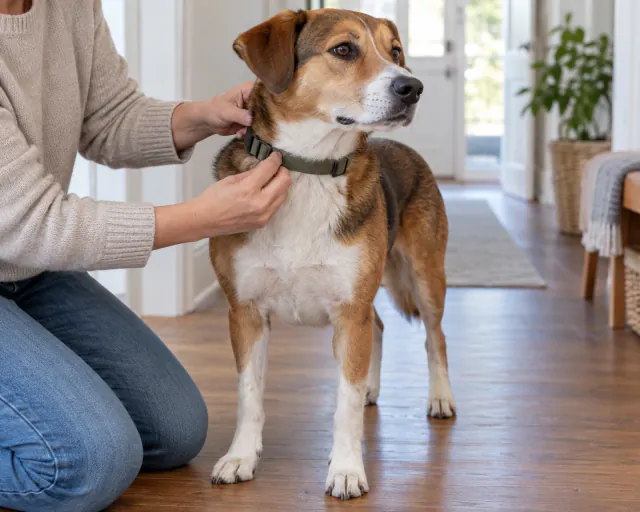
The standard check is to slide two flat fingers, side by side, under the collar while it sits at the base of the neck. You should be able to fit them in without forcing the collar to stretch, and without a lot of slack left over once they are in. If you can fit a third finger, or a whole hand, the collar is too loose. If you cannot get two fingers in without pulling hard on the webbing, it is too tight.
Do this check with the dog standing normally, not sitting or crouching, since the neck shape changes between the two. Run your fingers all the way round the collar rather than checking only at the buckle, because collars can sit unevenly, tighter at the back of the neck than at the front or the other way round.
Recheck after the dog has worn the collar for a few minutes. A collar that felt right straight off the shelf can settle differently once fur is compressed underneath it, and a collar checked on a dry coat can sit differently once the dog has been out in rain or has been swimming.
Looser for puppies, snugger for known slippers
A growing puppy needs the collar checked far more often than an adult dog, because neck growth can outpace a routine you would use for an adult. Weekly checks are sensible during a fast growth period, and monthly checks once growth slows. A collar bought with room to grow is, in the meantime, a collar that is currently too loose, so buy an inexpensive collar sized for today and replace it as the puppy grows rather than leaving slack in place and hoping it will be used up in a few weeks.
Some dogs are known collar-slippers: narrow-headed breeds, dogs with a thick neck that tapers sharply to a narrower head, and any dog that has slipped a collar before. For these dogs, fit on the snugger end of comfortable is safer than the standard two-finger gap, though it should never be tight enough to press on the throat or restrict a full head turn. A martingale-style collar, which tightens slightly under tension but has a limit that stops it closing fully, is worth considering for a dog with this history, since it will not go past a set point.
Identification collar versus lead-attachment collar
These are not always the same job. A collar used only to carry an identification tag can be lighter and does not need to withstand repeated pulling, since nothing beyond the tag’s weight is hanging off it. A collar that will also take a lead clip needs stronger stitching, a secure buckle or clip, and a D-ring rated for the dog’s size and strength. The guide to everyday dog collars compares collars for both jobs.
Many owners choose to run both: a light identification collar left on at all times, and a harness used as the actual lead attachment during walks. This avoids putting any pulling force through the neck at all. Where a dog is walked from a flat collar rather than a harness, the difference in suitability between the two setups, and when a harness is the better choice, is covered in the guide on harnesses and flat collars rather than repeated here.
Why a harness often suits a puller better
A collar concentrates the full force of a pull into a narrow band around the neck and throat. For a dog that lunges at other dogs, pulls hard towards interesting smells, or has any diagnosed or suspected neck sensitivity, this repeated pressure is worth avoiding where possible. A well-fitted harness spreads the same force across the chest and shoulders instead. This does not mean a collar is unsafe for every dog, only that it is a poor choice as the main lead attachment for a dog that regularly pulls, and it is not the right starting point while loose-lead skills are still developing.
Safety features worth checking
Buckle collars come with a few variations worth understanding before you buy.
- Standard buckle or side-release clip. Simple and secure for most dogs. A side-release clip is quick to remove but can be chewed or occasionally forced open by a very strong dog.
- Breakaway collars. These release under a hard, sustained pull, usually designed for dogs that might catch a collar on furniture, fencing or another dog’s mouth during play. The trade-off is that a breakaway collar can also release the same way if a lead is clipped to it and the dog pulls hard, so most breakaway designs include a separate loop for a lead clip that bypasses the release mechanism. Check exactly how a given collar’s release and lead-attachment points work before relying on it for a dog that pulls.
- Quick-release buckles versus traditional pin buckles. A quick-release buckle can be removed with one hand in an emergency, which matters if a dog becomes tangled or needs the collar off fast. A pin buckle is generally slower to release but harder to open accidentally.
There is a genuine trade-off between a collar that releases easily for safety and one that stays on reliably for identification. A dog that regularly loses a breakaway collar during normal play is not carrying a readable tag when it matters. Consider the dog’s actual risk, rather than assuming the most failsafe option for one scenario is automatically the safest overall.
Recheck the fit as things change
Fit is not a one-time job. Recheck a puppy’s collar on a fixed schedule until growth levels off, and recheck an adult dog’s collar whenever body condition changes noticeably, whether from weight gain, weight loss, a seasonal coat change or muscle change after injury or reduced activity. A collar that fit correctly six months ago is not guaranteed to fit correctly now. Build the check into an existing routine, such as a monthly grooming session, so it does not get forgotten.
Inspect the material itself at the same time. Webbing frays at the edges, stitching can pull loose near the buckle, and leather dries out and cracks if it is not conditioned. Replace a collar showing any of these signs rather than continuing to rely on it, since a fit check means little if the collar itself is close to failing.