
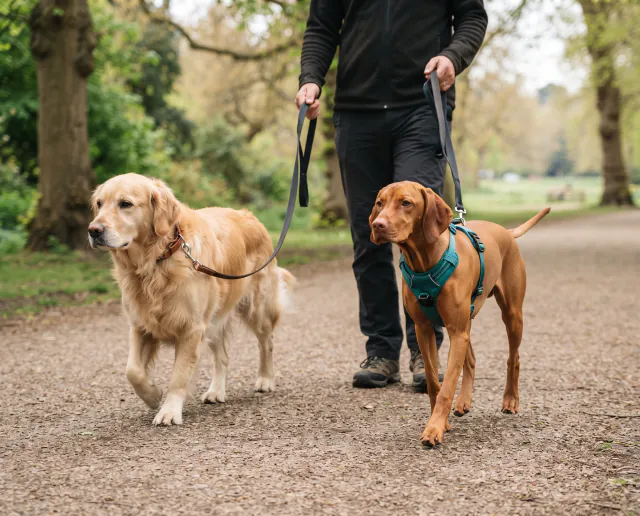
A flat collar and a well-fitted harness can both form part of a dog’s walking kit. The better choice depends on the dog’s body, behaviour and training, as well as the places you walk. Equipment can make handling safer and more comfortable, but it does not teach a dog to walk on a loose lead by itself.
What a flat collar does well
A flat collar is simple, light and easy to leave on for an identification tag. For a dog that already walks without pulling, it can also be a straightforward place to attach a lead. The collar should sit securely without pressing into the throat or slipping over the head.
Lead pressure is concentrated around the neck. That makes a collar a poor walking attachment for a dog that lunges, pulls hard or repeatedly hits the end of the lead. It also deserves extra care with puppies, small dogs and dogs with breathing, neck or back concerns. Ask your vet for advice if health or conformation affects the choice.
Avoid collars designed to tighten, pinch or deliver a shock. Discomfort can increase fear and frustration, and it does not show the dog what to do instead.
What a harness does well
A harness spreads pressure across a wider area of the body. A secure design can give useful support around roads, wildlife and busy entrances, particularly while loose-lead skills are still developing. Harnesses can also reduce pressure on the neck when a dog suddenly reaches the end of the lead.
Design and fit matter. A harness should allow the front legs and shoulders to move freely. Straps should not cut across the soft part of the armpit, rub behind the elbows or sit against the throat. A Y-shaped front often gives the shoulder more room than a straight horizontal chest strap, although the individual fit remains more important than the label.
A front lead attachment can help a handler turn a strong dog back towards them. It should not twist the harness or alter the dog’s gait. Some owners use a double-ended lead attached at the chest and back for balanced guidance. Keep both sections loose enough for natural movement.
Check the fit before walking
Fit the equipment while the dog is standing squarely. You should be able to slide fingers beneath each strap without large gaps. Check that buckles do not sit on the shoulder blade or elbow. The dog should be able to walk, trot, sit and lower its head without restriction.
Look again after the first few minutes of a walk. Coats compress, straps settle and wet fur changes how equipment sits. Watch for shortened steps, scratching, reluctance to move or pink skin after removal. These signs call for an adjustment or a different shape.
Escape risk matters too. Dogs with narrow heads, deep chests or a habit of reversing may back out of ordinary equipment. A three-strap escape-resistant harness or a safety connector between harness and collar can provide another point of security. Test the fit at home before relying on it outside.
Match the setup to the walk
A calm adult dog on a quiet pavement may be comfortable walking from a flat collar. A young dog learning around distractions will often be easier to manage from a harness. Long lines should attach to a harness, not a collar, because the dog can gather speed before reaching the end.
Whichever setup you choose, carry out regular checks for worn stitching, cracked clips and distorted rings. Clean grit from fastenings and follow the maker’s care instructions. Replace equipment that has been chewed or damaged.
Equipment does not replace training
Start loose-lead practice somewhere quiet. Reward the dog beside you while the lead is slack, then take one or two steps and reward again. Change direction before the lead becomes tight. Short, successful sessions are more useful than dragging through a full walk while both dog and handler become frustrated.
Sniffing is a valuable part of a walk, not a failure of heelwork. A consistent cue can tell the dog when you need close walking and when there is freedom to explore on a longer lead. Clear expectations make the equipment easier to use.
Where a head collar fits in
A head collar, sometimes called a head halter, is a third option some professionals use for extra steering control on a strong or highly reactive dog while loose-lead training is still in progress. It works on the same principle as a horse’s head collar: where the head goes, the body tends to follow, so a gentle turn of the head redirects the dog without the sustained neck or chest pressure a pulling dog can build up against.
A head collar needs a proper, gradual introduction with food and short positive sessions before it is ever used on a real walk, since an unfamiliar strap across the muzzle can be unsettling for a dog meeting one for the first time. It should never be used to jerk the dog’s head around, clipped to a long line where a sudden run could wrench the neck, or treated as a permanent substitute for teaching loose-lead walking. Most handlers use it as a temporary bridge while training progresses, then move back to a harness once the underlying skill is reliable.
Which should you choose?
Choose the option that fits securely, allows natural movement and suits the dog’s current lead skills. Many dogs wear a flat collar for identification and use a harness as the lead attachment; the buying guides to everyday collars and everyday harnesses compare the options for each. Others walk comfortably from a collar because they rarely apply pressure. Recheck the decision as a puppy grows, behaviour changes or health needs emerge.