Weight gain in dogs happens slowly enough that the people who see the dog every day are usually the last to notice. A few extra treats a week, a bag of food scooped by eye rather than measured, and a winter of shorter walks add up quietly. Carrying extra weight affects joints, breathing, heat tolerance, energy and long-term health, and getting it back off takes considerably longer than putting it on.
This guide covers how to get an accurate assessment, how to run the practical side of feeding at home, and how to keep condition steady once your vet is satisfied with it. Any judgement about what a dog should weigh, and any plan for changing it, belongs with the veterinary practice that has examined your dog.
Get a veterinary assessment first
Book an appointment and ask the vet or a veterinary nurse to assess your dog’s body condition and weight. They will weigh the dog on practice scales, examine them and take account of age, breed, neutering status, health conditions and current diet. That combination is what produces a sensible target, and no chart, calculator or website can replace it.
This matters in both directions. Weight gain can be a sign of an underlying health problem, and unexplained weight loss always needs veterinary attention rather than reassurance. So does a sudden change in appetite, drinking or energy.
If a change is needed, ask the practice for a written plan covering how much to feed, what to feed, how often to weigh in and when to come back. Many practices run nurse-led weight clinics, which give access to the same scales each visit and a record of progress over time. Follow the plan you are given rather than one from another dog’s owner, and go back to the vet before changing it.
Learn to check condition at home
Ask the nurse to show you how to assess your own dog by hand, then repeat it every few weeks. You are feeling for the ribs under a light covering, looking for a waist behind the ribcage when you view the dog from above, and looking for an upward tuck of the abdomen when you view them from the side.
Learning it with someone who can correct you is the point. Owners routinely misjudge their own dog in both directions, and thick or fluffy coats hide a great deal. Photographs from above and from the side, taken in the same spot and the same light every month, are surprisingly useful for spotting slow change.
Home scales work for small dogs if you weigh yourself, then yourself holding the dog. Larger dogs need practice scales, and most receptions are happy for you to pop in and weigh.
Measure what actually goes in the bowl
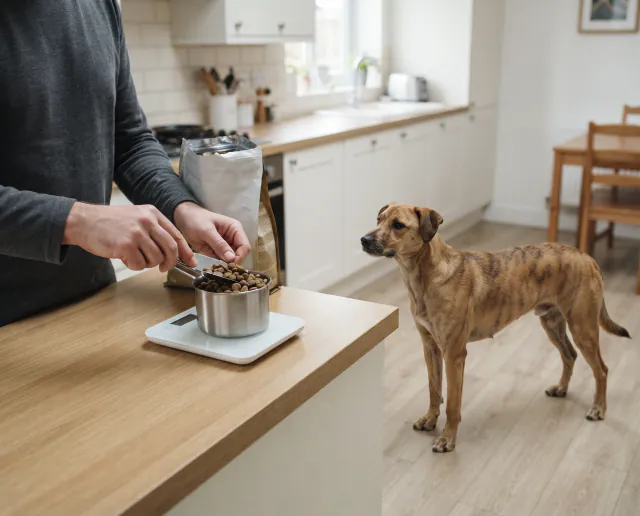
Scoops and cups are the most common source of accidental overfeeding, because the same scoop holds different amounts depending on how the food settles. Weigh dry food on kitchen scales instead, using the amount the practice has advised.
Weigh out the whole day’s allowance in the morning and keep it in one container. Everything the dog eats that day comes from that container, including anything used for training. This one habit does more than any other single change, particularly in households where several people feed the dog and each assumes someone else has not.
Feed at consistent times, take the bowl up after a reasonable period rather than leaving food down all day, and feed dogs separately if one finishes first and moves on to the other’s bowl.
Count the extras honestly
Write down everything the dog eats for one week. Chews, dental sticks, the last of the children’s sandwich, scraps while the dinner is being served, treats from a neighbour, a biscuit at the vet and food used in a food toy all belong on the list. Households are often surprised by the total.
Then reduce the extras rather than removing everything at once. Use part of the measured daily allowance for training. Swap high-fat treats for small pieces of a suitable dog-safe vegetable if your vet agrees they are appropriate for your dog. Break treats into smaller pieces, since dogs respond to the number of rewards more than the size of each one.
Agree the rules with everyone in the house, including visitors and anyone who walks the dog. One person quietly topping the dog up will undo the work of everyone else.
Build activity that suits the dog
Increase exercise gradually and in a form the dog can manage comfortably. Two or three shorter walks often suit an unfit or heavy dog better than one long one. Sniffing walks, gentle hill work, swimming where it is safe and clean, and scent games in the garden all burn energy without hammering the joints.
Watch for lameness, stiffness the following morning, reluctance to walk, or breathing that seems laboured, and stop and speak to your vet if you see any of them. Dogs already carrying extra weight, flat-faced breeds, older dogs and long-backed dogs such as the Dachshund need particular care about how quickly activity is increased.
Indoor enrichment counts on days when a long walk is not possible. Food toys, scatter feeding in the garden, short training sessions and puzzle feeders use mental energy and slow eating down at the same time.
Keep it steady once you are there
Weigh the dog at the same practice scales on a regular schedule, monthly for most dogs, and write the figure down. A trend across several months tells you far more than a single reading, and small fluctuations are normal.
Once the vet is happy with the dog’s condition, expect to adjust the amount you feed over time. Neutering, ageing, a change in activity, a house move, a new job pattern and the arrival of winter all shift the balance. Retriever types such as the Labrador Retriever are well known for a strong appetite that carries on regardless of need, and they benefit from tighter routine.
Go back to the vet if the weight will not shift despite following the plan, if it changes without an obvious reason, or if the dog seems hungry all the time, lethargic or unwell. A stalled plan is a reason for a review, not a reason to cut food further on your own.