
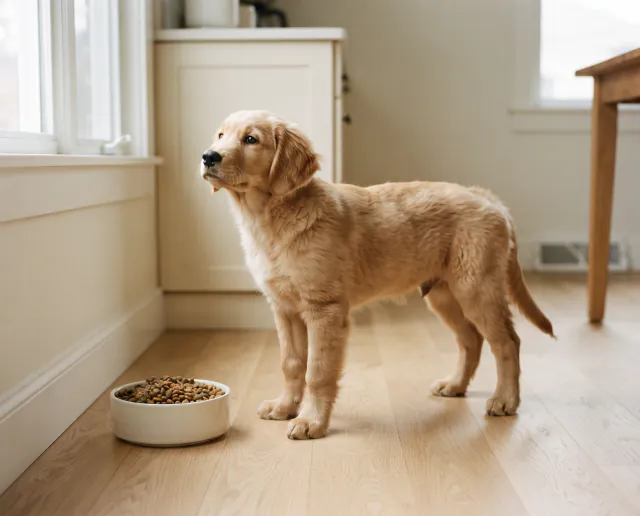
A puppy’s body is doing more work per day than it will at almost any other point in its life, building bone, muscle, and organ tissue at a pace that will never be repeated once growth finishes. That makes puppy feeding meaningfully different from adult feeding, not just a smaller portion of the same food, and getting the basics wrong, particularly in large and giant breeds, has been linked to developmental problems that are far easier to avoid than to correct.
This guide covers why puppies need a food specifically formulated for growth, how feeding frequency typically changes as a puppy matures, why free-feeding is usually discouraged, how to transition food safely, and why large-breed puppies in particular need a size-appropriate approach rather than an assumption that faster growth is better growth.
Why growth food is formulated differently
A food formulated for growth is generally more energy-dense than an adult maintenance food, because a growing puppy needs more energy relative to its body weight to fuel that pace of development. It also needs specific attention to calcium and phosphorus, minerals central to skeletal development, kept in the right proportion and within a controlled range rather than simply provided in abundance. This matters most in large and giant breed puppies, whose bones grow rapidly over a longer period than a small breed’s, and where an excess of calcium or an imbalance between calcium and phosphorus has been associated with skeletal developmental problems. This guide deliberately avoids stating specific ratios or figures, since getting that detail right for an individual puppy, particularly a large or giant breed, is exactly the kind of decision worth confirming with a vet rather than following a number pulled from a general article.
Many manufacturers offer growth formulas specifically labelled for large or giant breeds, reflecting this longer, slower growth pattern and the correspondingly different nutrient balance those puppies need compared with a small or medium breed puppy reaching adult size much sooner.
Feeding frequency changes as a puppy grows
Very young puppies typically need several smaller meals spread across the day, because their stomachs are small relative to their energy needs and they cannot comfortably manage the volume of food required in one or two sittings. As a puppy matures, the number of meals is usually reduced gradually while the amount per meal increases, moving from several small meals a day down to two meals by the time most dogs reach adulthood. The exact pace of that reduction varies by individual puppy and by breed size, and a vet or the food manufacturer’s guidance for the specific product is a better source for a particular puppy than a fixed universal schedule.
Why free-feeding is usually discouraged
Leaving food down all day for a puppy to graze on, sometimes called free-feeding, makes it considerably harder to notice early signs of a health problem, since a change in appetite is one of the more reliable signals owners and vets use to catch something going wrong early. It also makes portion control difficult, particularly in a multi-dog household, and it does nothing to support the mealtime routine and food-focused training window that measured meals naturally provide. Measured meals at set times, using a weighed amount rather than a scoop judged by eye, are the more commonly recommended approach for the great majority of puppies, allowing an owner to track intake, monitor appetite changes, and use part of the daily ration for training rather than adding treats on top of a full free-feeding bowl.
Transitioning food gradually
Whether moving between puppy foods, switching brands, or eventually transitioning to an adult formula, doing it gradually over seven to ten days by mixing increasing proportions of the new food with decreasing proportions of the old reduces the chance of digestive upset. A sudden switch, even between two perfectly good foods, is a common and avoidable cause of loose stools in puppies. The right time to move onto an adult food depends far more on the individual puppy’s growth completion, which varies significantly by breed size, than on a fixed age, and this is covered in more detail in the guide on life-stage feeding principles.
Large-breed puppies need a size-appropriate approach
It is a common and understandable instinct to assume that a puppy destined to become a large adult dog needs more food, sooner, to “catch up” to that eventual size. The evidence points the other way. Overly rich diets and rapid growth in large and giant breed puppies, such as a Great Dane, Bernese Mountain Dog or St Bernard, have been associated with a higher risk of skeletal developmental problems, not a healthier outcome. A size-appropriate large-breed growth formula, fed at an amount that supports steady, gradual growth rather than the fastest possible growth, combined with veterinary guidance and regular weight checks through the puppy’s first year, is the more supportable approach. The same logic applies in a milder form to breeds of any size: a lean, steadily growing puppy is generally considered a better outcome than a heavier one growing as fast as possible.
Working out how much to feed
Every puppy food carries a feeding guideline linking approximate age and expected adult weight to a daily amount, and that guideline is a starting point rather than a fixed instruction, since individual puppies vary in metabolism, activity and body condition even within the same breed and litter. The Dog Food and Calorie Calculator can help translate a puppy’s details into a starting daily estimate, though it should be checked against how the puppy’s body condition actually develops over the following weeks, ideally with input from a vet at routine vaccination or check-up visits. Budgeting for the cost of feeding a puppy through its first year, including the higher-calorie growth food many puppies need, is worth planning for early, and the Puppy First-Year Cost Calculator is a useful starting point for that wider picture alongside feeding costs specifically.