
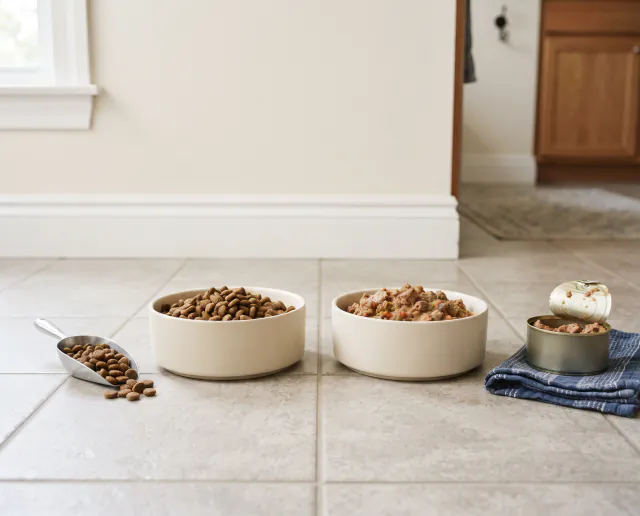
Owners often ask which is genuinely better, dry kibble or wet tinned and pouched food, expecting a clear answer. There generally isn’t one. Both formats can support a complete, balanced diet when properly formulated for the dog’s life stage, and the practical differences between them matter more for day-to-day convenience, cost and individual preference than for any inherent nutritional superiority of one format over the other.
This guide sets out the practical factors worth weighing up: cost per feed, hydration, dental considerations, storage and spoilage, and convenience for different households, along with why the right choice is usually specific to the dog and the owner’s circumstances rather than a fixed rule.
Cost per feed
Dry food is generally cheaper per calorie than wet food, largely because wet food is mostly water and that water adds weight and packaging cost without adding energy. A tin or pouch that looks like a generous portion often supplies considerably less energy than the same weight of kibble, so a direct price-per-kilogram comparison between formats is misleading. Comparing cost per typical daily feed, or cost per calorie if that figure is available, gives a fairer picture.
Mixed feeding, combining a smaller amount of wet food with a base of dry food, is a common way to manage cost while still getting some of wet food’s benefits, though it means checking that the combined feeding amount is still appropriate for the dog rather than simply adding a normal portion of each.
Hydration
Wet food’s moisture content, typically 70 to 80 percent or more, means it contributes meaningfully to a dog’s daily water intake, which can be a genuine practical advantage for dogs who drink comparatively little, dogs prone to certain urinary conditions where increased fluid intake is often recommended by a vet, or dogs in hot climates. Dry food’s low moisture content means fresh water needs to be reliably and constantly available, which matters most when a dog eats quickly, is anxious around the water bowl, or is left with access to water at times that don’t match when it actually eats.
Neither format replaces genuinely monitoring water intake and offering fresh water at all times, but wet or mixed feeding is one practical tool where a vet has raised hydration as a specific concern for an individual dog.
Dental considerations, without overstating them
The idea that dry kibble cleans teeth through a scraping action while wet food does not is widely repeated but is a considerably weaker effect than it sounds, and standard kibble is not a substitute for genuine dental care. Some dry foods are specifically formulated with a texture and size designed to encourage chewing that has some measurable dental benefit, but general dry food, eaten the way most dogs eat it, offers only a modest effect at best. Wet food does not inherently cause dental problems either. Dental health in dogs is influenced far more by genetics, individual anatomy, and a genuine dental care routine, including brushing and appropriate veterinary checks, than by the format of the main diet. Treat food texture as a minor factor at most, not a dental strategy on its own.
Storage, spoilage and practicality at home
Dry food keeps considerably longer once opened, generally weeks rather than a day or two, provided it is stored in a cool, dry, sealed container away from direct sunlight. It is lighter to carry, easier to portion by weight, and more forgiving if a meal is delayed. Wet food, once opened, needs refrigerating and using within a day or two in most cases, and it can spoil more quickly in warm weather or if left down for the dog to graze on through the day. For a dog who does not finish a meal promptly, wet food left out is more of a hygiene concern than dry food left in the bowl for a similar period, and this matters more in warm climates than cool ones.
Multi-dog households often find dry food easier to manage for portioning and storage, while a single dog with a strong preference for wet food, or a specific health reason to increase moisture intake, may be worth the slightly higher handling effort.
Travel and convenience
Dry food travels well, does not need refrigeration, and is straightforward to portion into travel containers for a day away from home or a longer trip. Wet food is heavier, needs more careful handling in warm conditions, and once opened away from a fridge has a shorter safe window. For dogs who need wet or mixed feeding for a specific health reason, planning refrigeration or buying smaller single-serve portions for travel is worth doing in advance rather than assuming it will sort itself out.
What actually decides the right choice
The practical factors above rarely point to one format being unambiguously better across every dog and every household. A working dog owner managing cost and convenience across several dogs may reasonably favour dry food. An owner with an elderly dog who has lost interest in dry kibble, or a dog recovering from dental surgery who cannot manage hard texture for a period, may reasonably favour wet or softened food. A dog who simply prefers one format’s smell or texture, and eats a complete, appropriately portioned diet of that format enthusiastically, does not need switching for the sake of it.
The individual dog’s preference, any health conditions a vet has flagged, the household’s budget and routine, and how reliably fresh water is available all matter more than picking a format because it has a reputation for being the “correct” way to feed. Where a dog has a specific medical reason to favour one format, such as a kidney or urinary condition, follow veterinary guidance for that individual dog rather than a general rule from an article like this one.