
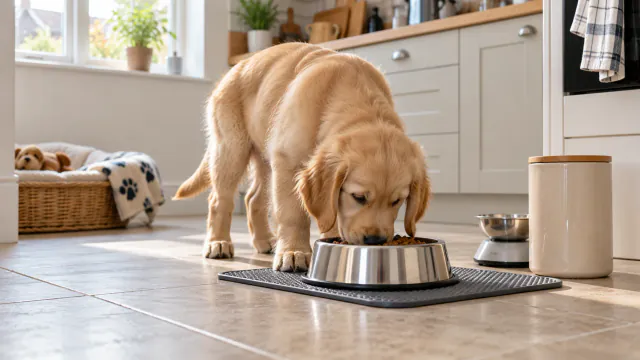
A useful puppy feeding schedule is a repeatable pattern of measured meals, not a universal chart that says every puppy must eat at the same age and hour. The number of meals depends on the puppy’s age, size, food and individual needs. The daily amount comes from the chosen food’s growth-stage guidance and the puppy’s expected adult size, then changes as the puppy grows. PDSA advises dividing a puppy’s daily allowance into small meals across the day; smaller puppies may need more frequent meals. Ask your vet for an individual plan if your puppy is very small, unwell, failing to grow as expected or has a prescribed diet.
Build the schedule from the daily allowance
Read the packet’s daily feeding table for your puppy’s current age and expected adult weight. Weigh the total daily amount first, then divide it across the meals your puppy needs. Include food used in training within that daily allowance. A cup or scoop is less reliable than kitchen scales because the same volume can hold different weights of kibble. Our guide to reading dog food labels explains which figures to look for.
If you feed wet and dry food together, each packet’s full daily allowance assumes it is the only food. Do not add both full allowances. Work from the energy information and ask the food maker or your vet how to combine them if the labels do not give a mixed-feeding guide. The dog food calculator can provide a starting calorie estimate, but the packet and your vet’s advice take precedence.
Recommended products
Bowl
Classic Super Premium Stainless Steel Slow Feeder
Stainless steel slow feeder with a moulded centre, in small and medium.
View product : Classic Super Premium Stainless Steel Slow Feeder at Amazon, affiliate link, opens in a new tabSlow feeder
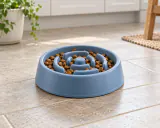
Outward Hound Fun Feeder Slo Bowl
Bowl with moulded ridges that make a fast eater work around them.
View product : Outward Hound Fun Feeder Slo Bowl at Amazon, affiliate link, opens in a new tab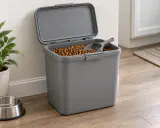
Food storage container
simplehuman Pet Food Storage Container
Airtight bin with a lid-mounted scoop for storing dry food.
View product : simplehuman Pet Food Storage Container at Amazon, affiliate link, opens in a new tab
A sample day, not a prescription
For a puppy currently eating four meals, a household might offer breakfast, a midday meal, a late-afternoon meal and an evening meal. Another puppy may be on three or two meals as it matures. Choose times the household can keep reasonably consistent, with enough room for toileting after eating and quiet rest. The pattern matters more than exact clock times. The puppy daily routine shows how meals fit alongside sleep, training and toilet trips.
Do not remove a meal simply because a puppy has reached an age printed in a generic online chart. Ask your vet when to reduce meal frequency for your own puppy, particularly a toy breed or a puppy with a health concern. When the number of meals changes, keep the daily amount under review rather than giving the old portion at every new meal.
Review the plan as your puppy grows
Weigh your puppy regularly and note whether appetite and body condition are changing. The feeding table is a starting point, not a target to force. PDSA recommends adjusting the amount as a puppy ages and asking a vet about concerns. A sudden refusal to eat, repeated vomiting, diarrhoea, lethargy or poor growth needs veterinary advice rather than a new timetable.
If you change foods, follow a gradual food transition instead of changing the food and meal pattern on the same day. For the reasons growth food differs from adult food, see puppy feeding principles. For a UK buying checklist, see Best Dog Food for Puppies.
Common questions
Should I leave puppy food out all day?
Measured meals make it easier to notice an appetite change and know how much the puppy ate. A vet may advise a different pattern for an individual puppy.
Can training treats replace a meal?
Use some of the measured daily ration as training rewards where practical. Treats are part of total intake, not a free extra. Check any dietary restriction with your vet.