
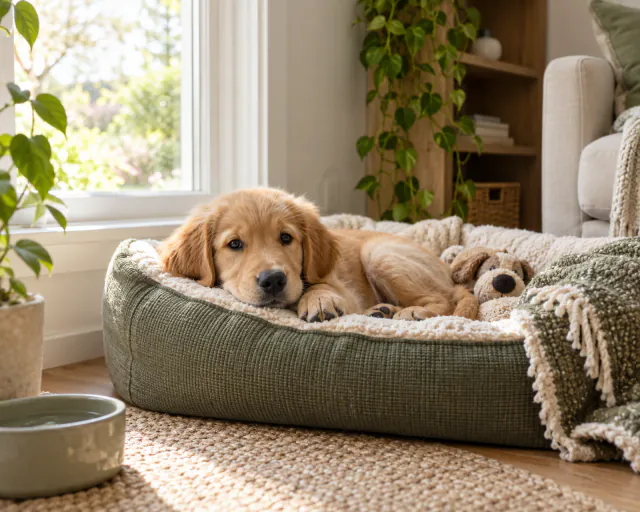
Once the first week has passed and the initial adjustment has settled, the question most owners land on is what an actual day should look like. There is no single correct timetable, because a puppy’s age, breed, temperament and household will all pull it in different directions, but there is a shape that tends to work: short blocks of activity, generous blocks of sleep, and frequent opportunities to toilet, repeated in a loose cycle through the day rather than a single long block of wakefulness followed by a single long sleep.
Getting this shape right matters more than most owners expect. A puppy whose day is built the wrong way round, long stretches of activity with sleep squeezed into the gaps, tends to become the puppy who is bitey, hyperactive and seemingly impossible to settle in the evening, not because anything is wrong with the puppy but because the day has been built on a false assumption about how much rest they actually need.
The basic building block: wake, go, do something, sleep
A useful way to think about a young puppy’s day is as a repeating cycle rather than a single timeline. After waking, take them to the toilet spot promptly, since a full bladder after sleep is one of the most reliable toileting moments of the day. After that, a short window of activity follows: play, a little food-based training, some calm exploration or a very short walk once that is appropriate for their age and vaccination status. Then, as that window winds down, guide them towards rest rather than waiting for them to collapse on the kitchen floor mid-game. Repeat this cycle through the day, with the active windows generally getting a little longer as the puppy gets older.
Sleep is not the gap between activities, it is the point
Very young puppies need substantially more sleep across each day than most new owners expect, and a lot of that sleep needs to happen in short, frequent bursts rather than one long block. The common mistake is treating sleep as something that happens if there is time left over, after visitors, walks, play and training. In practice it needs to be built into the plan on purpose. Overtiredness in a puppy rarely looks like a tired dog; it usually looks like frantic zooming, sudden bursts of biting, or a puppy who cannot settle even when clearly exhausted. If the evenings are consistently difficult, the fix is very often an earlier, more deliberate nap earlier in the day rather than more exercise or more stimulation. The specifics of normal sleep patterns and how to set up a good sleeping space are covered in puppy sleep.
Toileting opportunities belong at the joints of the day
Rather than trying to remember toileting as a separate task, attach it to the natural joints in the daily cycle: after waking, after eating, after a play session, and last thing before bed. These are the moments a puppy is most likely to need to go, and building trips around them catches far more opportunities than waiting for signs of needing to go and hoping to spot them in time. The detailed method for building this into a reliable habit, including what to do about accidents, is covered in puppy toilet training routine.
Keep training sessions short and spread through the day
Formal training does not need its own slot in the schedule. A handful of very short sessions, a minute or two each, worked into the natural pauses of the day, generally achieves more than one longer session and tires a young puppy’s brain without adding physical exhaustion. Before a meal, during a lull between naps, or while waiting for the kettle to boil are all reasonable moments for a few repetitions of something the puppy is currently learning.
Keep the pattern loose rather than rigid
A daily routine is a guide for the household, not a contract the puppy has to honour. Puppies vary day to day in how much sleep they need, how hungry they are, and how ready they are for activity, and a routine that cannot flex around an unusually sleepy or unusually lively day will cause more stress than it saves. Aim for a consistent order of events, wake, toilet, activity, toilet, sleep, repeat, rather than a fixed clock time for each one. Consistency of pattern matters far more to a young puppy than consistency of timing down to the minute.
Expect the routine to change as they grow
The shape of the day at eight weeks old will not be the shape of the day at five or six months. As a puppy matures, sleep needs gradually reduce, active windows lengthen, and the number of naps needed across the day drops. Rather than clinging to an early routine out of habit, keep adjusting it in the same direction the puppy is naturally moving: fewer, longer periods of rest, and longer, more varied periods of activity in between. A routine that keeps pace with a growing puppy, rather than one fixed on day one and left unchanged, is what actually makes life predictable for both the puppy and the household over the following months.