- Session length
- A few minutes, seven or more times a day around waking, eating, drinking and play
- Skill
- Foundations
- Suits
- Puppy
What you need
- A lead and well-fitted flat collar or harness, even for garden trips
- Small soft treats kept by the door for immediate rewarding
- An enzymatic cleaner for any indoor accidents, rather than a standard household cleaner
Toilet training goes wrong far more often because of an inconsistent routine than because of a difficult puppy. A young puppy has very little bladder and bowel control and cannot generalise “outside” from one part of the garden to another the way an adult dog can, so the job is to build a specific, predictable pattern around a fixed spot and a fixed schedule, then reward the exact moment it works. Punishing accidents does nothing useful, because a puppy cannot connect a reaction from you minutes later to something they did earlier.
Purpose
To teach your puppy to eliminate in one consistent, chosen location, on a schedule tied to their natural rhythms of waking, eating, drinking and play, and to build that into a routine reliable enough that accidents become rare. This matters because a puppy who learns a specific spot and a specific pattern early settles into reliable house manners far sooner than one given free run of the house or garden from the start.
Prerequisites
A confinement area or crate your puppy is already comfortable resting in, covered in the previous lesson, and a single consistent spot, either outdoors or an area set up with puppy pads, where you want your puppy to go. Decide on that spot before you start, since changing it partway through slows the whole process down.
Equipment
A lead and a well-fitted flat collar or harness, used even for short garden trips in the early weeks, so your puppy is guided to the chosen spot rather than free to wander and go somewhere different each time. Small treats kept ready by the door mean you can reward within a couple of seconds rather than fumbling for food afterwards. Keep an enzymatic cleaner on hand for indoor accidents, since ordinary household cleaners can leave a scent trace that draws a puppy back to the same spot even after the mark looks gone.
Method
- Set a fixed schedule built around your puppy’s natural triggers: immediately on waking, within a few minutes of eating or drinking, after any burst of play or excitement, and roughly every one to two hours in between for a very young puppy.
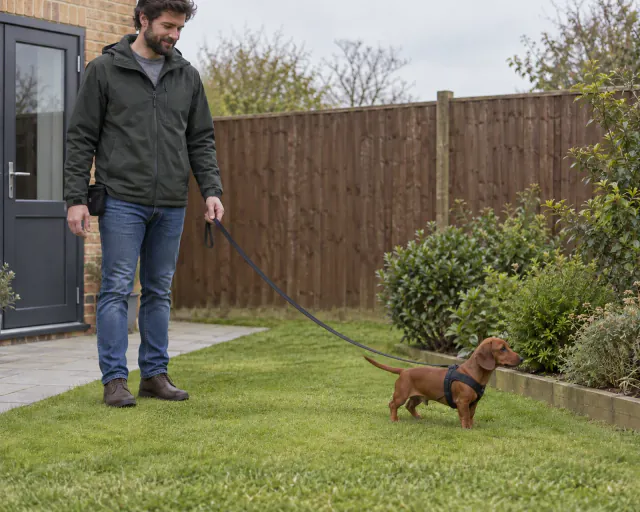
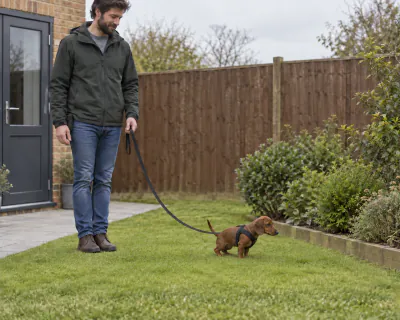
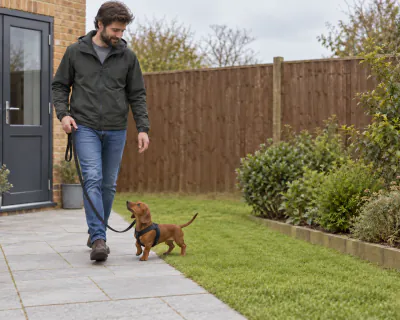
- Take your puppy out on lead to the same chosen spot each time, rather than releasing them for free run of the garden, so the smell and location become part of the cue.
- Stay quiet and fairly still while you wait. Avoid talking, playing or offering attention, since an overly social outdoor trip can turn into playtime instead of a toilet break.
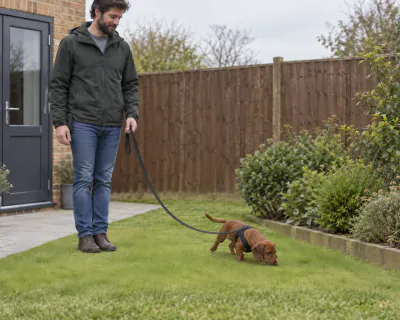
- Give your puppy a few minutes to sniff and settle before assuming nothing is going to happen. Puppies often need to move around and circle before they are ready.
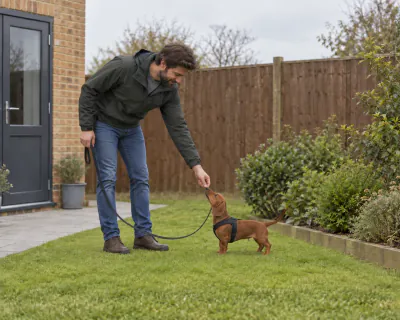
- The moment your puppy finishes, not while they are still going, mark and reward with a treat delivered right there at the spot, within a couple of seconds. Rewarding once you are back inside disconnects the reward from the act.
- If you use a cue word, say it quietly while your puppy is in the act of going, repeated calmly over many successful trips, so it eventually becomes something you can ask for on cue.
- If nothing happens within a few minutes, go back inside and either supervise your puppy closely with eyes on them at all times or return them briefly to their confinement area, then try again in ten to fifteen minutes rather than granting free access to the house.
- Manage the environment rather than relying on vigilance alone. Between scheduled trips, keep your puppy within sight, on a lead indoors if needed, or in their pen or crate, so accidents are prevented rather than caught after the fact.
Session length
Each outdoor trip takes a few minutes, but the schedule itself runs continuously through the day, typically seven or more trips for a young puppy, tapering as bladder control develops over the following months.
Progression criteria
Move on from close supervision once your puppy reliably chooses the designated spot and eliminates within a few minutes of arriving, on eight or nine occasions out of ten across a full week, with no indoor accidents during that period. Then raise the challenge one variable at a time. First stretch the gap between scheduled trips by around fifteen minutes, but only while your puppy is consistently comfortable and empty at each trip. Once that holds, loosen supervision indoors by allowing access to one additional connected room while still watching closely. Only after both of those are solid should you introduce a distraction such as a visitor arriving, rather than changing the schedule and the household activity at the same time.
Common mistakes
Giving a puppy free run of the whole house, or the whole garden, before the routine is established makes it far harder for them to learn one specific spot. Rewarding back indoors instead of at the location where the puppy actually went weakens the connection between the two. Scolding or cleaning up in an obviously frustrated way in front of the puppy, even without shouting, can teach a puppy to hide when they need to go rather than to ask to go outside. Letting different household members run different schedules, or reward at different moments, slows the puppy down because the pattern keeps changing.
Troubleshooting
If your puppy circles and sniffs but does not go, give a little more time before giving up, and avoid cleaning every trace of scent from the chosen spot, since a faint smell there is part of what tells the puppy where to go. If accidents keep happening in one particular indoor spot despite thorough cleaning, treat that area as off-limits with a barrier or furniture until the pattern breaks. If a puppy who has been reliable for some time suddenly starts having frequent accidents, treat that as a signal rather than a training lapse; a urinary tract infection or other medical issue can produce exactly this kind of regression, and a vet check is the right first step before assuming the training has failed.
Safety and when to stop
Never punish an accident after the fact, including scolding, rubbing a puppy’s nose in it or raising your voice at the mess; none of this teaches the puppy anything useful about where to go, and it risks teaching them to be afraid of eliminating in front of you at all, which makes the whole process harder. Keep outdoor toilet trips in your own garden or another private, secure area until your vet confirms your puppy’s vaccination protection is complete, since public ground carries disease risks for a puppy who is not yet fully covered. In cold weather, keep trips brief, since a young puppy loses body heat quickly and there is no benefit to lingering outside once the job is done.
Next lesson
With a settled toileting routine in place, move on to bite inhibition and mouthing, which addresses the other everyday puppy behaviour most households ask about early on.
Related reading
Much of the groundwork for this lesson, washable flooring, an accessible route to the garden and a stock of enzymatic cleaner, is worth sorting out in advance. See our guide on preparing your home for a new puppy for the practical setup.