Almost everything about the first fortnight is easier if the house is ready before collection day. Barriers, floors, cables and fencing are far simpler to sort out while there is no puppy underfoot, and the jobs below take an afternoon between them.
This guide is about the building and the ground it sits on. It covers the layout you will live with, the hazards at floor level, the garden, the rest area and the journey home.
Decide how big the puppy’s world will be
Choose which rooms the puppy may use for the first couple of weeks and make that decision physical rather than theoretical. A puppy with the run of a whole house will toilet where you cannot see it and chew things you will not find until later. Two connected rooms with washable flooring, usually a kitchen and one adjoining space, is enough.
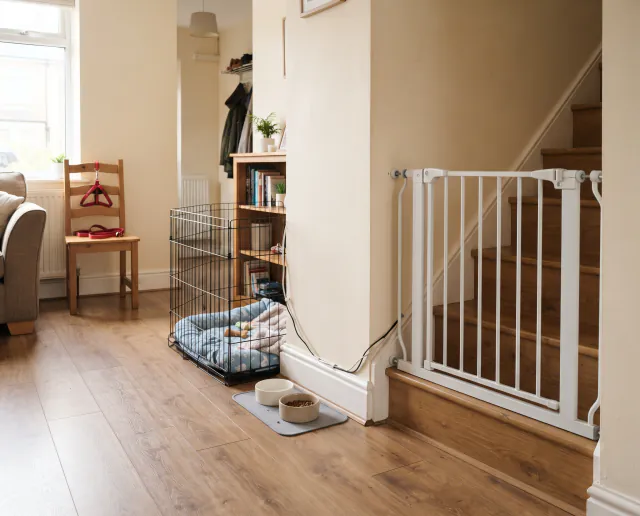
Fit a stair gate at the bottom of the stairs and, if bedrooms matter to you, at the top as well. A gate at the head of a staircase should be screwed to the wall rather than pressure fitted. Check the bar spacing, because gates sold for toddlers can let a small puppy through sideways. The dog gate guide compares fitting methods, heights and bar spacing. A folding pen is the other useful barrier, since you can move it into whichever room you are working in and take the puppy with you.
Work out the shortest route from your back door to the garden toilet spot and clear it. You will walk it many times a day, often in the dark and in slippers.
Go through each room at floor level
Kneel down in every room the puppy will use and look along the floor. Things that are invisible at standing height become obvious from there.
- Trailing cables, phone chargers, aerial leads and extension blocks
- Looped cords on blinds and curtains
- Handbags and coat pockets holding medication, chewing gum or keys
- Houseplants, cut flowers and their water
- Bins, laundry baskets, shoes, socks and small children’s toys
- Cat litter trays and any food left down for another animal
Move what you can and box in what you cannot. Cable trunking and a few clips deal with most of the wiring. Fit child locks to the cupboards holding cleaning products, and get into the habit of shutting the dishwasher and closing the oven and washing machine doors. Doors that swing shut in a draught should be wedged or fitted with a soft stop.
Sort out floors, stairs and furniture
Laminate, tile and vinyl give a puppy no grip. Skidding on a hard floor is uncomfortable at best, and a bad landing off a sofa can injure a young joint. Lay washable non-slip runners along the routes the puppy will run, especially between the back door and the kitchen.
Roll up rugs you care about and store them for a few months. Accidents will happen while toilet training is in progress, and a soft absorbent surface is exactly what a puppy heads for. Keep a stock of washable bedding and an enzymatic cleaner in the cupboard from day one.
Decide before arrival whether the puppy is allowed on the sofa, then make it possible to enforce. Puppies with long backs or short legs, such as a Dachshund, should not be jumping down from furniture at all, so provide steps or a ramp if you are going to allow it later.
Make the garden secure
Walk the boundary from the inside, then look at it again from the outside. You are checking for gaps under fence panels, loose feather boards, gaps beside the gate posts and any point where a puppy could push, dig or squeeze through. Fifteen centimetres of clearance under a gate is an exit. Fit a bolt or a lock to the side gate so a delivery driver cannot leave it swinging.
Then deal with what is in the garden. Cover or fence ponds and water butts. Move slug pellets, weedkiller, fertiliser, rodent bait and antifreeze into a locked shed or a high shelf in the garage. Block the gaps under sheds and decking. Lift netting, canes and string. Check which plants you have and remove or fence anything you are unsure about, then ask your vet about anything you cannot identify.
British winters make this practical rather than ornamental. A small area of hardstanding or slabs near the door, and a light that reaches it, means you are not standing in mud at two in the morning waiting for a puppy to finish.
Build the rest area
Put the bed where the household can be heard but not walked through. Beside a wall, out of the draught from the back door, away from a radiator and clear of direct sun through a window is usually right. Two beds are more useful than one, so the puppy can rest near you in the evening and still have a quiet option.
Set up the crate or pen a few days early and leave the door open so it is simply part of the furniture. If you plan to use one, read up on crate training before the puppy arrives rather than working it out on the first night. Keep a spare set of bedding washed and ready for the small hours.
Prepare the car and the journey home
Fit and test the travel setup before collection day. A secured crate or carrier in the boot, or a tested harness restraint on a back seat, is safer than a puppy loose on a lap. Line it with something absorbent and take spare towels, kitchen roll, waste bags and water.
Keep the journey quiet. One person can sit within reach of the puppy without handling them constantly. On a long drive, stop to offer water, but keep the puppy off the ground in public places until your vet confirms vaccination protection is complete.
Agree the household rules first
Write down who does the first toilet trip, who feeds, where the puppy sleeps and what everyone says for each cue, then stick the list somewhere visible. Puppies learn faster when the answer to a question does not change depending on which person is in the room.
Tell children the bed area is out of bounds while the puppy is in it, and teach everyone to check behind them before stepping back. Once the house is set up this way, you can spend the first week on the puppy instead of on shopping trips, which is exactly what the first few days need.