
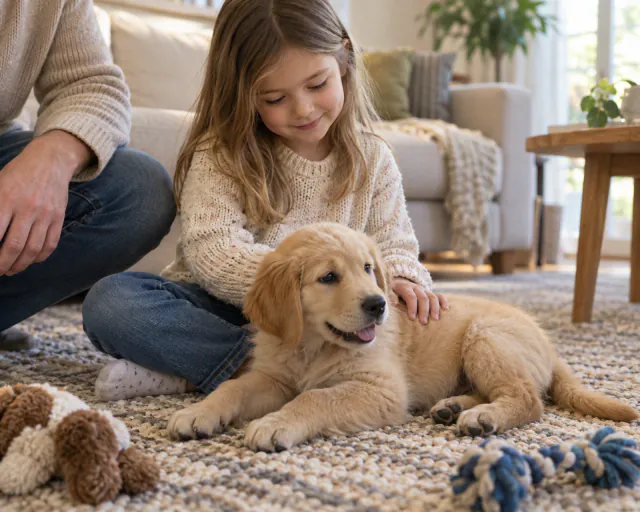
A puppy and a child can build one of the best relationships in a household, but the early weeks are where that relationship either starts on solid ground or picks up habits that cause problems later. Both are inexperienced: the puppy has no understanding yet of how to behave gently around a smaller, faster, less predictable human, and most children have no real sense of how a puppy communicates discomfort before it escalates to a growl or a nip. The gap between them is bridged by adult supervision and clear rules, not by hoping things naturally work out.
None of this means children and puppies should be kept apart. It means the early weeks need active management rather than the assumption that goodwill on both sides is enough, and that assumption is where most avoidable incidents come from.
Supervision is the standard, not trust
However calm a puppy seems, or however sensible a child is normally, puppies and children should not be left alone together, even briefly, even in a familiar room, and even alongside an experienced older family dog who is not the puppy at all. This is not a comment on any particular child or puppy, it is a recognition that both are still learning and that things can escalate faster than an adult in another room can respond to. A parent stepping out to answer the door, take a phone call or deal with something on the stove is exactly the kind of moment incidents happen in, so build the habit of taking the puppy with you, or briefly separating them, rather than trusting the situation to hold for a few minutes.
Teach children specific, concrete rules
Vague instructions like “be gentle” or “be nice to the puppy” do not give a child anything to actually do differently. Specific rules work far better: stroke along the side of the body rather than patting the head, let the puppy come to you rather than reaching for them or picking them up, and never disturb a puppy who is eating, chewing something, or resting in their bed or crate. Teach children to recognise the early signs that a puppy has had enough, turning away, moving off, becoming stiff or still, so they can step back before the puppy needs to escalate to a growl or a snap to get the same message across. A puppy who growls when uncomfortable has communicated clearly and should never be told off for it, since punishing the warning removes the warning rather than the underlying discomfort.
Give the puppy a retreat space children respect
Every puppy needs somewhere they can go to be left alone completely, whether that is a crate, a pen or simply a particular bed in a quiet corner. The rule attached to that space needs to be absolute and understood by every child in the household: nobody follows the puppy there, nobody reaches in, and nobody wakes them if they are asleep. A puppy who cannot fully switch off because their retreat space is regularly interrupted tends to become more reactive generally, not just around the interruptions themselves.
Involve children in calm training moments
Rather than keeping children entirely separate from training, involve them in short, calm, structured moments once the basics are underway. A child holding a treat pouch and rewarding a puppy for sitting, or gently working through a settled handling exercise under adult supervision, builds a genuinely useful relationship and gives the child a constructive role instead of unstructured excited play. Calm, low-key greetings when a puppy first arrives home or comes in from outside are a good place to start, and the approach is set out in calm greetings. Because mouthing is one of the most common flashpoints between puppies and children, it is worth every adult in the household understanding the approach in bite inhibition and mouthing before problems start, rather than after a first painful nip.
What to do if something goes wrong
If a puppy growls, snaps or nips at a child, treat it as information rather than a crisis to be punished away. Work out what happened immediately before it, whether the puppy was disturbed while resting, cornered, hurt, overtired or simply overwhelmed, and adjust supervision and rules accordingly rather than assuming the puppy is simply badly behaved. A single growl with an obvious, avoidable trigger is very different from a pattern of unpredictable aggression, and the latter warrants professional advice from a vet, to rule out pain or illness, and potentially a qualified behaviourist rather than home management alone.
Building the relationship over time
A good relationship between a child and a puppy is built gradually, through repeated calm, positive, well-supervised interactions rather than through a single dramatic bonding moment. Over the following months, as the puppy matures and the child gets more practice reading canine body language, the amount of direct supervision needed generally reduces, but it reduces because trust has been earned through consistent good experiences, not because enough time has simply passed.