Most first-time owners are not short of effort. They are working hard on the wrong things, or working hard on the right things at the wrong moment, and the puppy is telling them so through biting, toileting indoors, screaming in the crate or refusing to come back in the garden.
What follows is a set of diagnoses. Each one describes a pattern that turns up again and again in the first six months, what is actually going on underneath it, and the change that fixes it.
Filling the day and cutting the sleep
The most common mistake is treating a puppy like an under-exercised adult dog. A puppy who is bitey in the evening, cannot stop chasing feet, grabs clothing, races in circles or barks at nothing is usually overtired rather than under-stimulated, and the standard response of adding another walk or another game makes it worse.
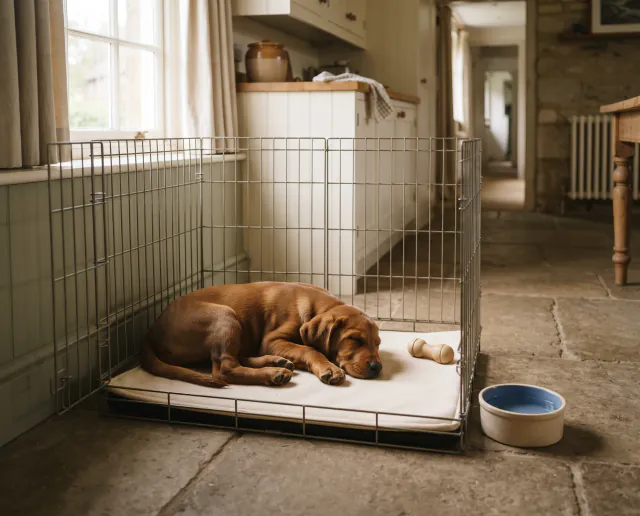
Young puppies sleep for a very large part of every twenty four hours, and they rarely take that sleep unaided in a busy room. Build the day around rest. After roughly an hour of being awake, put the puppy somewhere quiet with something to chew and let them drop off. If the frantic behaviour arrives at the same time each evening, move a nap earlier rather than adding activity.
Judge exercise by recovery, not by distance. A puppy who comes home and sleeps has had enough. A puppy who comes home wired has had too much of the wrong kind.
Treating toilet accidents as disobedience
Puppies do not toilet indoors to make a point. They go where they happen to be when the need arrives, and an accident nearly always means a missed opportunity rather than a stubborn dog.
Scolding, pointing at the mess or putting the puppy outside afterwards teaches the puppy that toileting near you is dangerous, which produces a dog who sneaks behind the sofa and one who will not perform in front of you in the garden. Say nothing, clean it with an enzymatic cleaner so the smell is genuinely gone, and shorten the interval between trips.
Go outside with the puppy every time. Reward within a second or two of them finishing, while they are still on the spot. Standing at the back door watching from indoors teaches nothing, because you cannot reward what you cannot reach.
Doing socialisation as a numbers game
Owners are told that socialisation matters, so they aim for volume: as many dogs, people and places as possible before sixteen weeks. A puppy dragged into a busy park, passed around a room of visitors, or lifted into the middle of something frightening learns that new things are overwhelming.
The opposite error is just as common. Waiting until vaccination protection is complete and doing nothing at all in the meantime wastes the weeks that matter most.
Work at a distance the puppy can handle, keep sessions short, let the puppy choose whether to approach, and end while they are still relaxed. If the puppy stops taking food, the session is already too much.
Getting the biting wrong
Puppy mouthing is normal, and almost every household escalates it by accident. Pulling a hand away quickly, squealing, wrestling with hands, pushing the puppy off or holding the muzzle all make the game better or make the puppy defensive.
Keep a toy within reach in every room so there is always something legal to redirect onto. When teeth land on skin, stop moving, get up calmly and step away for a few seconds, then return and offer something appropriate. Feed some meals through a food toy or a licking activity, since chewing and licking both settle a puppy in a way that another game of tug does not.
Watch the timing. Biting that spikes at predictable moments is nearly always tiredness, and the answer is sleep, not correction. Never use aversive responses such as shouting, smacking, holding the mouth shut or spraying water. They increase fear and make the mouth more of a problem, not less.
Everyone teaching something slightly different
One person says down for lie down, another says down for get off the sofa, a third lets the puppy on the sofa when they are on their own. The puppy is not being difficult, it has been given contradictory information and is guessing.
Write the household rules on one sheet: the exact word for each cue, who does which meal, whether furniture is allowed, and what happens when the puppy jumps up. Everyone follows the same list, including visitors and children. Consistency across people improves behaviour faster than extra training sessions do.
Buying equipment instead of building the skill
When a puppy pulls, the reflex is to buy something. Equipment changes what the pulling feels like at the human end. It does not tell the dog what to do instead, and anything designed to work through discomfort, including slip leads used to correct, choke chains and prong or electric collars, damages trust and often makes fear-based behaviour worse.
Fit matters and comfort matters, and the choice between a harness and a flat collar is worth getting right. Then teach the skill separately, in short sessions, somewhere quiet. Retractable leads deserve a particular mention, because they teach a dog that pulling extends the lead.
Waiting too long to ask for help
Owners tend to wait, hoping a behaviour will be grown out of. Some are. Guarding food or objects, growling at people approaching the bed, panic when left alone, or fear that is worsening month on month will not be.
Book a vet appointment first, because pain and illness change behaviour, and a dog who has started guarding or snapping may be sore. Then find a qualified reward-based trainer or, for anything involving fear or aggression, a clinical animal behaviourist. Puppy classes are worth attending early, ideally ones that keep groups small and give the puppies time to settle rather than an hour of unstructured play. Getting help at five months is a far smaller job than getting help at two years.