A ten or fifteen minute consultation goes a long way further when the groundwork has already been done. Vets work through a huge amount of information in a short appointment, and much of that time can be spent asking questions you could have answered in writing beforehand, rather than examining your dog or discussing what to do next. This matters most for a routine check-up, a mild ongoing concern, or a follow-up, where there is time to prepare properly, as opposed to an emergency where you simply need to get there.
This guide covers what to bring, how to describe a concern usefully, and how to help an anxious dog arrive in a state where the vet can actually examine them. It assumes a scheduled or non-urgent visit. If your dog has a sudden or worsening symptom and you are deciding whether to call rather than book ahead, the companion guide on what to record before calling your vet covers that situation instead.
Write the history down before you go
If you are booking about a specific concern, write down when it started, whether it has changed since, and any pattern you have noticed, such as it being worse after exercise, in the evening, or after eating. Note anything you have already tried, including any change of food, bedding or routine, and whether it made a difference. A vet can ask you these questions in the room, but a written note means you are not trying to recall exact dates and details under time pressure, and it stops important details getting lost if a locum or a different vet at the practice sees your dog.
Bring a current list of everything your dog eats and takes regularly, including the exact food and brand, treats given often, any supplements, and any medication with its name and how often it is given. Owners frequently forget to mention a supplement or an occasional medication because it has become routine, and that gap can matter. If your dog is on a repeat prescription, bring the packaging or a note of the exact product name rather than a description.
If you are seeing a new practice, or the appointment concerns an ongoing issue that has previously been seen elsewhere, request that your dog’s records are transferred or bring a summary yourself. Most practices can request records from a previous practice directly, but this can take time to arrive, so ask early rather than the day before.
Practicalities that make the visit smoother
Confirm what the practice needs from you before you arrive. Some ask you to withhold food before certain procedures, some want a urine or stool sample, and appointment systems vary considerably between countries and even between individual practices: some offer telephone or video triage before deciding whether a physical visit is needed, some have dedicated same-day slots for non-urgent concerns, and some require a longer wait for a routine booking than others. If you are not sure what a booking involves, ask when you make it rather than assuming it matches what you are used to elsewhere.
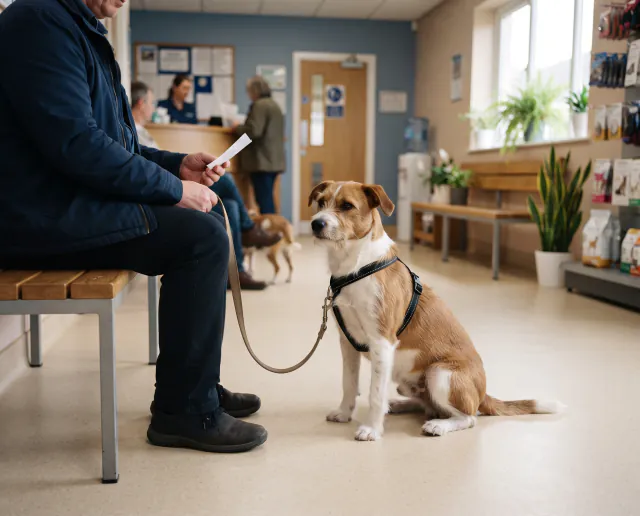
Think through transport in advance. A secure crate or carrier for a small dog, a well-fitted harness rather than a collar alone for a dog that might pull or panic, and a lead that is long enough for the waiting room but short enough to keep control near other animals all reduce stress on the journey and in reception. Bring water and, for a long journey or a dog prone to travel sickness, plan stops rather than pushing straight through.
Arrive calm, not wound up
A dog that arrives in a heightened state, whether from a stressful car journey, an overexcited greeting of other dogs in the waiting room, or being rushed out of the door at the last minute, is harder to examine accurately and more likely to find the whole experience unpleasant. Heart rate, breathing rate and even reported pain response can shift with stress, so a calmer dog gives the vet a more accurate picture as well as an easier one.
Arrive a little early rather than exactly on time, so there is no rush at the door, and use those extra minutes in the car or a quiet corner rather than in the middle of a busy waiting area if your dog finds other animals overwhelming. Many practices will let you wait outside or in the car and come in when called if you ask. For a dog who finds handling, restraint or the clinical environment genuinely difficult, working through a structured desensitisation routine between now and future visits, such as the one in preparing for veterinary handling, makes a real difference over time, though it will not transform a single upcoming appointment.
Bring a few small pieces of your dog’s usual food or a favourite treat, checked as suitable beforehand if there are dietary restrictions, so the vet or nurse can use it to build a positive association during the visit if your dog is receptive to food away from home.
Ask before you leave
Before the appointment ends, make sure you understand what has been found, what if anything needs to happen next, and what would prompt you to come back sooner than planned. If a medication or treatment has been prescribed, confirm exactly how to give it, for how long, and what side effects would be worth reporting, since instructions given verbally are easy to misremember once you are home. Ask the practice to write down anything complex rather than relying on memory.
If nothing conclusive was found and you have been asked to monitor the situation, ask what specifically to watch for and over what timeframe, so you know when “keep an eye on it” has turned into “this needs another visit.” It is reasonable to ask the vet to explain something again if you did not follow it the first time, and reasonable to ask what the reasoning is behind a recommendation if you want to understand it better, particularly for anything ongoing like a change of diet or a repeat medication.
Keep your own record afterwards
After the visit, note down what was said, any diagnosis given in plain terms, and any instructions, even if the practice also provides written aftercare notes. This becomes useful if you see a different vet at a future visit, if a locum covers for your usual vet, or if you eventually move to a different practice or a different country and need to summarise your dog’s history quickly. A dog with a well-kept history, even a simple one kept by the owner, tends to get more efficient and better-targeted care over a lifetime than one whose history exists only in scattered memory and paperwork.