Weight alone is a surprisingly poor measure of whether a dog is in good condition. Two dogs of an identical weight can look and feel completely different depending on their frame size, height, bone structure and how much of that weight is muscle rather than fat. A vet or veterinary nurse assessing a dog for the first time will typically look at weight as only one part of the picture, alongside a hands-on body condition score, and increasingly a separate assessment of muscle condition too. This guide explains how that scoring approach works and why the two assessments, fat and muscle, are not the same thing.
None of this is a substitute for a professional assessment. It is background so that the concepts make sense when a vet or nurse explains them, and so that a hands-on check at home means something once it has been learned properly.
What body condition scoring actually measures
Body condition scoring is a hands-on system for judging how much fat covers a dog’s frame, independent of its actual weight in kilograms or pounds. Most veterinary scoring systems run on a numbered scale, commonly nine points, with the middle of the scale representing an ideal body condition and the two ends representing progressively more severe underweight and overweight states.
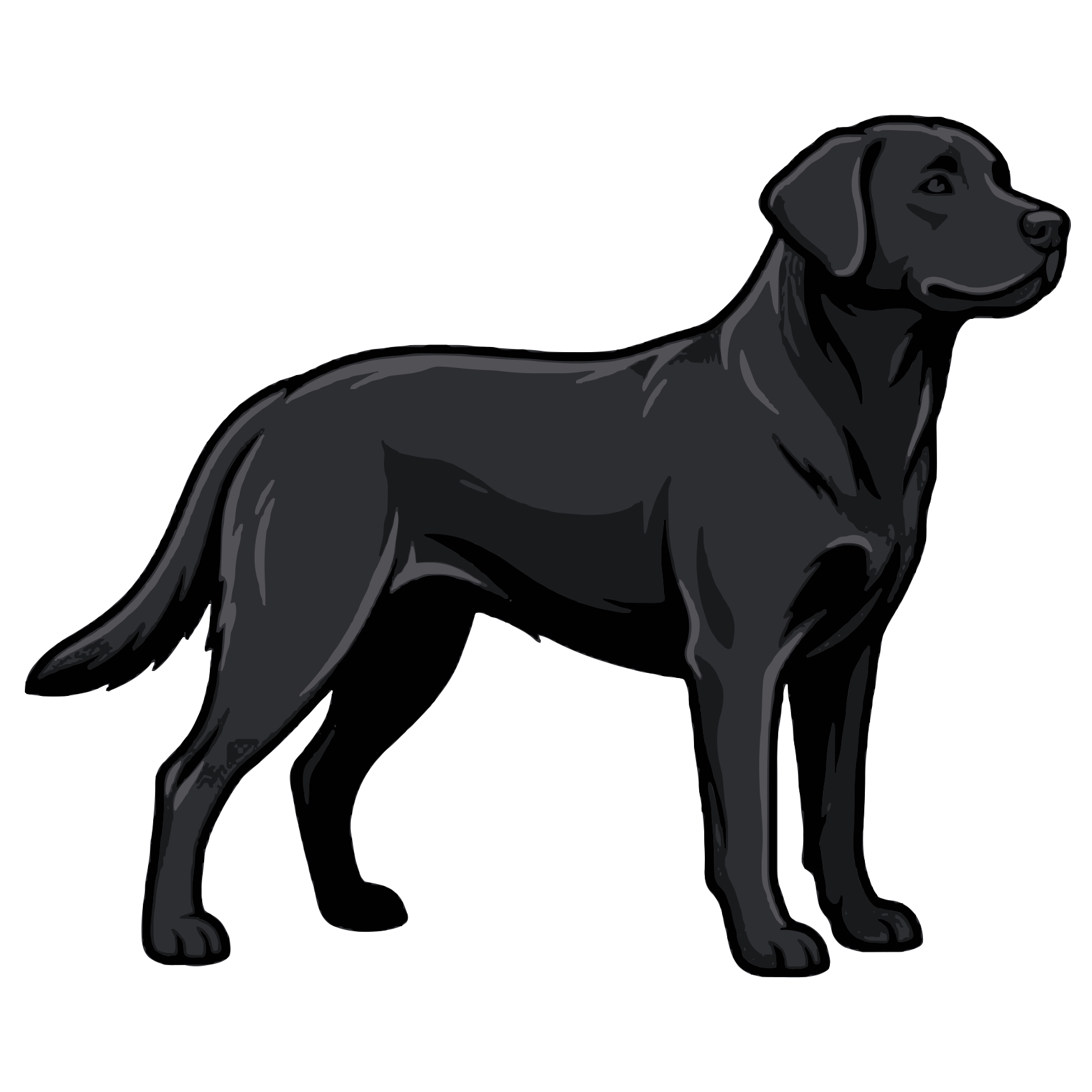
At an ideal score, ribs are easily felt under a slight covering of fat without needing to press hard, and individual ribs are not visible in a short-coated dog standing normally. Viewed from above, there is a visible waist behind the ribcage, a narrowing between the ribcage and the hips rather than a straight or bulging line. Viewed from the side, the abdomen tucks upward behind the ribcage rather than hanging level with the chest or sagging below it.
Moving down the scale toward underweight, ribs, spine and hip bones become easy to see as well as feel, the waist becomes exaggerated, and there is minimal fat cover anywhere on the body. Moving up the scale toward overweight, ribs become difficult to feel under a thicker fat layer, the waist disappears or bulges outward, and fat deposits appear over the base of the tail, the lower back and the chest. At the most overweight end of the scale, heavy fat deposits accumulate over the chest, spine and the base of the tail, the abdomen distends visibly, and there is no waist at all from any angle.
Why weight alone misses this
A tall, heavy-boned dog and a stockier dog of the same breed can weigh the same number on the scale while sitting at completely different points on a body condition scale, because their frames simply carry different amounts of muscle and bone at a healthy weight. A dog that has recently gained noticeable muscle from an active job or sport can also weigh more than expected for its size without carrying any extra fat at all.
This is why a target weight taken from a chart or a breed average, without reference to the individual dog’s actual frame and condition, can be misleading in either direction. A vet setting a genuine target weight for a specific dog uses body condition scoring, along with the dog’s own history and frame, rather than reading a number off a generic table.
Muscle condition is a separate assessment from body fat
Body condition scoring measures fat cover. It does not directly measure muscle. A dog can score in the ideal range for body fat while still losing muscle mass, particularly over the spine, shoulders and hindquarters, and this distinction matters because muscle loss can be an early sign of illness, of reduced activity, or a normal but still important part of ageing that benefits from attention.
This is why veterinary nutrition guidance increasingly assesses muscle condition alongside body fat condition rather than treating a good body condition score as the whole picture. Muscle condition scoring typically looks separately at areas such as over the shoulder blades, along the spine, and over the hips, feeling for how much muscle sits under the skin in those areas compared with the bone structure beneath it, and classifies muscle loss as mild, moderate or severe rather than combining it into the same score as fat cover.
The practical significance is that a dog described as “a healthy weight” is not automatically in good overall condition. A thin-looking dog with poor muscle tone across the back and hindquarters is a different concern from a lean, well-muscled dog of the same visual silhouette, even though both might look broadly similar standing still. Equally, an overweight dog can still be reasonably well muscled underneath the fat cover, which changes how a vet might approach weight management compared with an overweight dog that has also lost significant muscle. This is one of the reasons a hands-on professional assessment, covering both fat and muscle, gives a far more useful picture than an owner’s visual impression from across the room.
Learn the hands-on check with a professional first
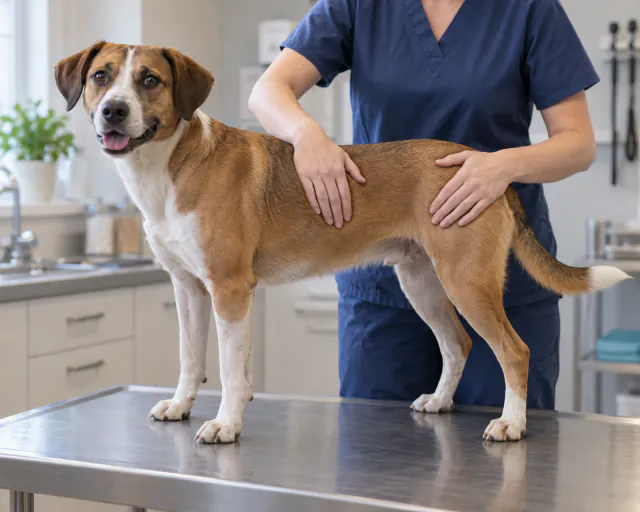
Coat length, coat thickness and grooming style can hide a surprising amount, which is why body and muscle condition are assessed by feel rather than by eye. A dog can look trim in a photograph and feel quite different under the coat, in either direction.
The most useful way to learn this is to ask a vet or veterinary nurse to talk through the assessment on your own dog, showing you exactly where and how firmly to feel for ribs, spine and hip bones, and where to check for muscle loss over the shoulders and hindquarters. Once shown, most owners can repeat a rough version of the check at home between veterinary visits, which is useful for noticing gradual change early. It is not a replacement for a periodic professional assessment, particularly for muscle condition, which takes more practice to judge reliably than fat cover does.
Using condition scoring alongside everyday feeding and activity
Body and muscle condition are the two things that should actually drive adjustments to a dog’s feeding and exercise routine, more than a number on a chart or a breed average. If regular checks show fat cover increasing, the Dog Food and Calorie Calculator can help estimate a more appropriate daily energy intake to discuss alongside the dog’s own history, and the Dog Exercise Planner can help structure a gradual, appropriate increase in activity where that is part of the plan. If muscle condition looks reduced rather than fat cover being the issue, that is a different conversation for a vet, since the right response, more of the right kind of exercise, a dietary change, or investigation of an underlying cause, depends on why the muscle loss is happening in the first place.
Used together, and checked regularly rather than once, body condition and muscle condition give a far more complete and individual picture than weight in kilograms ever can on its own.
Sources
- Global Nutrition Guidelines and the supporting body condition and muscle condition scoring tools, World Small Animal Veterinary Association