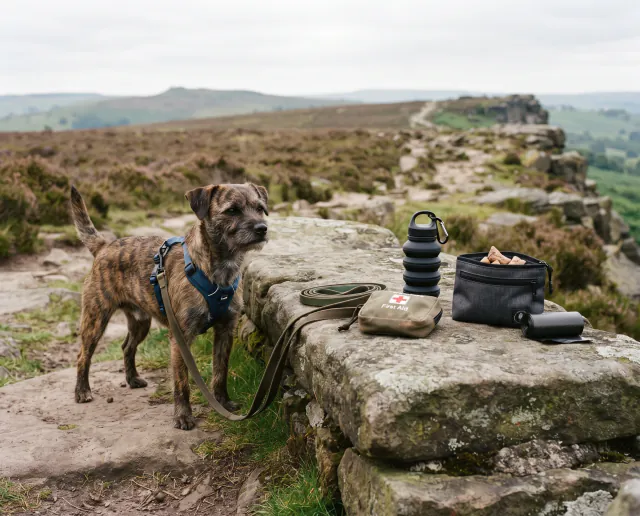
Most walks need very little. The problem is that the walks which go wrong are rarely the ones you planned for, and the missing item is usually a spare bag, a lead you can actually clip on, or water on a warmer afternoon than the forecast suggested. A small amount of kit, kept in the same place and checked regularly, covers nearly everything you are likely to meet on a British walk.
This guide sets out what to carry on an ordinary daily walk, what to add for longer or more rural routes, what belongs in a basic first aid pouch, and how to keep the whole lot ready without carrying a rucksack to the park.
Sort identification before anything else
Identification is the item that matters most and the one people forget to check. In the United Kingdom, dogs must be microchipped, and the details held on the database need to be current. A change of address or phone number is worth updating the same week it happens, because an out of date record is close to useless if the dog goes missing.
A dog in a public place is also generally required to wear a collar with the owner’s name and address on it, either on a tag or on the collar itself. The guide to everyday dog collars covers collars that carry a tag well. Check the engraving is still readable and the split ring has not worn thin. Many owners add a mobile number, and some add a line noting that the dog is chipped.
Do this before worrying about anything else in the bag. A well-stocked walking kit will not get a lost dog home.
The kit for an ordinary daily walk
For a normal walk from the house, most of the following fits in a coat pocket or a small belt pouch:
- Waste bags, and more than you expect to need. Carry them somewhere you cannot leave the house without them.
- A secure lead and correctly fitted walking equipment, checked for worn stitching and cracked clips.
- Food rewards in a pouch or a pocket, both for training and for calling the dog away from something. The treat pouch guide compares pouches you can open with one hand.
- A phone, charged, with the vet’s number saved and your location sharing available.
- A slim torch or a head torch through the darker months, plus something reflective or a light on the dog.
Two small additions save a lot of trouble. A spare lead, even a lightweight slip of cord kept folded in a pocket, covers a broken clip or a loose dog you need to hold safely. A short length of paper towel or a cheap flannel deals with mud, drool and a bag that splits.
Water, and when food matters
Carry water on any walk longer than a short local loop, and on any warm or humid day regardless of distance. A collapsible silicone bowl and a bottle weigh almost nothing. Puddles, streams, ponds and standing water on farmland are not a safe substitute, since they can carry bacteria, agricultural run-off and blue-green algae.
Offer water at intervals rather than waiting for the dog to look thirsty. Small, frequent drinks suit most dogs better than a large amount at the end.
Food beyond training rewards is only needed on long outings. Bring the dog’s normal food rather than something new, and keep chocolate, raisins, grapes, sweetened snacks and anything containing xylitol out of the bag entirely, since all of these are dangerous to dogs.
Additions for longer and rural walks
Countryside walks bring livestock, wildlife, changing weather and long distances from the car. Add a long line for a dog whose recall is still developing, attached to a harness rather than a collar. Bring a paper map or an offline map on the phone, since signal disappears in valleys and woodland.
Livestock fields need a short lead and a route that gives stock a wide berth. Ground-nesting birds on moorland and heath need the same care during the breeding season, and local signs will usually say so. Gates, stiles and cattle grids all need a plan for a dog who cannot climb them.
For roads without pavements, walk facing oncoming traffic where you can, keep the dog on the inside, away from the carriageway, and use a light or high visibility gear in poor conditions. Rural lanes in the rain are darker than most people expect.
A small first aid pouch
The purpose of a walking first aid kit is to protect a wound and get the dog home or to a vet, not to treat anything. A sensible pouch holds a couple of non-adhesive dressings, a conforming bandage, self-adhesive tape, blunt-ended scissors, disposable gloves, a tick removal tool and a foil blanket.
Learn the tick tool before you need it, since these are common across much of the UK and removal technique matters. Keep your vet’s daytime number and the out of hours provider’s number written on a card inside the pouch as well as on your phone.
Ring the vet for advice with any wound that is bleeding heavily, any limp that does not settle, any suspected bite, any collapse, any breathing difficulty and anything the dog may have eaten or drunk. Phone advice early is far better than a decision made an hour later in a car park.
Keep it packed and checked
The kit only works if it is ready. Keep everything in one pouch or bag that lives by the lead, and restock waste bags and food rewards on the same day each week. Check clips, stitching and the lead itself at the same time, and replace anything chewed, frayed or cracked rather than trusting it for one more walk.
Twice a year, empty the bag out completely. Bin the crushed bags, replace out of date items in the first aid pouch, check the torch batteries and confirm the tag is still legible. Swap the contents with the season, adding a towel and a drying coat for winter mud and moving water up the list for summer.
Fitting the walking equipment correctly is a separate job worth doing properly, and the guide on harnesses and flat collars covers what to look for.