A collar does two jobs, and they are worth keeping apart when you choose one. It carries your dog’s identification every time you leave the house, and on many dogs it is also where the lead clips on. A collar that suits the first job, light, quiet and comfortable enough to wear for hours, is not always right for the second. This guide is for anyone choosing an everyday collar for an adult dog, a puppy or a sighthound, and it answers two questions: which collar suits your dog, and what it has to carry. If you are still deciding whether your dog should walk from a collar at all, our guide to harnesses and flat collars covers that choice first. Head collars, GPS collars and LED collars are not covered here, and check chains, prong collars and electronic collars are not recommended on this site at all.
For a puppy, the lead and harness introduction lesson starts with comfortable equipment rather than a long walk. If a dog pulls, the loose-lead guide teaches the skill; choosing a different collar alone does not fix pulling.
How products are chosen
Canine Origin has not tested these collars hands-on. Each one was chosen from the maker’s published details and a UK stockist’s listing, and every specification on the product cards names the page it came from. The criteria were a published size range by neck measurement, stated widths and materials, the type of fastening, a clear point for the lead and the tag, care instructions, any warnings the maker gives, and a UK listing for sale when checked. Each collar also had to fill a different role, so the list covers an everyday webbing collar, a light collar for puppies and small dogs, a leather collar, a waterproof coated collar and a martingale for sighthounds. How a buckle holds up after a year of daily use, how leather ages, how a coating wears at the holes and how comfortable a collar is on a particular dog can only be judged in use, so no claim is made about any of them. A collar with a riveted name plate was considered, but no UK maker checked published enough detail about widths and how the plate is fixed to include one.
What the collar has to carry
In Great Britain, the Control of Dogs Order 1992 requires a dog on a highway or in a public place to wear a collar showing the owner’s name and address. The details can be inscribed on the collar itself or on a plate or badge attached to it, so an engraved tag, a name plate fixed to the collar or lettering on the webbing can all meet it. The Order lists exceptions, mostly for working dogs while they work, such as dogs herding livestock or used in emergency rescue, and dogs registered with the Guide Dogs for the Blind Association. The PDSA’s summary of the law includes the postcode as part of the address. A phone number is not part of the requirement, though the Royal Kennel Club notes you can add one, and says the dog’s name does not need to go on the tag.
Microchipping is a separate legal requirement and does not replace the collar. Government guidance says dogs in the UK must be microchipped and registered by eight weeks old, and that a dog must still wear a collar and tag with the owner’s name and address in public. The two do different jobs: a chip lets a vet or warden trace you once the dog has been scanned, while a tag lets whoever finds your dog in the street contact you straight away. Keep the details on both up to date when you move.
The Order refers to a collar, so a dog that walks in a harness still needs a collar with these details when out in public. This is a summary of what the sources say, not legal advice, and rules differ outside Great Britain, so check what applies where you live.
Buckle, clip or martingale
Flat collars fasten in one of two ways. A buckle collar uses a pin through punched holes, like a belt. It is slower to open, rarely comes undone by accident, and its fixed holes make it easy to return to the same fit every time. A side-release or quick-release collar has a plastic clip you squeeze to open and a slider to set the length. It opens with one hand, which matters if a collar ever needs to come off fast, but a slider can creep, so recheck the length now and then.
A martingale, sometimes called a limited-slip collar, is a different tool for a particular kind of dog. It has a large loop around the neck and a small control loop that the lead clips to. When the lead tightens, the small loop draws the large one closed, but only as far as its fixed length allows. It is made for dogs whose heads are narrower than their necks, such as greyhounds, whippets, lurchers and salukis, which can reverse out of an ordinary flat collar in a moment. Fitted correctly, it closes just enough to stop the collar sliding over the head. Fitted too loosely, it closes fully and gives no protection; fitted too tightly, it presses on the throat. A martingale is for walks, not for wearing all day. Makers of these collars say it should be worn only under supervision, so a sighthound also needs a flat collar for its tag at home.
That limited closing is what separates a martingale from a check chain, which can keep tightening, and from prong and electronic collars, which work through discomfort. None of those are recommended here.
Webbing, padding, leather or coated webbing
Nylon or polyester webbing is light, washable and easy to replace, which is why most everyday collars use it. It soaks up water, holds mud and smells, and its edges can fray over time. Padded collars add a soft lining, often neoprene, which some owners prefer on short-coated dogs, but padding holds water and takes longer to dry.
Leather is traditional and hard-wearing if it is looked after. It needs more care than any other material: it should not be soaked, some dyes transfer when wet, and it needs conditioning so it does not dry and crack. A dog that swims most days is hard on leather.
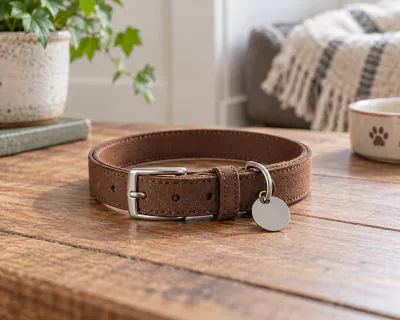
Coated webbing, sold under names such as BioThane, is a webbing core sealed in a smooth coating. It does not absorb water, so it wipes clean and does not stay damp, which suits dogs that swim, roll or walk muddy footpaths. It feels firmer than padded webbing, and its holes and edges still need checking for wear.
Whatever the material, look at the hardware. The lead ring should be solid and sized for the dog. A separate tag ring keeps the tag off the lead ring, so you are not clipping the lead through a bundle of metal, and a small rubber tag silencer stops the jangle at home.
Sizing and fit
Measure the neck where the collar will sit, using a soft tape, with the dog standing. Choose a size that puts your dog’s measurement in the middle of its range rather than at either end, so there is room to adjust both ways. For a martingale, also measure around the widest part of the head including the ears, because the collar goes on over the head.
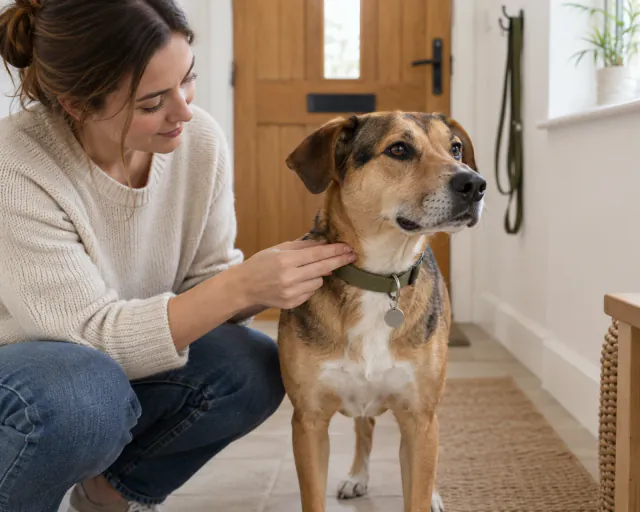
The standard check is the two-finger rule: two flat fingers should slide under the collar, and no more. The Royal Kennel Club puts it as not so loose that it slips over the head, and not so tight that you cannot fit two fingers underneath. Check all the way round, not only at the buckle, and check again after a few minutes of wear and after the dog has been wet, because a compressed or damp coat changes how a collar sits. Width matters too: a narrow collar suits a small dog and a light tag, while a larger dog is better with a wider band. Our collar fit guide explains the checks in more detail, including how to fit a dog that has slipped a collar before.
Puppy collars
A puppy’s first collar should be light, narrow, soft and adjustable, and sized for the puppy it is now. A collar bought to grow into is simply a loose collar, and a loose collar can be slipped or caught. The Royal Kennel Club advises choosing a collar that suits the breed, size and age of the puppy, and checking condition and fit almost daily while puppies grow fast. At the very least, refit a growing puppy’s collar every week, and expect a fast-growing breed to need more than one collar before its first birthday.
Keep the tag small and light. Some puppies scratch at a new collar at first, so put it on for short spells alongside meals or play before it stays on for longer. The puppy lead introduction lesson shows how to build from a collar to a lead without a tussle. If the puppy will walk in a harness, the collar only needs to carry the tag, and the lightest one that fits is the right one.
How the collars on this page differ
The Ruffwear Front Range collar is the everyday webbing option, with a side-release clip, a separate tag point with a silencer and a lead ring that does not share space with the tag. Its smallest size starts at a neck too big for many young puppies and toy breeds, which is where the Ruffwear Hi & Light collar comes in: lighter webbing and an extra-small size, with the same tag arrangement. Both are clip collars, so choose one of them if a one-handed release matters to you.
The Ancol Heritage Leather Collar suits someone who wants a buckle and a traditional material, in eight sizes. The trade-off is care: keep it out of water and condition it. If your dog is often wet, the Rock It Dog Design BioThane Buckle Collar gives a similar buckle fastening in a coated material that rinses clean, with narrow widths for small dogs. Its product page does not name the buckle material, so look over the hardware when it arrives.
The Petiquette Collars Whippet Martingale is for sighthounds on supervised walks only. Pair it with a light flat collar for the tag at home. Its neck range stops short of the largest greyhounds and lurchers, whose owners need a sighthound maker with bigger sizes.
Safety: catch hazards, tethering and long lines
Many collar accidents start with a collar catching on something. Ruffwear’s safety advice, which applies to any collar, is to take collars off in a crate, at home and when dogs play roughly together, because a crate bar, a tooth or a piece of furniture can hook under a collar or tag and the dog panics as it twists. A dog in a crate is safer without a collar; our guide to crate training a puppy covers setting one up. Ruffwear also notes that a caught collar may need cutting off, even one with a clip, so keep blunt-ended scissors where you can reach them.
Never tie a dog out by its collar, and never leave a tethered dog. A dog that bolts or tangles on a tether takes the whole force through its neck. Keep tags small and quiet, and check that a tag cannot hang low enough to catch in crate bars or drag in a bowl.
Never attach a long line to a collar. A dog can reach full speed before it hits the end of a long line, and a collar puts all of that force into the neck. Long lines belong on a well-fitted harness, as our long line guide explains, and the same reasoning makes a harness the better lead attachment for any dog that pulls hard; our no-pull harness guide compares the options. Stop using a collar and speak to your vet if you see hair loss, redness or sores where it sits, or if your dog coughs or gags when the lead tightens.
Care and when to replace a collar
Hand wash webbing collars in mild detergent and let them dry naturally, as the makers of the webbing collars here advise. Wipe or rinse coated collars. Keep leather out of water where you can, let it dry away from direct heat if it does get wet, and condition it; Ancol suggests once a year. After a swim in the sea, wipe any collar to remove the salt.
Replace a collar when the webbing frays or is cut, stitching near the buckle or ring loosens, the holes stretch or tear, leather cracks, a clip no longer snaps firmly shut or a ring bends. A chewed collar should go even if the damage looks small, because the weakness only shows under load. Tags wear too: check the engraving can still be read, and order a new tag when you move house.
Before you buy
- Measure the neck where the collar will sit, and the head as well for a martingale.
- Decide whether the collar is for the tag only or will also take the lead, and whether you want a buckle or a one-handed clip.
- Match the material to your walks: webbing for everyday use, coated webbing for wet dogs, leather for owners happy to keep it dry and conditioned.
- Look for a solid lead ring and, ideally, a separate point for the tag.
- Have a tag engraved with your name and address, including the postcode, and keep the microchip details current.
- For a puppy, buy for the neck it has now and refit weekly.
Common questions about dog collars
Does a harness replace an identification collar?
For a dog in public in Great Britain, the identification requirement described above refers to a collar. A harness can be the lead attachment while a suitable collar carries the required details. Check the current rules for your location.
How often should a puppy collar be checked?
Check fit frequently during growth, and at least weekly. It should not slip over the head or press tightly into the neck. The collar-fit guide explains how to measure and check it.
Can I attach a long line to a collar?
No. Use a well-fitted harness for long-line work so a sudden run does not load the neck. See using a long line safely.
- Pair the collar with a lead that suits the dog; our lead guide covers length and clips.