- Session length
- 10 to 15 minutes, three or four times a week
- Skill
- Recall
- Suits
- Adult
What you need
- A long line of ten metres (about thirty three feet), biothane or another material that does not soak up water, without a handle loop
- A well-fitted Y-shaped harness with a back ring
- A flat collar with an identification tag
- High value food rewards in a pouch
- Access to a secure, fully fenced field, such as a private hire dog field
The moment a dog comes off the lead for the first time in an open space is the moment most recalls are lost. The dog discovers a freedom it has never had, the owner calls too late or too often, and a behaviour that took months to build learns in five minutes that the cue is optional. This lesson makes that transition in small, protected steps: a line that trails before it disappears, a secure field before an open one, and clear rules about when a dog is ready.
Purpose
By the end of this lesson the dog should come back on one cue, off lead, inside a secure fenced field, from a distance of around fifteen to twenty metres (fifty to sixty five feet). The dog should also accept a brief touch on the collar as they arrive. That touch matters, because in real life you will need to take hold of the dog to clip a lead back on, and a dog who has learned to dodge a hand stops just out of reach.
Off lead in a secure field is not the same as off lead on an open footpath. This lesson ends with the dog ready to be trusted in more places, not with a dog who can go off lead anywhere.
Prerequisites
- The dog turns on the first call from ten metres with a distraction nearby, as covered in recall around distractions.
- The dog has a working stop or wait cue at short range, from emergency stop foundations.
- The dog wears a collar with an identification tag and is relaxed about it being touched.
- You can book or use a secure, fully fenced space.
Equipment
Use a ten metre (thirty three foot) long line without a handle loop, in a material such as biothane that does not soak up water and get heavy, clipped to the back ring of a harness. The dog also needs a flat collar carrying an identification tag, because a dog off lead is a dog who might be separated from you. The dog collar buying guide covers fit and fastenings. Carry the best food you have. A private hire dog field is ideal, because you know the fence and there will be no other dogs arriving.
Method
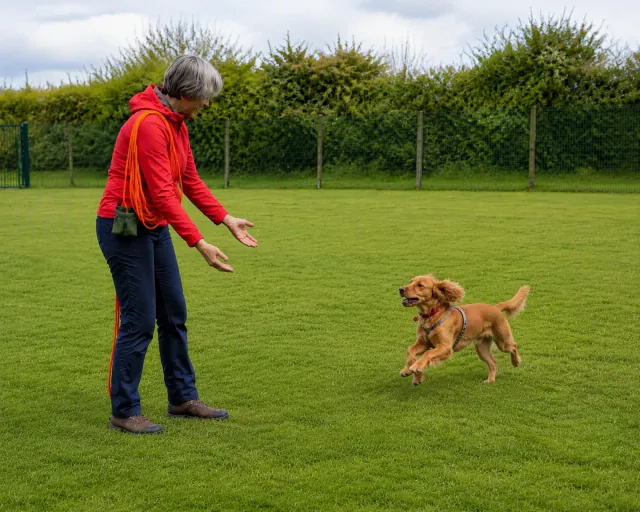
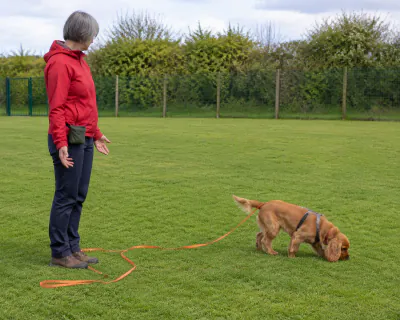
- Check the whole fence line and make sure the gate is shut. Clip the long line to the harness and let the dog explore on the full line for a few minutes.
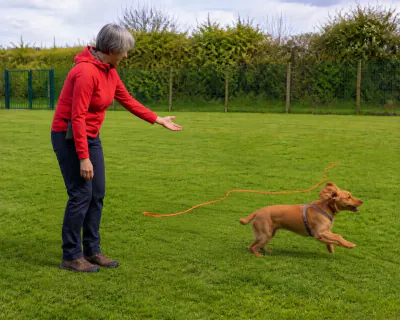
- Drop the line and let it trail. You are no longer holding it, but you can reach it or step on it if you need to.
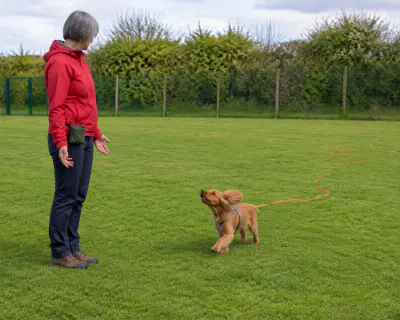
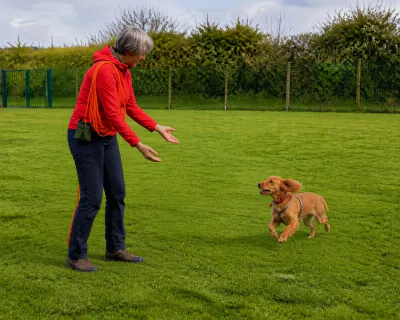
- While the dog is exploring, call once. Stay upright and still, and let the dog come all the way to you without touching the line.
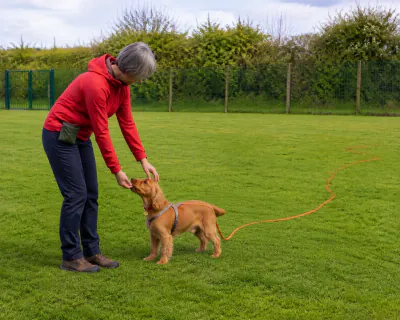
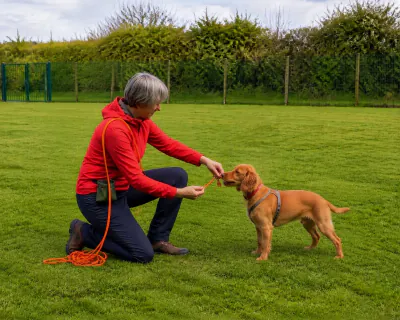
- As the dog arrives, slide two fingers under the collar for about a second, let go, and then feed three or four pieces at the seam of your trousers. The collar touch comes first and the food second, so the touch predicts food.
- Release the dog to run again with your release word. Most recalls should end this way, so that coming back is not the signal that the fun is over.
- Repeat six to eight times per session. If the dog does not respond within about three seconds, do not call again. Walk calmly to the line, step on it, take up the slack and make the next recall shorter and easier.
- Build distance with the trailing line over several sessions, from about five metres to fifteen metres or more. Keep the field the same while you change distance.
- When the dog comes back reliably with the line trailing across three sessions, unclip the line after a successful recall and coil it over your shoulder.
- Call from a short distance first, five metres or so, and pay generously. Then let the dog go and build distance again, exactly as you did with the line on.
- Change one thing at a time from here: a larger secure field, then a mild distraction in the same field, then a second secure location. Go back to the trailing line whenever you change place.
- Before letting the dog off lead anywhere that is not fenced, ask yourself honestly whether they would come back from the most interesting thing likely to happen there, and read the guide to walking near livestock if farmland is part of your walks.
Session length
Ten to fifteen minutes, three or four times a week, usually when you have access to a secure field. Eight to ten recalls in a session is plenty, with plenty of free running between them.
Progression criteria
Move on to a new secure location when the dog comes back off lead on the first call, nine times out of ten, from fifteen metres, across three sessions. Before using an open space, the dog should also recall reliably in at least two secure places with a mild distraction present. If anything slips, put the trailing line back on.
Common mistakes
Unclipping the line as a reward for a good session, rather than as a planned step, often means the first off-lead recall is attempted when the dog is already excited. Calling only at the end, when the lead goes back on for the walk home, teaches the dog to avoid the call. Grabbing the collar as the dog arrives creates a dog who stops just out of reach. Letting the dog off lead in a new place without a trailing line first skips the stage that makes the new place safe.
Troubleshooting
If the dog comes back well on the line but plays keep-away off it, the line was doing more work than you realised, so go back to trailing it and shorten your distances. If the dog dodges your hand, practise collar touches at home paired with food, away from any recall. If the dog ignores you only when running with another dog, that is a much harder distraction and belongs in a later stage. Some dogs, particularly sighthounds, scent hounds and many terriers, may never be safe off lead in open country, and the guide on recall and prey drive explains why that is a realistic outcome rather than a training failure.
Safety and when to stop
Stop and put the line back on if the dog shows any sign of chasing wildlife, birds or other dogs. Never let a dog off lead near livestock, roads or water you are unsure about. Stop the session if the dog seems sore, lame or reluctant to run, and speak to your vet. If the dog chases, lunges at or frightens other animals or people, speak to a qualified behaviourist working alongside your vet before trying any more off-lead work. Never use a shock collar, a remote spray collar or any device that works through discomfort or startle to control a dog off lead.
Next lesson
Continue with loose lead walking past distractions, which brings the same proofing approach back onto the lead for busier walks.
Related reading
The teaching reliable recall guide explains why a recall is built from many small repetitions and how to protect it once the dog has real freedom.