A dog that comes back reliably from a sniff, a slow-moving dog across a field, or a person walking past can still take off after a rabbit, a squirrel, a cat, or a jogger as though the recall had never been taught at all. Owners in this situation are frequently told they simply need better treats, a stronger relationship, or more consistent practice, and when none of that produces off-lead reliability, the conclusion is often that they, or the dog, have failed at something achievable. That conclusion is usually wrong, and this article sets out a more honest picture of what is actually happening and what a realistic plan looks like.
Prey drive is commonly strong in sighthounds, many terriers, and some working and herding breeds bred for generations to notice, chase and sometimes catch moving animals, but plenty of individuals outside those groups have it too, and its strength varies considerably between dogs even within the same breed. This guide explains why a genuinely high prey drive changes the recall problem itself, what realistic management looks like, the training approaches actually used for it, and why no single method, including equipment, guarantees a result with every dog.
Why this is a different problem, not just harder distraction-proofing
Ordinary recall training builds reliability by gradually increasing distraction while keeping the dog under threshold: a bit of movement, then more, then a jogger, then another dog, each level practised until it is solid before moving to the next. Prey drive breaks this model because a genuinely triggering stimulus, a small animal moving fast and erratically, does not behave like an ordinary distraction that scales smoothly. It can flip a dog from calm and responsive into a highly focused chase state within a second or two, and that state is not simple disobedience or a dog choosing the squirrel over the owner in some deliberate way. It reflects a different, powerfully rewarding internal state that predates any training the dog has ever had, and once a dog is fully engaged in it, the usual channels a recall relies on, hearing a cue, valuing a reward, weighing options, are substantially reduced or unavailable until the chase resolves or the trigger disappears.
This is also why reward value is not the answer some owners expect it to be. A dog mid-chase is not comparing the appeal of a sausage against the appeal of the rabbit and choosing the rabbit because the sausage was not good enough. It has moved into a state where the usual decision-making machinery a recall depends on is not engaged the same way, and no realistic reward, presented in that moment, reliably interrupts it. Recognising this distinction, prey drive as a different motivational system rather than a bigger version of ordinary distraction, changes what a sensible plan tries to do.
Management as an honest first line
For many dogs with a genuinely strong prey drive, realistic management is not a fallback for while training is incomplete. It is a legitimate, ongoing part of keeping the dog and local wildlife safe, and presenting off-lead reliability as an achievable guarantee for every such dog is not honest.
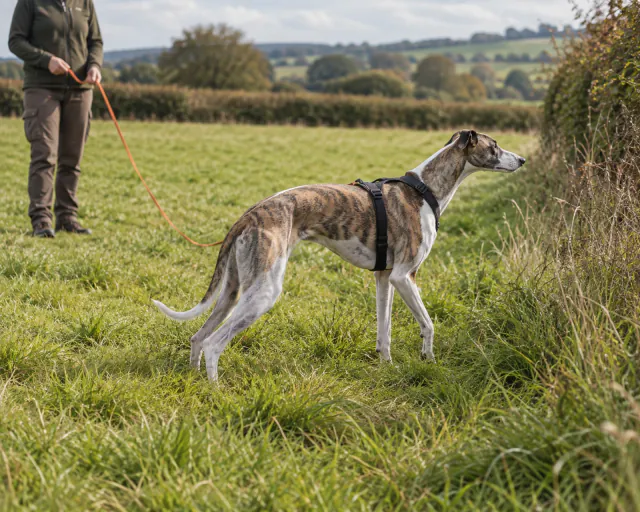
A long line gives a dog real freedom to explore, sniff and move at pace in areas with known triggers, rabbits in a hedge line, deer in woodland, without the risk of a genuine chase developing, and it remains one of the most useful pieces of equipment for this specific problem. Keeping a dog on a lead, rather than off, in higher-risk locations, a field edge known for rabbits at dusk, a park with resident squirrels and low branches, a coastal path near livestock, is a deliberate choice rather than an admission of failure. Choosing walking locations and times with the dog’s specific triggers in mind, avoiding the field at dawn and dusk when rabbits are most active, or a different route altogether where livestock share the land, reduces the number of high-stakes moments a plan needs to manage in the first place. None of this prevents a dog from getting exercise or enrichment; it simply directs it towards settings where a chase is not the standing risk.
Structured training approaches genuinely used for this problem
Training still has a real place alongside management, and several approaches are genuinely used by trainers working with high-drive dogs.
Extensive, staged recall-around-distraction training starts at a level of trigger intensity far below an actual chase, a toy dragged slowly at a distance, a scent trail, a person jogging far away, and builds up gradually over weeks, adding proximity, speed and unpredictability only once the current level is reliably solid. This mirrors ordinary distance and distraction progression, but it needs to start much further from the real trigger and progress more slowly than most owners expect, because the gap between “manageable distraction” and “full prey engagement” is often narrower and more sudden for these dogs than it is for ordinary distractions.
A separate “emergency” cue, trained in complete isolation from everyday recall and reserved only for genuine emergencies, is a specific technique worth understanding on its own terms. The everyday recall cue gets used dozens of times a week, in low-stakes contexts, and inevitably gets diluted over time by imperfect responses, distractions and inconsistent follow-through. An emergency cue is built and rehearsed separately, paired with an extremely high-value reward, and never used for routine recall, precisely so it retains its strength for the rare moment it is actually needed. Beginner emergency stop foundations covers the foundational version of this idea, and the principle scales directly to a dedicated, protected recall or stop cue for a dog with strong prey drive.
For some dogs and handlers, professional-guided, equipment-assisted training is one option among several, including but not limited to the approaches covered in the article on electronic collars for dog training. This is presented here neutrally rather than as a recommendation: some professionals use distance-communication equipment specifically for prey-drive and recall reliability in working and sporting contexts, others achieve comparable results without it, and the right choice, if any, depends on the individual dog, the handler’s skill and comfort, and hands-on professional supervision rather than a generic instruction from an article.
No method offers a guarantee
It is tempting to want a definite answer for a genuinely high-drive individual, and none of the approaches above, alone or combined, can honestly promise one. Some dogs reach a level of reliability that allows confident off-lead exercise in most settings. Others, despite excellent, consistent training, remain a genuine chase risk around specific triggers for their entire lives, and continued long-line or on-lead management in higher-risk locations remains the sensible, permanent answer for those dogs rather than a stage to graduate out of. Presenting a fully off-lead outcome as achievable for every dog with strong prey drive sets owners up to blame themselves or their dog when a realistic biological limit, not a training failure, is the actual explanation.
Building a plan calibrated to the individual dog
A sound approach combines management and training deliberately, rather than treating them as alternatives to choose between. Assess honestly how strong the drive actually is, which specific triggers set it off, and in which locations and conditions risk is highest. Use long-line and on-lead management as the default in genuinely high-risk settings from the outset, not as a last resort after a chase has already happened. Build structured, staged recall-around-distraction training over a realistic timeframe, starting well below the level that would trigger a chase. Keep a protected emergency cue in reserve rather than eroding it through everyday use. For working breeds, dogs with any bite or livestock-chasing history, or handlers who are not confident assessing their own dog’s threshold, a session or two with a trainer experienced in prey-driven breeds, rather than a general obedience instructor, is worth the cost, since this is a genuinely specialised problem within recall training. See teaching reliable recall for the general recall-building process this approach extends, and when to involve a trainer, behaviourist or vet for guidance on finding the right kind of help for a dog whose prey drive is creating a genuine safety risk.