Pulling is not defiance and it is not a dominance problem. Dogs walk faster than we do, the world is more interesting ahead than beside us, and every dog who has ever reached a lamp post by leaning into a lead has been paid for leaning.
Fixing it takes three things: equipment that does not hurt, a clear picture for the dog of where you want them, and a period of weeks in which you stop practising the old habit. The order below matters, because most owners start on a pavement and never get anywhere.
Work out what is driving it
Watch a walk properly before changing anything. A dog who explodes out of the front door and tows you for ten minutes before settling is over-aroused at the start. A dog who pulls only towards other dogs has a social motivation. A dog who pulls constantly, evenly and calmly has simply learned that leaning works.
The last case is the easiest. The first two need the arousal or the emotion dealt with alongside the mechanics, which usually means starting further from the trigger and spending longer at each step.
Consider the walk itself as well. A dog getting one rushed pavement walk a day, with no chance to sniff and nothing else to do, will pull harder than the same dog getting time on a long line in an open space a few times a week.
Sort the equipment and your hands
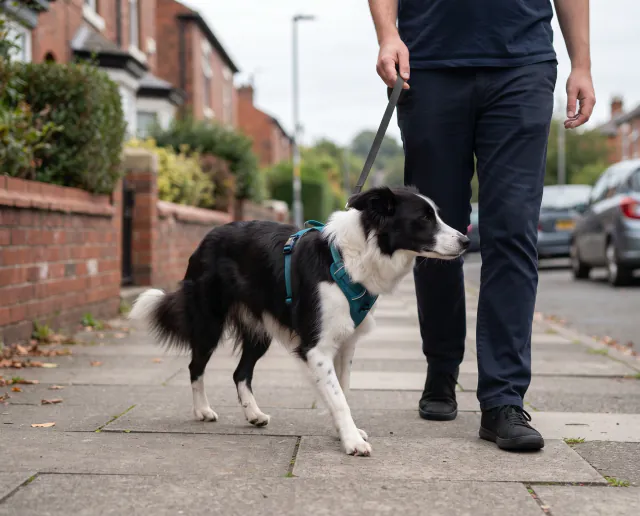
Use a well-fitted harness with a lead attached at the chest, the back, or both ends of a double-ended lead. Nothing that tightens, pinches or delivers a shock has any place here, and a lead attached to a collar puts all the force through the neck of a dog who is already pulling. The harness and collar comparison covers the fit checks in detail.
Use a fixed lead of about two metres. Retractable leads teach a dog that pulling produces more lead, which is the exact opposite of the lesson.
Hold the lead in the hand furthest from the dog, with the slack looped comfortably and your hands relaxed near your waist. A tight, high hand creates tension the dog leans into. Practise walking with a slack lead and no dog attached if you need to feel the difference.
Teach the position before you teach the walk
Stand still in your kitchen with the dog beside you. Every time the dog is in the position you want, level with your leg on your chosen side, feed a piece of food at the seam of your trousers. Feeding low and against your leg is what draws the dog into position; food delivered at chest height pulls them in front of you.
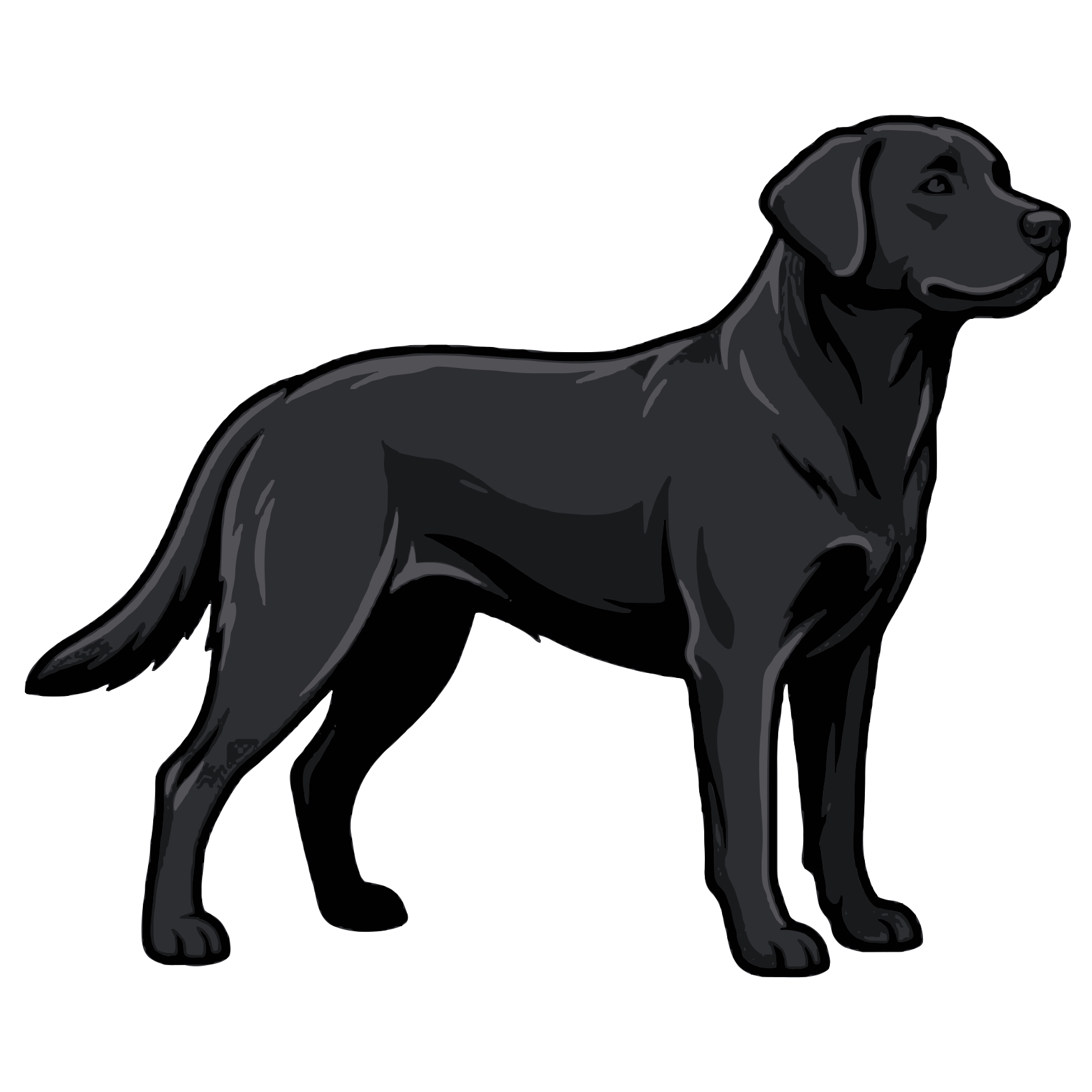
Do this until the dog offers the position without being lured. Then take one step, feed in position, take another, feed again. Two or three minutes at a time is enough. Bigger dogs, or strong ones such as a Labrador Retriever, benefit from more repetitions at this stage than owners usually give.
Good enough looks like this: the dog chooses to come back to your leg when you stop, rather than being manoeuvred there.
Build up to a few steps at a time
Move to the hall, then the garden, then the quietest stretch of pavement you can reach, ideally at a quiet hour. Reduce the number of steps between rewards every time the environment gets harder. Three easy steps in a new place beat twenty struggling ones.
Stretch the intervals gradually. Feed after two steps, then three, then five, then vary it so the dog cannot predict when the next one arrives. Keep the food coming often enough that being beside you stays worthwhile.
Separate training from transport for a few weeks. If the dog has to get to the park, drive or accept that stretch as a write-off. If every walk is a training walk, you will not have the patience to hold the standard, and inconsistency is what keeps pulling alive.
Deal with the moment the lead goes tight
Have one response and use it every time. Stop moving the instant the lead tightens, stand still and wait. Say nothing. The moment the dog releases the pressure or glances back, mark it and either feed in position or, better, walk on, because moving forwards is what the dog wanted.
If standing still achieves nothing after a few seconds, turn calmly and walk two or three steps in the other direction, then reward the dog for catching up. Never yank the lead, and never use a jerk as a correction. Pain and startle suppress behaviour without teaching an alternative, and around other dogs they can create an association between another dog appearing and something unpleasant happening.
Expect a rough patch. A behaviour that has always worked gets tried harder before it fades.
Give the dog somewhere to put the sniffing
A dog held at your leg for an entire walk has no outlet, and pressure builds. Use two clear states: a cue such as with me for close walking near roads and busy pavements, and a release such as go sniff for the long lead in a park, on a verge or in a field.
Sniffing is genuinely tiring and it lowers arousal, so it makes the close-walking sections easier rather than undermining them. Ten minutes of a dog reading a hedge does more for a dog’s evening than an extra mile of pavement.
Keep the standard once it improves
Loose lead walking slips when the reinforcement stops entirely. Carry food on walks for months, not weeks, and pay the dog occasionally for the position long after it looks solid. Reward heavily in the first two minutes of any walk, when arousal is highest.
If progress stalls, drop the criteria rather than the effort: quieter place, shorter session, more food, fewer steps. A dog who pulls hard enough to hurt you, lunges at other dogs or drags a handler off balance is a safety problem as much as a training one, and a qualified reward-based trainer working with you in person is the right next step.
For a structured, session-by-session version of this skill with progression criteria, see loose lead walking.