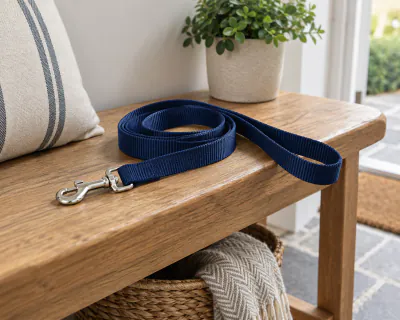
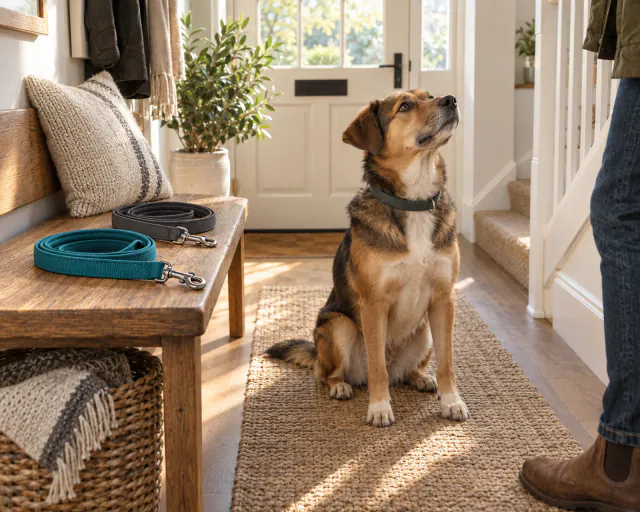
The everyday lead is the piece of kit a dog owner handles more than any other, and the choice matters more than it looks. A lead that is too short keeps the dog pinned against your leg and turns every pause into a tug. One that is too long tangles around lamp posts and other dogs. A clip that is hard to open with cold, wet hands turns the end of a walk into a fumble at the kerb. This guide covers the lead you use on pavements, paths and in the park on an ordinary day. Long lines for recall practice have their own guide, because they answer a different question and are handled very differently.
How products are chosen
Canine Origin has not tested these leads hands-on. Each one was chosen from the maker’s published details and a UK stockist’s listing, checked against the criteria below, and every specification on the product cards names its source. The criteria are published lengths and widths, the type and number of clips, what the maker says the lead is and is not designed for, care instructions, and whether a UK retailer lists it. Grip, how the material wears and how a clip behaves after a winter of rain can only be judged over months of use, so no claim is made about them.
How to choose
Start with the walk you actually do. For town pavements, a lead of around 1.2 m to 1.5 m keeps a dog close enough to manage at crossings and in narrow spaces while still leaving a loose curve of slack. For quieter paths where the dog is allowed to sniff, 1.8 m to 2 m gives more freedom without the tangling of a long line. Match the clip to the dog: a heavy trigger hook on a small dog hangs off the collar ring and swings against the neck, while a light clip on a strong dog is a weak point. Then choose a width that suits your hand and the dog’s size, and a material you are happy to wash or wipe after muddy walks. Our guide to lead types explains the main designs in more detail.
Fixed-length, adjustable and double-ended leads
A fixed-length lead has one clip, one handle and nothing to adjust. It is the simplest lead to hand to someone else, and there is nothing to set up wrongly. An adjustable or multi-function lead has rings along its length so it can be shortened or lengthened, and usually a second clip at the other end. That second clip lets you attach to two points on a harness, such as the front and back rings, or to a harness and a collar at once. The trade-off is more hardware and more ways to set it up wrongly: every change of configuration is a moment when a clip could be left open. If you are new to this kind of lead, learn one setup well before trying the others, and check the maker’s own list of what the lead is not designed for. One of the leads on this page, for example, is made to work with a particular harness and its maker says plainly that it should not be used to walk two dogs together.
Clips, rings and hardware
Look at the clip before anything else, because it is the part most likely to fail. A trigger hook, the common spring-loaded clip, should close fully by itself and should not open when twisted against a collar ring. A locking clip adds security but takes longer to attach, which matters with a dog that bounces at the door. If there is a swivel, check it turns freely so the lead does not twist. Makers that publish hook sizes by dog weight make the choice easier: one lead here matches its hook to the dog, from a light clip for dogs up to 10 kg to a large hook for dogs over 25 kg. Wherever the hardware meets the webbing, look closely at the stitching or rivets, because that is where the load concentrates.
Width, grip and material
Width is about the dog’s size and your hand. Narrow leads of around 13 mm to 15 mm suit small dogs and are lighter on a small collar, while 20 mm to 25 mm leads are easier to hold with a larger, stronger dog. Padded webbing is comfortable in the hand and easier to grip in the cold, but it soaks up water and mud and takes time to dry. Coated webbing such as BioThane is waterproof and wipes clean with a damp cloth, which appeals to anyone crossing wet fields in winter, though it has less cushioning. Rope leads are strong and easy to grip but can be heavy for small dogs; the rope lead on this page comes in a thinner and a thicker rope, so the lighter one can go on a smaller dog, and it closes with a locking carabiner rather than a trigger hook. Whatever the material, do not wrap the lead around your hand or wrist: a sudden lunge can injure fingers and joints. Hold the handle and let the slack sit loosely in your other hand instead.
Leads, harnesses and collars together
A lead is only as secure as what it clips to. On a flat collar, check the fit before every walk, because a collar loose enough to slip over the ears lets a dog reverse out of it the moment it panics. Our guide to collar fit explains the checks, and the guide to harnesses versus flat collars sets out when each suits a walk. On a harness, clip to the ring that suits the walk: the front ring for more steering on a busy street, the back ring for relaxed stretches. A double-ended lead attached to both a harness and a collar gives a backup connection while you are still confirming the fit of new equipment. If pulling is the problem you are trying to solve, no lead fixes it by itself. The guide on how to stop a dog pulling on the lead and the loose lead walking lesson set out the training, and our no-pull harness guide compares the equipment that helps while you teach it.
Retractable leads
Retractable leads are not recommended here. The thin cord can cut or burn if it wraps around a leg or a hand, the dog is under constant slight tension, which works against teaching a loose lead, and at full extension the dog can be too far away to stop at a road. If you want to give a dog more room to sniff, a longer fixed lead on quiet paths, or a long line in an open space, is the safer route.
Safety and common mistakes
Check the clip, and the stitching near every piece of hardware, each time the lead goes on. Never tie a dog to a post and walk away, even briefly: a lead used for tethering should only be used while you are right beside the dog. Keep the lead short and the dog on the side away from the traffic, the people or the animals you are passing; our guide to walking near livestock covers what to do around sheep and cattle. Common buying mistakes include choosing a lead because it matches a collar rather than because the clip suits the dog, buying a heavy lead for a small puppy, and assuming a lead designed as part of a system works the same way on its own. For a young puppy, the lead introduction lesson shows how to make the first lead a pleasant experience before it is ever used on a walk.
When to replace it and questions to ask
Replace a lead once the webbing is frayed or cut, once stitching near the clip or handle is loosening, once the clip no longer snaps shut by itself, or once a swivel has seized. A lead that has been chewed should be replaced even if the damage looks small, because the weakness only shows under load. Before buying, ask: is this length right for the walks I do most, does the clip suit my dog’s weight and the ring it will attach to, will I actually use the extra settings of a multi-function lead, and can I clean and dry this material in the conditions I usually walk in.