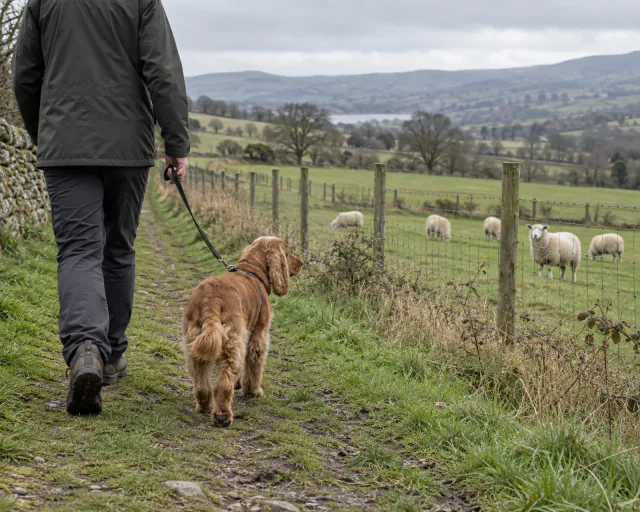
Walking a dog through farmland, open access land or anywhere sheep, cattle or horses graze carries real risk, both to the livestock and to the dog and handler. Most incidents are preventable with a lead, a bit of route planning and an understanding of what to do if things go wrong. Some are not, and knowing the difference matters.
This guide sets out why dogs should generally be kept on a lead and under close control around livestock, the specific harm a loose or chasing dog can cause, the counterintuitive advice about letting go of the lead if cattle charge, and how to plan a route around fields that hold animals. Laws and access rules covering dogs and livestock differ significantly between countries and even between regions within the same country, so treat the general principles here as a starting point and check the specific rules that apply to where you are walking.
Why close control matters
A dog does not need to physically catch or bite a farm animal to cause serious harm. The mere presence of a loose or excitable dog can cause livestock to panic and run, sometimes into fences, ditches, roads or each other. Sheep are particularly vulnerable to this kind of stress-related injury, and the term used for a dog causing this kind of harassment is usually “worrying” livestock, whether or not any physical contact occurs.
The consequences are not limited to visible injury. A pregnant ewe or cow that is chased or panicked can miscarry, sometimes with no immediate outward sign that anything happened. Young or weak animals can be trampled by the rest of the herd or flock during a panic. None of this requires a dog that intends harm, only a dog that is loose, barking, chasing or simply running enthusiastically through a field of grazing animals.
Because of this, keep dogs on a lead whenever livestock are present, or under close and reliable voice control where a lead is genuinely impractical and local rules permit it. A dog that has excellent recall in a park is not automatically reliable around the specific, intense prey drive that livestock can trigger, so do not assume off-lead control transfers directly to this situation without having tested and trusted it.
The legal position, and why it varies
In many countries and regions, a farmer or landowner has a legal right to take action, in some jurisdictions including shooting a dog, if it is actively worrying or attacking livestock and there is no other reasonable way to stop it. The exact conditions under which this is lawful, what counts as sufficient justification, and what obligations exist around reporting the incident afterwards, differ significantly from one country and even one region to another. Access rights to farmland and open country, and any legal requirement to keep a dog on a lead in specific areas or during specific seasons such as lambing time, also vary widely.
This is not a topic where general advice can safely stand in for local knowledge. Check the specific laws, access rights and any seasonal restrictions that apply in the country and region where you are walking, particularly if you are visiting an area you do not know well.
If cattle charge
Cattle, particularly cows with calves at foot, can act aggressively towards a dog they perceive as a threat, and this can extend to charging at the dog and, by extension, at the person walking it. This situation catches many walkers off guard because the instinct is to hold onto the dog tightly and try to leave together.
The advice given by many countryside and farming safety organisations is the opposite of that instinct: if cattle charge and you are walking a dog on a lead, let go of the lead. A dog is faster and more agile than a person and can usually outrun cattle on its own once it is not tethered to a slower-moving human. Holding onto the lead ties the dog’s speed and manoeuvrability to yours, and can result in both of you being caught by animals that would otherwise have chased the dog only. Once the lead is released, move calmly but quickly towards the nearest gate, stile or fence you can get over, without trying to catch the dog again until you are both safely out of the field.
This advice is specific to cattle and is widely recommended precisely because it runs against instinct. It does not apply the same way to every livestock encounter, and checking guidance from a relevant countryside or agricultural safety body for the region you are walking in is worthwhile if you regularly walk routes that cross grazing land.
Route planning
The safest way to manage livestock risk is to avoid it where practical. Before walking an unfamiliar route across farmland, check whether current maps, signage or local sources note which fields are stocked, and treat that information as provisional since livestock is moved between fields regularly. Look ahead at field gates and stiles before entering, since a field that looks empty from a distance can have animals gathered behind a hedge or a dip in the land.
Where a route must cross a field with livestock, keep to the marked path where one exists, keep the dog on as short a lead as practical, and give the animals the widest reasonable berth the field allows without leaving the right of way if access rules require staying on it. Move through calmly and without lingering, since the goal is to pass through without provoking a reaction, not to give the animals extended exposure to an unfamiliar dog.
When avoidance is the better plan
Sometimes the better answer is choosing a different route altogether, particularly if the dog is known to be reactive around other animals, if the field holds young animals or animals close to giving birth, or if a known aggressive animal, some bulls in particular, is present. A short diversion around a stocked field is a minor inconvenience against the alternative of a genuinely dangerous encounter for the dog, the livestock or the handler.
This is a topic worth treating seriously rather than as a minor walking inconvenience. The combination of a loose or poorly controlled dog and grazing livestock is one of the more common sources of serious injury, legal dispute and animal welfare harm connected to ordinary dog walking, and nearly all of it is avoidable with a lead, some route awareness and knowledge of the specific rules that apply locally.