
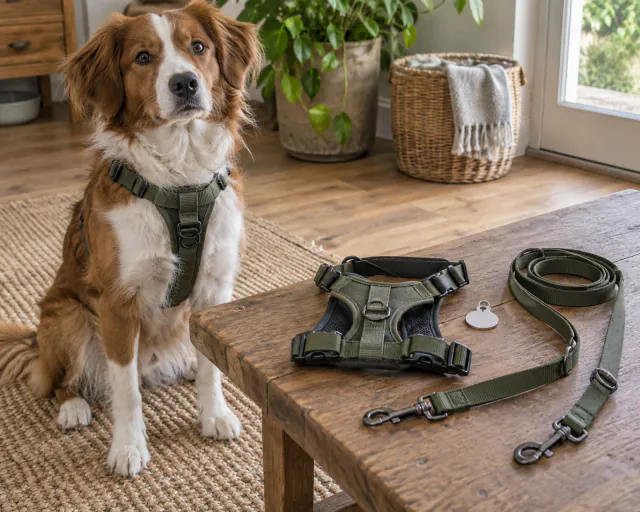
Walk into most conversations about dog equipment and the questions arrive already jumbled together: what harness stops pulling, what lead is safest, what collar gets the best behaviour. These are three different questions wearing one coat. Equipment can help with physical control of a dog’s movement, it can support clear communication between handler and dog, and it can add genuine safety margin, but these are separate jobs, and a single item rarely does all three well.
This article sets out those three jobs separately, why the same piece of equipment can work very differently depending on who is holding the lead, and a practical process for deciding what a specific dog and situation actually need rather than reaching for whatever a chart or a forum thread recommends.
Three different jobs, one shopping trip
Control is about physically managing where a dog’s body can go: a harness that keeps a strong dog from reaching a road, a secure double-ended lead that gives two points of attachment, a properly closed gate latch. Communication is about the dog understanding what the handler wants and responding to a signal, which is mostly a training outcome rather than a property of an object, though some equipment supports specific communication-heavy exercises better than others. Safety covers a different set of concerns again: secure fastenings that will not fail under load, visible identification, equipment that makes a dog easier to see in low light, and a proper restraint system in a car. A single purchase decision often tries to solve all three at once, which is one reason equipment choice causes so much frustration. Naming which job you actually need solved narrows the decision considerably.
Control: keeping a dog physically manageable
A well-fitted harness distributes force across the chest and shoulders rather than concentrating it on the neck, which matters most for a dog that pulls, lunges or has not yet learned loose-lead walking. Fit is not a minor detail here: a harness that rotates, slips or allows a narrow-headed dog to back out of it provides none of the control it was bought for. The specifics of measuring, fitting and checking a harness are covered in choosing the correct harness size and the dog harness size helper, and the comparison between harness and flat collar for everyday walking is covered in harness vs flat collar for dog walks.
A secure double-ended lead, clipped to two attachment points, gives a handler a second point of physical leverage without relying on a single connection. This is control in its purest form: it changes what the dog’s body can physically do in the moment, independent of what the dog has learned. Lead types explained covers the practical differences between fixed leads, long lines, hands-free designs and retractable leads, and where each earns its place.
Communication: what equipment can and cannot do
Communication is the dog understanding a specific signal and responding to it reliably, and that understanding is built through training, not purchased. A long line supports certain communication-heavy exercises well, distance recall work and practising a reliable stop cue while the dog still has room to make a mistake safely, because it lets a handler intervene physically at exactly the moment a verbal or visual cue would otherwise go unheeded. Using a long line safely covers handling technique in detail. But the line itself is not teaching the dog anything; it is creating a safe space for the training underneath it to happen. The same point applies to any equipment marketed on its ability to improve responsiveness: what actually changes a dog’s behaviour is the combination of clear, consistent cues and appropriate consequences, covered in full in structure, boundaries, rewards and correction. Electronic collars sit at the more contested end of this conversation, and the genuine disagreement between professional camps on their use is set out in electronic collars for dog training rather than resolved with a blanket recommendation either way.
Safety: a separate category entirely
Safety equipment is not about behaviour at all. It covers fastenings and clips rated to hold under sudden load, an ID tag with current contact details alongside any legally required microchip registration, high-visibility equipment for walking before dawn or after dusk, and a proper harness or crate-based restraint system for car travel rather than a dog loose in the back seat or held on a lap. A dog can be beautifully behaved and still be unsafe if a clip fails, if identification is out of date, or if a sudden stop in traffic turns an unrestrained dog into a projectile. These are worth checking on their own terms, separate from whatever control or communication equipment is also in use.
No single item does all three
A harness that gives excellent control on a strong young dog says nothing about whether that dog will check in with its handler at the park gate, because that is a communication outcome built through training. A collar that carries perfect identification does nothing for a dog that pulls hard enough to take a person off their feet. And critically, the same item in different hands produces very different results: a well-fitted harness attached to a lead held by a handler who has done the groundwork on loose-lead walking looks completely different from the identical harness on a dog that has never been taught anything, because the equipment is only ever one part of a complete system. Trainer competence and consistent handling underneath the equipment matter more than which item was chosen, a point covered further in how to assess whether a dog trainer is competent.
A decision process instead of a shopping list
Before buying anything, it helps to work through a short sequence of questions rather than starting from a product.
- What specific problem is this meant to solve: physical control on walks, a communication gap in training, or a safety gap such as identification or car travel?
- Would training alone solve it, at least in part, without any new equipment? Many pulling and jumping problems improve significantly with consistent loose-lead practice and management before any equipment change is needed.
- Does this piece of equipment fit this dog correctly and comfortably, checked while the dog is standing and again after a few minutes of movement?
- Is it legal in the country you live in and any country you might travel to with the dog? Some collar and lead types, and electronic training collars in particular, are restricted or banned in certain countries, and rules vary by region within some countries too.
- Would a professional trainer’s individual assessment of this dog change the answer? A dog with unusual strength, high drive, a difficult training history, or a specific behavioural concern often needs an assessment tailored to that dog rather than a generic recommendation.
Equipment choice made this way, driven by the dog in front of you and the actual problem rather than by a general rule about what every dog of a certain size or breed needs, tends to hold up far better than a purchase made from a chart alone.