Choosing a dog trainer is harder than it should be, partly because the industry is genuinely unregulated in many countries and partly because the public conversation about training tends to focus on which camp a trainer belongs to rather than what that trainer actually does with a dog in front of them. Two trainers can use the same label, the same marketing language and even the same certificate, and still differ enormously in timing, communication, adaptability and judgement. Those qualities, not the name of a method, are what most reliably predict whether your dog makes progress and whether the process is a good experience for it.
This guide sets out specific, practical questions to ask a prospective trainer, organised into groups that reflect what each answer actually tells you. None of the questions below are trick questions with one correct answer written in advance. What matters is whether the trainer can explain their reasoning clearly, whether their answer fits your dog’s specific situation, and whether they seem to be listening to you rather than delivering a rehearsed pitch.
Methods and philosophy
Ask what methods the trainer generally uses and why they use them. A competent trainer, whatever their general approach, should be able to explain their reasoning in plain language rather than reciting a slogan. Listen for whether they talk about your dog specifically, including its age, breed tendencies, history and the actual behaviour you want addressed, or whether they give the same answer regardless of the details you have just given them.
It is reasonable to ask directly whether they consider themselves reward-based, force-free, balanced, or something else, but treat the answer as a starting point for further questions rather than a verdict. A trainer’s philosophy tells you the general shape of their toolkit. It does not tell you their timing, their mechanical skill, how they read a dog’s body language, or how they behave under pressure when a session is not going to plan, and those qualities matter at least as much as the label.
Adaptability: what happens when the plan does not work
One of the most revealing questions you can ask is what they do when food or toys do not hold a dog’s attention. This comes up constantly in real training, whether because a dog is too aroused, too anxious, too distracted by the environment, or simply not motivated by what is on offer that day. A rigid answer in either direction is worth noticing. A trainer who only ever answers “use a higher-value treat” has not really addressed the question, because higher-value food does not help a dog that is too aroused or too shut down to process it as information in the first place. A trainer who jumps straight to equipment the moment food stops working, without first considering distance from the trigger, arousal level, session length or environment, is skipping a step rather than solving the actual problem.
A genuinely competent answer usually involves several possibilities: reducing difficulty, changing the environment, adjusting timing, checking whether the dog is actually in a state to learn at all, and only then considering what else might help. Ask them to walk through what they would actually try, in order, and see whether the sequence makes sense for a dog that is not responding rather than jumping to a single fixed answer.
Boundaries, and telling interruption from teaching
Ask how they teach a dog to respect a boundary, such as staying off furniture, not barging through doorways, or not raiding a bin. A good answer usually involves consistent management to prevent the unwanted behaviour being rehearsed, combined with reinforcing an acceptable alternative, applied the same way every time.
Ask them directly to explain the difference between interrupting a behaviour and teaching a dog not to do it. This distinction matters because the two are genuinely different jobs. Interruption stops something happening right now, which is sometimes exactly what a situation calls for, but it does not by itself change what the dog is likely to do the next time the same situation arises. Teaching changes the underlying behaviour over repeated, structured practice. A trainer who cannot articulate this difference, or who treats the two as interchangeable, may not have a clear framework for building a plan that actually holds up once you are no longer standing there to intervene.
Equipment: what, when and why
Ask what equipment they might use during training and, just as importantly, how it gets introduced. There is a meaningful difference between equipment introduced gradually, after related skills have already been taught, with a clear explanation of what it is for and how it will eventually be phased out or reduced, and equipment introduced immediately, with little explanation, as the default starting point for a problem that has not yet been properly assessed.
This applies whether the equipment in question is a front-clip harness, a long line, a head halter, a clicker, or something more contested such as an electronic collar. None of these tools are automatically appropriate or automatically wrong for every dog; what varies enormously between trainers is the thought and sequencing behind introducing them. Ask specifically how they decide a piece of equipment is warranted for a given dog, and what they would try first. The guide to electronic collars covers that particular piece of contested equipment in more detail, including the genuine disagreement between professional camps about when, if ever, it belongs in a plan.
Safety, proportionality and avoiding dependency
Ask how they would handle an immediate safety problem in a session, such as a dog lunging at another dog, jumping on a visitor, or bolting towards a road. The answer should describe a specific, practical response rather than a vague reassurance that it “won’t happen” or that they will “just manage it.” Safety answers that are concrete and specific are a good sign; answers that dodge the question are not.
Ask how they decide what is proportionate for a given dog and situation, since proportionality is not a fixed rule that applies identically to every case. A response that might be appropriate for a large, powerful dog rehearsing a dangerous behaviour extensively is not automatically appropriate for a small, worried puppy learning something for the first time, and a trainer worth working with should be able to explain how they adjust for the difference.
Also ask how they prevent a dog becoming dependent on constant food presence or on a piece of equipment indefinitely, rather than the dog genuinely learning the behaviour. A competent trainer should have an actual plan for fading prompts, whether that prompt is a treat held in the hand or a long line, and should be able to describe roughly what that fading process looks like and how they know it has worked.
Measuring progress
Ask how they measure progress during a course of training. A vague answer such as “you’ll just see it get better” is far weaker than a concrete one: tracking duration, distance, frequency of a specific unwanted behaviour, or the dog’s ability to perform a skill reliably across different locations. A trainer who tracks something specific is more likely to notice a stalled plan early and adjust it, rather than continuing an approach that has quietly stopped working.
It is also worth asking them to explain what the dog is actually expected to learn from a particular exercise, not just what will happen in the room during the session itself. A trainer who can describe the underlying lesson, such as building tolerance for handling, learning to disengage from a distraction, or associating a cue with a specific action, understands training as teaching rather than as a sequence of things that happen to look correct in the moment.
Experience, scope and knowing when to refer
Ask what specific experience the trainer has with the exact behaviour you are dealing with, rather than assuming general experience with dogs covers it. Experience with loose lead walking does not automatically transfer to experience with resource guarding, and experience with puppies does not automatically transfer to experience with an adult dog with an established behaviour problem.
Ask when they would refer you to another professional rather than continuing to work with your dog themselves. A trainer who says they would never need to refer anyone, regardless of the case, is a red flag rather than a sign of confidence, because no single professional is equipped for every presentation, and serious aggression, significant fear, anxiety-driven behaviour and resource guarding often need a qualified behaviour professional working alongside or instead of general training. A trainer comfortable naming the edge of their own scope is generally more trustworthy than one who is not.
Credentials, titles and regulation
Ask what qualifications, certifications or professional memberships the trainer holds, and what those actually required to obtain, such as supervised practical hours, assessed casework or ongoing continuing education. A genuine credential from a reputable body is a meaningful positive signal and worth asking about directly.
It is also worth being honest about the limits of any credential. In many countries, “dog trainer” is an unregulated title with no legal qualification requirement at all, which means anyone can call themselves a trainer regardless of ability. Where accrediting bodies do exist, they vary considerably in rigor between organisations and between countries, and even a well-regarded body cannot audit every graduate’s day-to-day practice indefinitely. None of this means credentials or years of hands-on experience are worthless. It means a stated credential is a starting point for further questions about what it actually involved, not proof of competence on its own, and the same caution applies to claimed experience without any way to verify what it actually consisted of.
Before you commit: observing a session
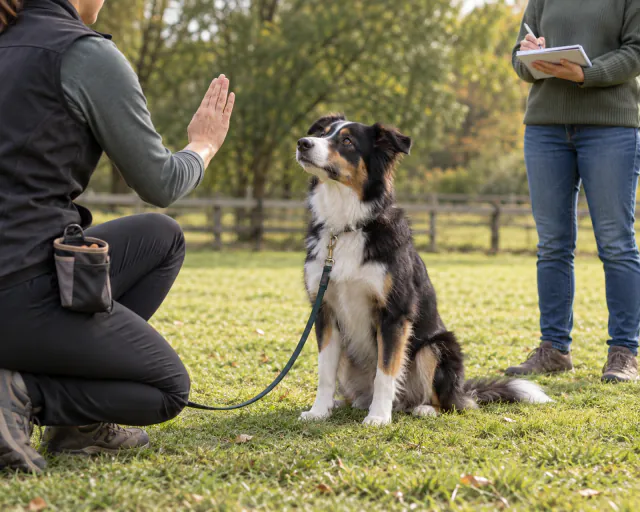
Wherever possible, ask whether you can observe a session, or part of one, before committing to a course of training. Watching a trainer work with another dog, or watching the first session with your own dog before agreeing to a longer programme, tells you more in twenty minutes than any amount of conversation. Watch specifically for the trainer’s timing, how they read the dog’s body language, how they respond when something does not go to plan, and whether the dog in front of them looks engaged rather than shut down or overwhelmed.
If a stalled plan is the reason you are looking for a new trainer in the first place, what to do when a training plan is not working covers how to judge whether the issue is genuinely the approach or something else worth fixing first.