- Session length
- 5 minutes, once a day, plus every real arrival
- Skill
- Distraction proofing
- Suits
- Any age
What you need
- The settle mat from the earlier lesson, placed within sight of the door
- A house line or lead to prevent rehearsal during real arrivals
- Soft food rewards kept in a pot by the front door
- A stair gate or closed door to create separation when needed
Jumping up is a friendly behaviour with an unhelpful shape. Dogs greet face to face, and every time a visitor has laughed, pushed them off or made eye contact mid-jump, the behaviour has been paid. This lesson does not try to stop jumping directly. It teaches an alternative that pays better, and it stops the old behaviour being practised while the new one is fragile.
Purpose
By the end of this lesson the dog should stay on a mat while the front door is opened, and greet a visitor with all four feet on the floor once released. Arrivals are the hardest moment in the house because excitement, noise and a new person happen at once, which is why this lesson comes last.
Prerequisites
- A settle the dog can hold for a few minutes in a quiet room.
- A wait the dog can hold at an internal doorway.
- One helper who will follow the plan. A visitor who says they do not mind being jumped on will undo a fortnight of work in one arrival.
Equipment
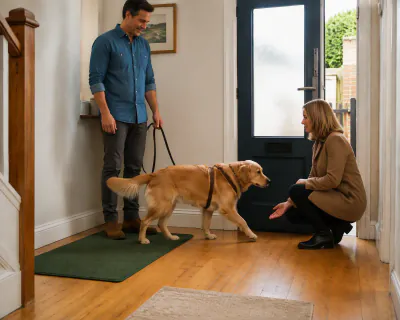
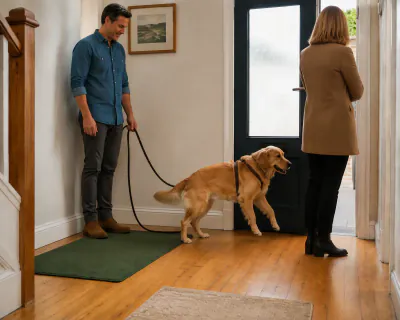
Put the settle mat where the dog can see the door but is not directly behind it, and keep a pot of food by the door. A house line, which is a light lead left trailing indoors under supervision, lets you prevent a rush without grabbing at the dog.
Method
- Start with no visitor. Cue the dog onto the mat, walk to the front door, touch the handle, then return and feed on the mat. Repeat six times.
- Extend duration first. Stand with your hand on the handle for two seconds, then five, then ten, returning to feed on the mat before each release.
- Change one element: open the door onto an empty doorstep, close it, then return and feed. Build until you can open the door fully with the dog staying put.
- Add sound. Knock on a wall, then on the inside of the door, then use the doorbell. Keep the duration short again each time the sound changes, because a doorbell is a distraction, not a duration increase.
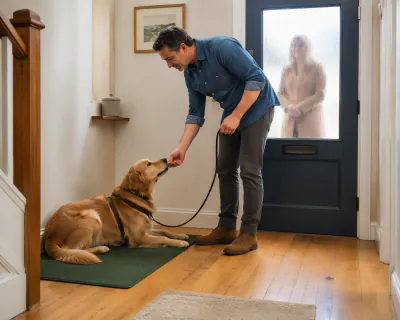
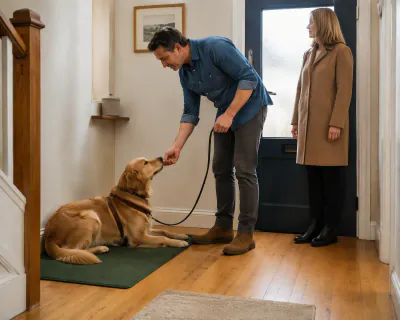
- Bring in a helper. Ask them to knock, wait outside for ten seconds while you feed the dog on the mat, then come in and stand still, hands by their sides, looking away from the dog.
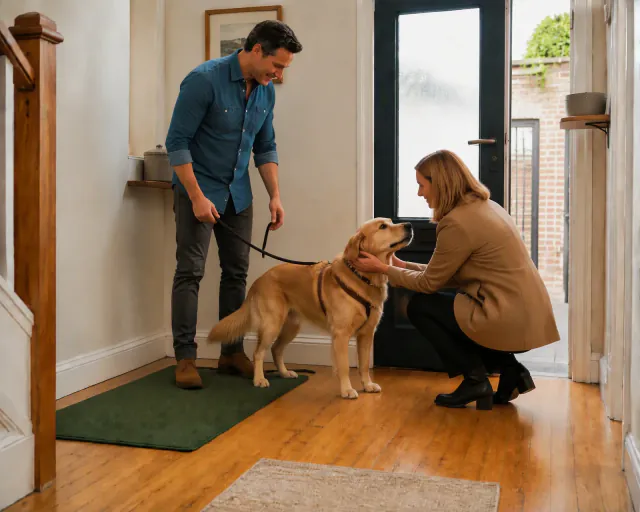
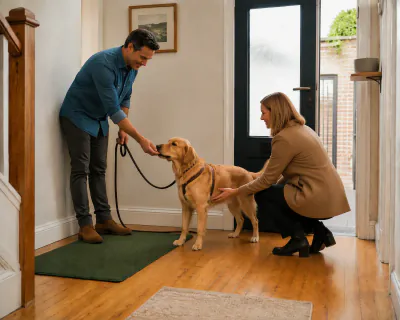
- If the dog stays on the mat, feed twice, then release with a word and let them approach. The visitor crouches side-on, hands low, and strokes the dog’s chest or shoulder, never the top of the head.
- If the dog jumps, the visitor stands up, turns away and says nothing. The moment all four feet are back on the floor, they crouch again. Repeat until the dog offers four feet without that cycle.
- Add distance next, keeping everything else the same. Practise from further inside the house, so the dog holds the mat while you walk a hallway to answer the door.
- Add distraction last and one layer at a time: a helper who talks, a helper carrying a bag, two helpers, a helper the dog is genuinely excited about.
- Manage every real arrival. Use a gate or another room for deliveries and unplanned callers so the dog does not practise jumping between sessions.
- Take the same standard outdoors. On a walk, ask for four feet on the floor before anyone greets your dog, and say no to strangers who reach for an excited dog.
Session length
Five minutes of staged practice once a day, plus a plan for every real arrival. Two or three staged arrivals per session is enough, because excitement rises with each one and a fourth is often worse than the third.
Progression criteria
Move on when the dog stays on the mat through a knock and a door opening, and greets with four feet on the floor, in nine out of ten staged arrivals across three sessions with at least two people. Count any paw on a person as a failure, however light. If you fall short, go back to arrivals with no visitor and rebuild the duration.
Common mistakes
Practising only with the same helper builds a dog who greets that one person calmly. Allowing occasional jumping because a visitor does not mind makes the behaviour more persistent, not less, because it is now paid unpredictably. Holding the collar through a whole greeting prevents jumping without teaching an alternative.
Troubleshooting
If the dog breaks the mat as soon as the knock happens, the sound is too strong a distraction, so knock more quietly and build up. If the dog is calm at the door but jumps two minutes later, the greeting is not finished, and the visitor needs to stay boring for longer while you keep paying. Some dogs bred for close human contact, including many spaniels and retrievers, find greetings especially hard to contain, though that varies by individual.
Safety and when to stop
Stop if the dog is frightened rather than excited. Barking with a stiff body, backing away, growling, hiding or hard staring at a visitor is fear, not enthusiasm, and pushing through it makes things worse. That needs a qualified behaviourist working alongside your vet, and any sudden change in how a dog reacts to people should be checked by a vet first, since pain can change tolerance. Do not use lead corrections, sprays, noise devices or knees to interrupt jumping. If your dog is large enough to knock someone over, manage arrivals with a gate until the training is reliable.
Next lesson
Continue with polite food manners, which applies the same impulse control to mealtimes and food left within reach.
Useful tool
The dog exercise planner helps here because greetings go badly when a dog arrives at the door with unspent energy, and a day with proper sniffing and free movement makes calm arrivals much easier.