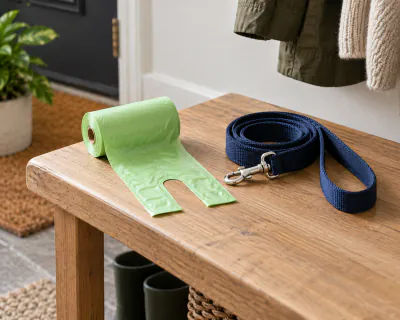
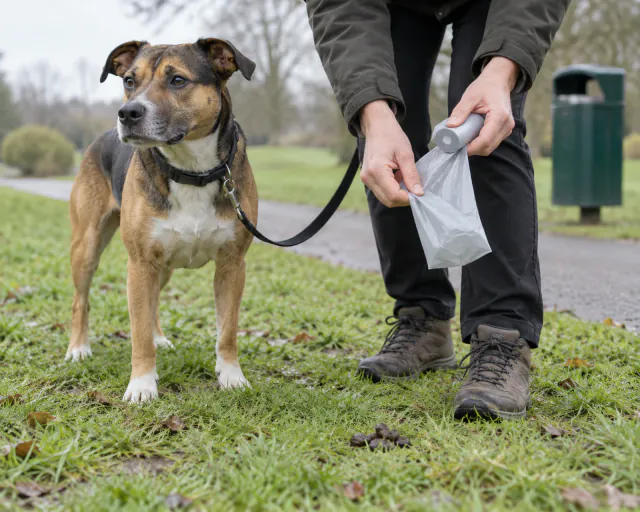
A poo bag is the cheapest thing a dog owner buys and the one with the least room for error. It either holds, or the walk changes character entirely. Most owners choose on price or on the word on the front of the box, and the word on the front of the box is where this subject gets complicated: recycled, biodegradable and compostable describe three different things, only one of which is tightly defined, and none of which changes what happens to a bag of dog waste in an ordinary UK bin. This guide covers the bag itself, what the labels mean, and where the bag is supposed to end up.
How products are chosen
Canine Origin has not tested these bags hands-on. Each one was chosen from the maker’s published details and a UK listing, checked against the criteria below, and every specification on the product cards names the page it came from and the date it was read. The criteria are published bag dimensions, published thickness in microns, the stated material composition, whether the bags have tie handles, whether a specific composting standard is named rather than a vague claim, and what the maker tells you to do with the bag afterwards. How a bag behaves in the cold, whether a roll tears cleanly at the perforation after a month in a pocket, and whether a seam survives a heavy load are matters of months of use, so no claim is made about them here.
How to choose a poo bag
Start with the dog. A bag that is generous for a terrier is a knuckle-scraping exercise for a Labrador, and the two figures that matter are the flat width and the length. Anything around 33 cm long gives room to tie a knot without your hand near the contents. Thickness is published in microns and sits between roughly 15 and 20 for the bags on this page: thicker material is more forgiving of a sharp stick or a gravel edge, and it also uses more material, which is the trade-off nobody writes on the box.
Then think about how you carry them. A roll that fits a standard dispenser is the simplest option and the easiest to refill. Tie handles make one-handed knotting far easier if you are also holding a lead, which matters more than it sounds when you are managing a dog on a narrow pavement. Our guide to what to carry on a dog walk covers where the roll actually lives, and a treat pouch with an outside pocket often ends up doing that job.
Finally, decide honestly what you want the bag to do beyond its five minutes of work. That is where the labels come in.
Recycled, compostable and biodegradable
These three words are not interchangeable, and the difference is the single most useful thing to understand before buying.
Recycled describes what the bag is made of. A bag made largely from post-consumer recycled polyethylene diverts plastic that already exists rather than making new material. It stays plastic. Beco states plainly on its own product page that its bags are not compostable and that very little breaks down in landfill, “including most things marketed as biodegradable”. Pet Impact takes the same position and adds recovered oyster shell to the mix, and its bags are labelled for general waste and dog waste bins rather than for composting.
Compostable is the one term with a definition behind it. The European standard EN 13432 sets out what a material has to do to be called compostable, and TUV certification tests it in either home or industrial composting conditions. Adios Plastic states that its cornstarch and PBAT bags are certified to EN 13432 and TUV standards, and that they can break down in three to six months in warm, moist, aerated conditions. Those are real conditions, not a bin.
Biodegradable on its own means very little. Almost everything biodegrades eventually, under some conditions, and the word carries no test, no timescale and no environment. The Competition and Markets Authority’s Green Claims Code makes the point that an environmental claim has to be accurate and must not hide information that would change how the claim reads, and a bare “biodegradable” on a poo bag is exactly the sort of claim that invites a reader to assume something the maker has not said. GOV.UK’s own guidance for woodland managers goes further and advises avoiding the word altogether, “to prevent visitors from thinking they can leave them in the woodland”.
There is a fair argument on both sides here, and it is worth knowing who is making it. Vet Sustain published a piece arguing that composting certifications are largely irrelevant in practice because there are no UK industrial composting facilities that accept dog waste and few owners have a dedicated dog waste composter, so reusing existing plastic is the better route. That piece was written by a co-founder of Pet Impact, one of the brands on this page, which does not make it wrong but is worth weighing. The counter-argument, which Adios Plastic makes on its own site, is that a certified compostable bag is still preferable at end of life even when it goes to general waste. Neither position turns a poo bag into an environmental good deed. Picking the bag up at all is the part that matters.
Where the bag goes afterwards
For almost everyone, the answer is the general waste bin, and every maker on this page says so. Beco states its bags are not flushable and are “not suitable for food waste or garden waste collections”. Adios Plastic says a doggy poo bin or a black bag is fine, and warns that its bags are not flushable either. Home composting a compostable bag is possible in a dedicated dog waste composter or wormery, kept separate from food waste, and Adios Plastic is clear that the resulting compost must not be used on anything edible.
Out on a walk, GOV.UK’s guidance is that any public waste bin will do for bagged dog waste. What is never acceptable is the bagged waste hung on a branch or left beside the path for collection later. The same guidance notes that dog waste and bags can kill sheep, cattle and wildlife, which is the practical reason our guide to walking near livestock treats this as a farm safety issue rather than a tidiness one.
Safety and hygiene
Dog waste can carry parasites and bacteria that pass to people and to other animals, so treat the bag as the barrier it is. Use a fresh bag each time, knot it before it goes in a pocket or a pouch, and wash your hands when you get home. Do not reuse a bag, and do not let a child carry one. Keep rolls out of reach of the dog: a swallowed roll or a chewed dispenser is an obstruction risk, and the same goes for a discarded full bag, which some dogs will happily pick up again.
If you notice anything unexpected in what you are picking up, such as blood, mucus, a sudden change in consistency that lasts more than a day, or anything that looks like a worm, that is information worth acting on rather than ignoring. Our guide to routine health checks at home covers what is worth noting and when to ring the vet. Puppies are a special case: frequent, soft stools during house training are normal, and the toilet-training routine lesson sets out what a settled pattern should look like.
When to replace a roll, and questions to ask
Bags do not have a shelf life in any meaningful sense, but a roll that has been crushed in a pocket for months tears badly at the perforations and is worth retiring. Cornstarch-based compostable bags are the exception: they are designed to break down, so store them somewhere cool and dry and use them within a reasonable time rather than keeping a two-year supply in a shed.
Before buying, ask: is the bag long and wide enough for my dog, will I use the handles or are they just extra material, does the pack fit the dispenser I already own, and does the label name a standard or only a mood. A bag that names EN 13432 has been measured against something. A bag that says only “eco” has not. Our guide to walking a dog in busy urban environments covers the rest of the pavement etiquette that goes with it.