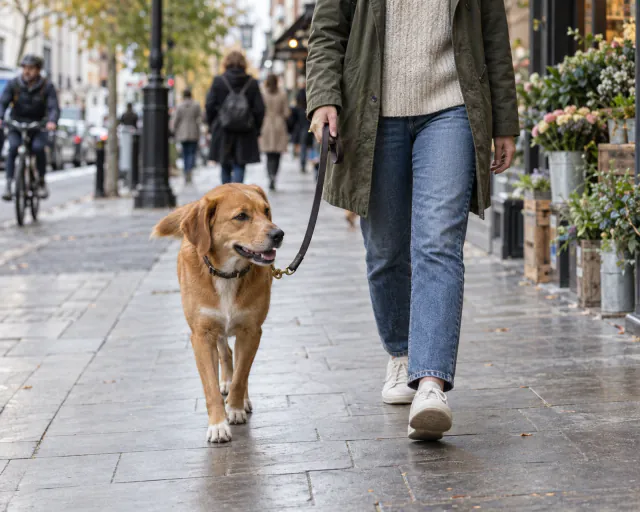
A city or town walk asks a very different set of questions of a dog than an open field or a quiet country lane does. Traffic never really stops, pavements are shared with bikes, scooters, prams and other dogs at close quarters, and the sheer density of sound, movement and smell can be exhausting for a dog even on a short outing. None of this makes urban walking unsuitable, but it does mean the approach that works in open countryside often needs adjusting.
This guide covers the specific challenges of walking in a busy urban environment: traffic and crossings, reactions to wheeled traffic sharing the pavement, managing close contact with other dogs and people, lead choice and footing in crowds, hot pavement surfaces, and helping an overstimulated dog find some calm.
Traffic and crossing safety
Urban traffic is close, frequent and often moving faster than it looks from the pavement. Keep the dog on a short lead near any road, ideally within a metre or so of you rather than ranging to the end of a longer lead, and never allow a dog off lead near a road regardless of how reliable its recall is elsewhere, since traffic noise and other stimuli reduce a dog’s responsiveness exactly when it matters most.
Use formal crossing points rather than crossing wherever a gap looks convenient, and treat the crossing itself as a moment requiring full attention rather than a chance to check a phone or greet a passer-by. A dog sitting or standing calmly at your side while you wait to cross is a genuinely useful skill worth practising specifically at kerbs, separate from general loose-lead walking.
Bikes, scooters, skateboards and prams
Fast-moving, quiet or unusually shaped wheeled traffic on shared paths and pavements can startle a dog that copes fine with cars and pedestrians. A silent electric scooter or a skateboard rattling past at speed can trigger a lunge, a bark or a sudden dodge sideways into your legs or into the path of something else.
Watch ahead for this kind of traffic approaching and give the dog a cue and a wide a berth as the pavement allows before it arrives, rather than waiting for a reaction and then managing it. Rewarding calm attention to you as something passes, rather than only reacting after a bark or lunge, builds a more reliable response over repeated exposure than correction alone.
Close contact with people and other dogs
Urban pavements often force closer contact with people and other dogs than either party would choose in open space. Narrow pavements, doorways and queues outside shops all create tight passing distances where an uninvited greeting is hard to avoid entirely.
A short lead gives you the most control in these moments, since it lets you position the dog closer to your side and step slightly wider around an approaching dog or person if needed. Where another dog is clearly straining towards yours, it is reasonable to cross the road, step into a doorway or turn briefly rather than allow a greeting neither dog signed up for. Not every dog wants to meet every dog, and a busy urban pavement is rarely the ideal spot for an introduction even between two friendly dogs.
Footing, lead management and crowds
Crowded areas call for a shorter lead than you might use elsewhere, both to keep the dog closer and to reduce the chance of the lead being stepped on, tripped over or wrapped around someone’s legs. A long line, useful in open space, is a poor choice on a busy urban pavement, since there is neither the sightline nor the room to manage several metres of slack safely among moving people. Details on choosing and handling a long line properly, for the settings where one does suit, are covered in the guide on using a long line safely.
Keep an eye on the ground itself too. Broken paving, drain covers, wet leaves outside cafés and general street debris are all more likely underfoot in a town centre than on a rural path, and a dog moving suddenly to avoid or investigate one of these can catch you off balance if the lead is held loosely.
Hot pavement surfaces
Paved and tarmac surfaces absorb heat far more than grass or soil, and a pavement or road surface can reach a temperature that burns a dog’s paw pads on a warm day well before the air temperature alone would seem concerning. This is a genuine and often underestimated risk in urban walking specifically, since so much of an urban route is paved rather than natural ground. The detail on checking surface temperature, timing walks around the hottest part of the day and recognising the signs of heat-related harm is covered fully in the guide on temperature and heat risk awareness, and it is worth reading alongside this one for anyone walking dogs regularly in a built-up area during warmer months.
Managing arousal and building in calm
Constant stimulation, whether from traffic, other dogs, unfamiliar people or general noise, can push some dogs into a state of ongoing low-level stress or excitement that does not settle on its own during the walk. Signs include a dog that will not stop scanning, struggles to take food rewards it would normally accept readily, or seems unable to relax even once home.
Build brief decompression points into an urban route where possible: a quieter side street, a small green space, or simply a pause somewhere away from the busiest stretch of pavement, where the dog can sniff, settle and recover before continuing. This is not wasted time on the walk. A dog given the chance to come down from a heightened state partway through tends to cope better with the rest of the outing than one kept at a constant level of stimulation from door to door.
Choosing quieter routes and times
For a dog who finds constant urban stimulation genuinely overwhelming rather than simply exciting, changing the route or the time of day can make more difference than any amount of in-the-moment management. An early morning or late evening walk before the streets are at their busiest, a route that favours a park or a residential side street over a main shopping strip, or splitting one long walk into two shorter ones at quieter times, can all reduce the cumulative load an urban environment places on a dog that struggles with it. There is no requirement to walk the busiest, most direct route simply because it is the obvious one, and a dog that copes better on a quieter alternative is getting more genuine benefit from the walk even if it covers less distance.