Dogs cool themselves far less efficiently than people do, and the mechanisms involved are easy to underestimate because they are not obvious from the outside. Understanding how a dog’s body actually deals with heat, and which individual dogs are more vulnerable, makes it much easier to recognise a problem developing before it becomes a genuine emergency. This article focuses on the physiology and the recognition side of heat risk; for practical advice on planning and timing a walk itself, see the separate guide on walking a dog safely in hot weather.
Heat-related illness in dogs is not rare, and it is not limited to obviously extreme conditions. Warm, humid days that would feel merely uncomfortable to a person can be genuinely dangerous for a dog engaged in ordinary exercise, and the margin between coping and struggling can be narrower than owners expect.
How dogs actually lose heat
People cool down mainly by sweating across the whole skin surface, which is a highly effective mechanism. Dogs sweat only through their paw pads and nose, which contributes very little to overall cooling. Their main mechanism is panting: moving air rapidly across the moist surfaces of the mouth, tongue and upper airway to evaporate saliva and shed heat that way.
Panting has real limits. It becomes markedly less effective in humid air, because evaporation slows when the surrounding air is already holding a lot of moisture, and it becomes less effective in any dog whose airway is narrowed or obstructed to any degree. A thick or dense coat also traps heat close to the body and can work against a dog’s own cooling effort, even though coats also provide some protection from direct sun on the skin.
Because panting is the main tool available, anything that limits it or requires the dog to increase it dramatically, such as vigorous exercise, excitement, stress or restricted airflow, raises the overall risk in hot conditions.
Which dogs face higher risk
Some dogs are considerably more vulnerable to heat than others, generally because something about their anatomy, age, size or health status limits their ability to dissipate heat effectively.
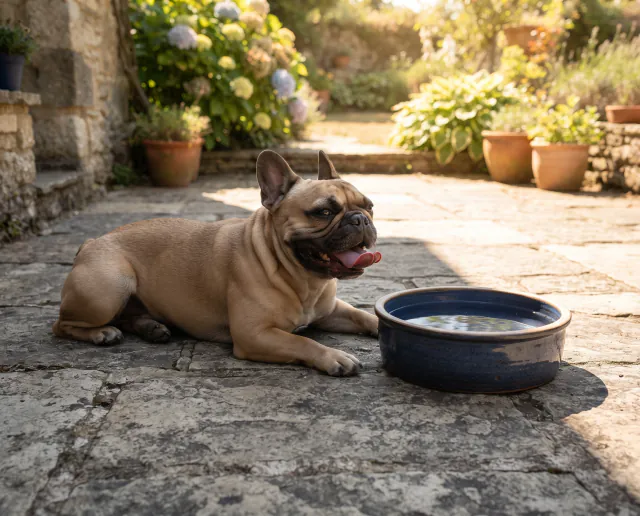
- Flat-faced (brachycephalic) breeds have airways that are narrower and more restricted than average, which makes panting a much less effective cooling tool. Breeds such as the French Bulldog and the Pug fall into this category, along with other short-muzzled breeds and their crosses.
- Thick-coated and double-coated breeds retain heat close to the body more than short, single-coated breeds do.
- Very young puppies and older dogs both regulate body temperature less efficiently than a fit adult dog.
- Dogs carrying extra weight generate more internal heat during activity and have a thicker insulating layer working against them.
- Dogs with existing heart or respiratory conditions have less physiological reserve to cope with the extra demand that heat places on the body, and the same applies to dogs recovering from illness or on certain medications; ask your vet what precautions make sense for your individual dog if any of this applies.
- Dogs that have previously experienced a heat-related episode appear to be at higher risk of a further one, so extra caution is sensible for the rest of that dog’s life during warm weather.
More than one of these factors is common in an individual dog, and where they combine, the level of caution needed rises accordingly rather than simply adding up in a predictable way.
Recognising early heat stress
Early signs are subtle and easy to write off as normal tiredness on a warm day. They include heavier panting than the effort would normally justify, seeking shade or slowing down of its own accord, lying down repeatedly, reluctance to continue moving, and a generally flatter demeanour than usual. A dog showing any of these signs has already told you it needs to stop and cool down, and continuing the activity because the destination is close or the walk is nearly finished is a common and avoidable mistake.
At this stage, moving the dog to shade, offering water, stopping all activity and allowing the panting to settle is a reasonable and proportionate response. Most dogs recover well from this stage once removed from the heat and allowed to rest, but they should still be watched for a while afterwards rather than simply returned to activity once the panting slows.
Recognising a genuine emergency
Heatstroke is a different order of problem and looks noticeably more severe than ordinary tiredness. Signs that point towards a genuine emergency include heavy, laboured panting that does not settle with rest and shade, bright red or very pale gums, thick drooling, vomiting or diarrhoea, wobbliness or apparent disorientation, collapse, seizure-like activity, or a dog that becomes unusually quiet, unresponsive or difficult to rouse. Any of these, alone or together, should be treated as a genuine emergency rather than something to monitor for a while longer.
Heatstroke can develop and worsen quickly, and it can be fatal without prompt treatment. It is not a condition where a wait-and-see approach is appropriate, and there is no reliable way to judge severity from the outside well enough to justify delay.
Immediate steps while getting to a vet
If you suspect a dog is showing signs beyond early heat stress, contact your vet or the nearest emergency out-of-hours service immediately and follow their instructions while arranging transport. While you do that, move the dog into shade or a cool, well ventilated area, offer water if the dog is alert enough to drink but do not force it, and use cool (not ice-cold) water or damp towels on the body, particularly around the neck, armpits and groin, to help lower body temperature gradually. Increasing airflow with a fan or open windows in the vehicle also helps.
Avoid fully submerging a dog in ice-cold water or applying ice directly, since a very rapid drop in surface temperature can cause blood vessels near the skin to constrict, which paradoxically slows the loss of heat from the body’s core and can make the situation worse rather than better. Gradual, steady cooling combined with prompt veterinary care gives a far better outcome than an aggressive attempt to cool the dog as fast as possible on your own.
Plan around the risk, not just the temperature
Because exertion generates so much of a dog’s internal heat, planning activity levels around the day’s actual conditions, rather than a fixed daily routine, meaningfully reduces risk. The Dog Exercise Planner can help you put together a lower-intensity pattern of walking, play and mental stimulation for a hot day, so a dog’s exercise needs are still met without pushing into conditions that raise heat risk unnecessarily. Combined with the timing, shade and ground-temperature checks covered in the hot-weather walking guide, this gives a fuller picture of how to manage warm conditions safely rather than reactively.