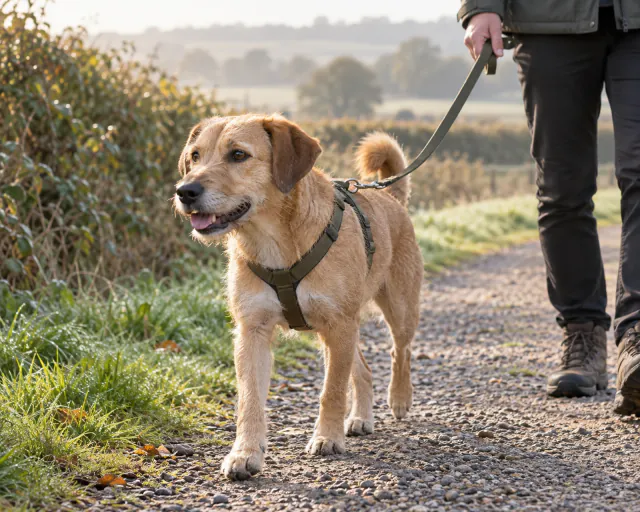
This guide is for owners whose dog already walks reasonably well on the lead and who want a harness that is comfortable, stays put and is easy to live with every day. If pulling is the real problem, start with our guide on how to stop a dog pulling on the lead instead: front-clip and no-pull harnesses are a separate buying question that this guide does not cover. For a dog that already walks nicely the priorities are different. You want the shoulders left free, a back clip that puts no sideways pressure on the body, a fit the dog cannot back out of, and materials that suit the walks you actually do.
How products are chosen
Canine Origin has not handled or tested these harnesses. Each one was chosen from the maker’s published details and a UK stockist’s listing, and every specification on the product cards names the page it came from. The criteria were a published size chart or measuring method, where the lead attaches, how the harness goes on, what it is made of and how to wash it, reflective detailing, what the maker says about fit, and a current UK listing. How comfortable a harness stays over months of wear, whether it rubs on a particular dog, how quickly it dries and how well it holds a determined dog that reverses can only be judged in use, so no claim is made about any of them.
Y-fronts, chest straps and what the gait studies show
Everyday harnesses come in two broad shapes at the front. A Y-front harness has a strap running from the neck down the breastbone and between the front legs, so nothing crosses the point of the shoulder. A horizontal-strap harness has a band running straight across the front of the chest. Dogs Trust advises avoiding harnesses that cross directly in front of the shoulders because they can get in the way of natural movement, and that is the main reason many owners choose a Y-front.
The research is thinner and less tidy than that advice suggests. In a Veterinary Record study, Lafuente and colleagues filmed nine dogs walking and trotting on a treadmill, first with no harness and then in two harness designs: one with a strap across the chest, sold as restrictive, and a Y-shaped one sold as non-restrictive. Both harnesses generally reduced how far the shoulder extended compared with no harness. Unexpectedly, the Y-shaped harness reduced it slightly more, by about 2.6 degrees at walk and 4.4 degrees at trot. A systematic review by Blake and colleagues found only three studies of harness biomechanics, judged most of them weak on sample size or method, and noted that the Lafuente study was limited by its small number of dogs. A larger study by Williams and colleagues in 2023 analysed 66 dogs walking on a loose lead in three commercial harnesses. It found differences in stride length and in how weight was shared between the front and hind legs, and the differences varied between breed types.
In practice, no design has been shown to leave a dog’s movement untouched, and the fit on your own dog matters more than the label on the box. A Y-front remains a sensible default because it keeps straps off the point of the shoulder, but watch any harness in motion and judge the stride, not only the straps.
Where the lead clips on
For a dog that walks well, a ring on the back, between or just behind the shoulder blades, is usually the most comfortable place to clip the lead. It puts no sideways pressure on the body and leaves the chest free. Several harnesses here also have a chest loop or front point, which is handy on a busy street or during an excitable phase, but that is not why they were chosen. Long lines are a separate case. Clip a long line to the back ring of a harness, never to a collar, so that a dog that hits the end of the line at speed takes the jolt through its body rather than its neck. Battersea also recommends the back fastening because it keeps the line further from the dog’s feet. Our long line guide covers handling.
Over the head, step-in or buckled at the neck
Most Y-front harnesses go on over the head and then fasten around the chest. That is quick with a relaxed dog but unpleasant for one that ducks or backs away when anything comes near its ears, and Dogs Trust suggests designs that clip around the neck and body for these dogs. A step-in harness is laid on the floor, the dog steps its front feet through, and it fastens on the body. A neck buckle does a similar job on a strap harness: the neck loop opens, so nothing passes over the head. If your dog already dislikes being handled around the head, choose one of these designs and introduce it slowly with food rather than expecting the dog to get used to it.
Padding, webbing, drying time and visibility
Padding spreads pressure and can suit a thin-coated or bony dog, but it adds bulk and warmth, and fabric-covered foam and mesh linings can hold water. A padded harness that goes on damp every winter morning is more likely to rub and smell. One maker here uses closed-cell foam, which it says is there to stop water seeping in. Light webbing or a thin ripstop shell has less material to soak up water, which suits warm days and dogs that swim, but narrow straps concentrate pressure on a smaller area, so the fit matters even more. Whichever you choose, let it dry fully before it goes back on the dog. Reflective trim helps drivers and cyclists pick out a dog in headlights, and a loop for a clip-on light is worth having if you walk before dawn in winter. Our guide to walking in low light covers the rest.
Three-strap designs for dogs that reverse out
A standard two-strap harness has a neck loop and a chest strap just behind the front legs. A dog that stops, braces and walks backwards can sometimes slide out of it, particularly a narrow-headed dog or a deep-chested one whose ribcage narrows sharply towards the waist. A three-strap design adds a second girth strap further back, behind the ribs, which makes it harder for the harness to slip forward over the chest. It suits nervous dogs, rescue dogs still settling in and any dog that has already slipped a harness. It does not remove the risk. The harness still has to be snug, and the rear strap has to sit on the narrow part of the body, not on the ribs. Until you trust the fit, a double-ended lead clipped to both the harness and a well-fitted collar gives you a second connection.
Measuring and fitting
Measure the chest girth around the widest part of the ribcage, just behind the front legs, with the dog standing square. Measure the neck around its base, where a harness neck loop sits, which is lower than where a collar sits. Measure twice and write both figures down, then use each maker’s own chart, because makers size differently. Ruffwear sizes by chest girth but advises the smaller size between sizes for one harness here and the larger for another. Non-stop dogwear sizes its harness mainly by neck circumference. Doodlebone publishes a chest girth for each size. Our Harness Size Helper checks a girth against published charts, and the guide to choosing the correct harness size takes you through measuring.
Fit it with the dog standing first. Most makers suggest about two fingers under a strap; Dogs Trust describes a finger’s width, snug enough that the harness does not shift while the dog moves. The neck loop should rest at the base of the neck, not against the throat, and the chest strap should sit clear of the armpits. Then watch the dog walk and trot. Look for straps sliding onto the point of the shoulder, a shortened front stride, the harness twisting to one side or the back ring creeping towards the neck. After the first few walks, check behind the front legs for flattened or broken hair and pink skin. Recheck a growing puppy’s fit at least every couple of weeks, and recheck an adult after clipping, a change in weight or a seasonal change of coat.
How the five harnesses differ
The Ruffwear Hi & Light is the lightest option: a Y-front in thin ripstop with no body padding, two lead points and the widest size range here, starting at a 23 cm chest. That makes it the first to look at for small dogs and warm weather. Its trade-off is that it has no strap behind the ribs, so it depends on a good fit to stay on a dog that backs up.
The Non-stop dogwear Line Harness 5.0 is the padded Y-front, with closed-cell foam and reflective details. It suits a dog that walks for long stretches, or a thin-coated dog that benefits from some cushioning. It is sized mainly from the neck, so measure that carefully. Its under-chest and front points are useful extras rather than the reason it is here.
The Ruffwear Web Master is the choice for a nervous dog, or one that has reversed out of a harness before. It is padded, has a third strap behind the ribs and opens at the neck, so it never goes over the head. The cost is bulk and more straps to fit.
The Ruffwear Flagline is the lightweight alternative from the same maker, with a chest and belly panel and six points of adjustment, which gives more scope to fit a deep chest and a narrow waist. More adjustment also means more to get right and more to check.
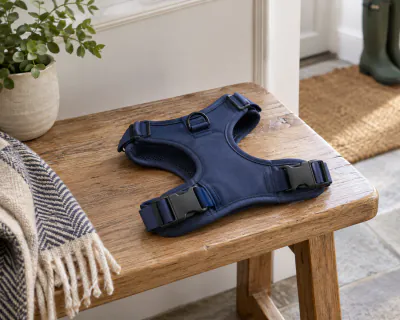
The Doodlebone Snappy is the step-in. The dog walks into it and it fastens with a hook-and-loop tab and a buckle. Its largest size stops at a 64 cm chest, so it suits small and medium dogs, and it can go in the washing machine.
Safety and supervision
Take the harness off when the walk ends. Never leave a harness on an unattended dog, and never in a crate: a strap, ring or handle can catch on crate bars, furniture or fencing, and a dog that panics when caught can hurt itself. For the same reason, never use a harness to tie a dog up and walk away. Before each walk, check that every buckle clicks shut and cannot be pulled apart, and look at the stitching where webbing meets rings and buckles, because that is where the load concentrates. Hook-and-loop fastenings lose grip as they fill with fur and wear, so press them down firmly every time. After walks, look under the harness, especially behind the front legs. Rubbing, hair loss, sore skin, or a dog that starts to hesitate when the harness comes out are signs to stop, refit or try a different design. See a vet if the skin is broken or sore, or if the dog seems stiff or lame. None of these harnesses is described by its maker as a car restraint, so do not use one in place of a travel restraint. In Great Britain a dog in a public place must also wear a collar carrying the owner’s name and address, so a harness adds to a collar rather than replacing it; the guide to harnesses and flat collars compares the two.
Care and when to replace
Follow the care label, which differs even within one brand: one harness here can go in the washing machine on a cold, gentle cycle, others are hand wash only, and one can be machine washed at 30 degrees. Ruffwear advises fastening the buckles before machine washing. Air dry away from direct heat. Rinse off salt water and mud after beach and field walks, because grit wears webbing and clogs buckles. Replace a harness once the webbing is frayed or cut, once stitching near a ring or buckle is loosening, once a buckle no longer clicks shut firmly, once hook-and-loop no longer grips, once padding has flattened, or once a growing dog has reached the end of the adjustment range. Replace a chewed harness even if the damage looks small, as the weakness only shows under load.
Before you buy
- Does your dog walk comfortably on a back clip, or is pulling the real issue? If it is pulling, our guide on stopping a dog pulling on the lead is the better starting point.
- Have you measured both chest girth and neck, and checked them against the maker’s own chart rather than a general one?
- Does your dog tolerate things going over its head? If not, choose a step-in or neck-buckle design.
- Has your dog ever reversed out of a harness or collar? If so, choose a three-strap design and use a backup connection until you trust the fit.
- Will the harness be wet most winter mornings, or worn mainly on warm days? Choose padding or light webbing to match.
- Can you watch your dog walk and trot in it at home, with the labels still attached, before the first real walk, in case you need to exchange the size?