- Session length
- 2 to 3 minutes, three or four times a day
- Skill
- Recall
- Suits
- Puppy
What you need
- High value soft food such as cooked chicken or cheese, kept separate from everyday treats
- A well-fitted harness, and a long line of five metres (about sixteen feet) once you move outdoors
- A securely enclosed space with the gate shut
- A second person to hold the puppy for the early repetitions, if one is available
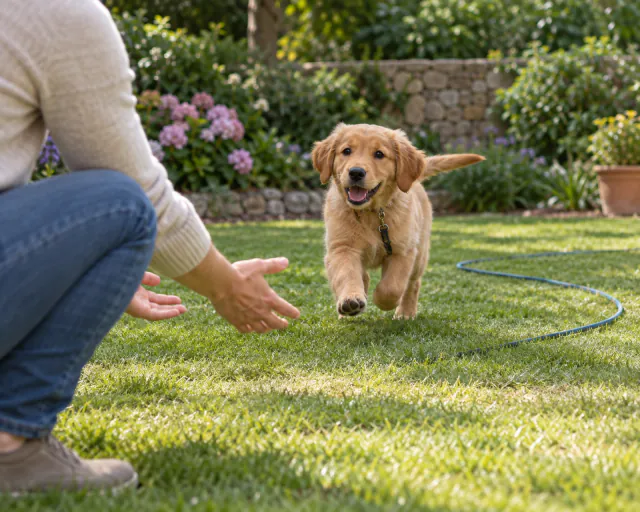
Recall is easiest to build in the few weeks when a puppy naturally wants to follow you. The aim now is not a recall for a busy park; it is a cue that has never once failed, because it has only been used where success was certain. Where dogs may legally be off lead differs between countries and local areas, so check the rules where you live.
Purpose
To build a single cue that makes your puppy turn immediately, run to you, and stay close enough to be touched until released. Turning and drifting over is not recall, and accepting it now guarantees it later.
Prerequisites
Your puppy answers to their name in a quiet room and takes food readily. You also need a genuinely enclosed space; a garden with a gap in the hedge does not count.
Equipment
A recall cue that is not the puppy’s name, so the name keeps its job of getting attention. Food better than anything else you use, kept for this purpose only. A well-fitted harness, and a five metre (about sixteen feet) long line outdoors. A whistle is worth teaching alongside the word, since it carries further and sounds the same whoever blows it.
Method
- Choose a cue word the puppy has never heard shouted, and load it indoors: say it once and immediately feed three pieces of food, whatever the puppy is doing. Repeat ten times.
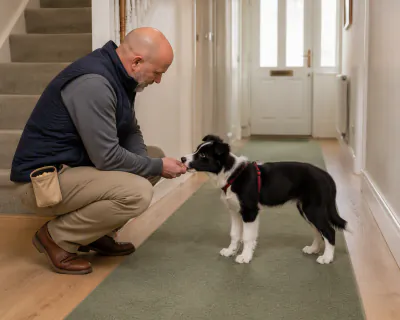
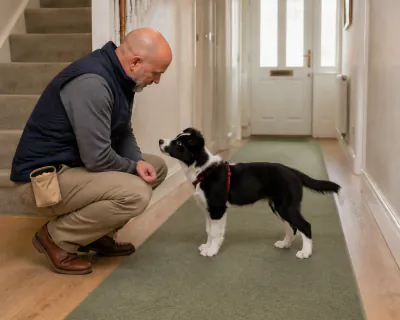
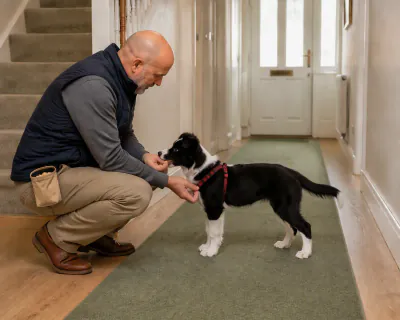
- In a corridor, wait until the puppy is a metre away and facing you. Say the cue once and feed several pieces one at a time when they arrive.
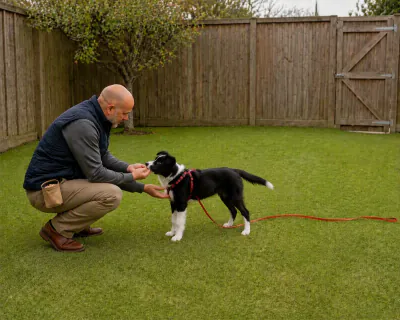
- Before feeding, slip two fingers under the harness, so the hand reaching in is always good news.
- Release the puppy with a word such as off, so the recall does not end the fun.
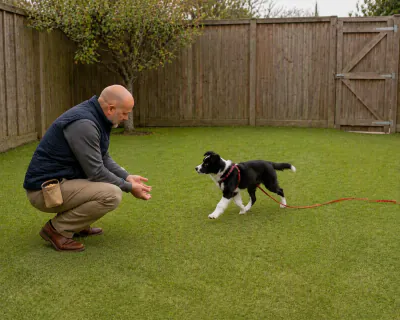
- Move to the garden and repeat at three metres (about ten feet), with the long line clipped to the harness and trailing loose.
- Extend the distance one step at a time to about six metres (about twenty feet), keeping everything else identical.
- Once distance is solid, hold it steady and add duration instead: call, hold the harness and feed for a full five seconds before releasing.
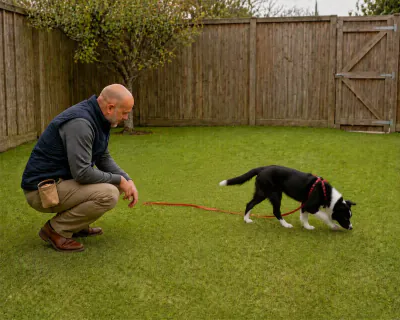
- Only then add mild distraction: call when the puppy is sniffing grass, then when a family member is standing quietly nearby.
- Several times a day, call for nothing at all and then release, so the cue never predicts the end of anything.
Session length
Two to three minutes, three or four times a day, and no more than five recalls in a session. Short and frequent builds a stronger cue than long and occasional.
Progression criteria
Move on when your puppy turns immediately and comes all the way in on a single cue, at six metres (about twenty feet) in an enclosed garden, on nine out of ten calls across three separate sessions on different days, with no second call and no clapping. Then raise difficulty by one variable at a time: distance first, then duration held at the handler, then distraction. If success drops below eight out of ten, go back a step for a session.
Common mistakes
Repeating the cue teaches that the first one is optional. Calling the puppy to do something they dislike, such as nail trimming or the end of a garden session, poisons the cue quickly. Paying with a single piece of food makes coming back less rewarding than staying away. Testing the recall off lead before it is built is how most recalls are lost. Telling off a late puppy punishes the arrival, which is the only part they connect it to.
Troubleshooting
If the puppy comes halfway and stops, you are probably leaning forward, so crouch, turn side on and let them come to you. If they come and then bounce away, take the harness before the food appears. If they ignore the cue outdoors, the environment is too hard for the stage you are at, so shorten the distance and go back inside. Puppies bred to work at a distance or to follow a scent independently often need more repetitions at the distraction stage, though that is a tendency across individuals rather than a rule. If a puppy who previously responded starts ignoring you, mention it to your vet, since hearing problems and pain can look like disobedience.
Safety and when to stop
Recall practice means running, and a puppy’s growth plates are not closed. Keep the number of sprints low, work on grass rather than concrete, and avoid calling a puppy repeatedly down slopes or stairs. Never call across or towards a road or an open gate; go and fetch the puppy instead. Stop the session while the puppy is still keen and still fast, not once they are ambling in. Slowing down, sniffing on the way and sudden frantic activity all point to over-tiredness, and the answer is sleep rather than another repetition. If your puppy is reluctant to run or tires far sooner than usual, speak to your vet.
Next lesson
Once recall is fluent in a quiet, enclosed space, move on to calm exposure to everyday sounds, which continues building the confidence a reliable recall depends on.
Useful tool
Recall practice and free running add up, and a growing puppy needs far less than most people expect, so the dog exercise planner helps keep the daily total appropriate for their age.