A growing puppy’s skeleton is not a smaller version of an adult dog’s, it is a work in progress. Growth plates at the ends of the long bones remain soft cartilage until they close, and they close at different times depending on the individual and, significantly, on breed size. Because that structure is still forming, the exercise question for a puppy is not how far they can go but how much repetitive or high-impact load their joints should be asked to absorb while they are still developing.
This matters because the instinct with an energetic young dog is often to think in terms of distance and duration, the same way an owner might plan exercise for a fit adult dog. For a puppy, that instinct works against the goal. The aim in these early months is controlled, varied, low-impact activity that tires the puppy out mentally and physically without stressing joints that are not ready for sustained, repetitive pressure.
Why growing joints change the rules
Until growth plates close, a puppy’s joints are more vulnerable to damage from repeated impact and from being pushed to run at a forced, sustained pace. This is different from a single boisterous burst of play in the garden, which is normal and generally low risk. The concern is specifically repetitive, forced or prolonged impact: the kind that comes from being asked to keep up a set pace for a set distance over and over, rather than from choosing their own pace during free play.
What to avoid while a puppy is growing
Several common activities are worth avoiding until a puppy is closer to physical maturity. Running alongside a bicycle or a jogging owner at a forced, sustained pace asks a puppy to maintain an unnatural rhythm for longer than their joints are ready for. Repetitive jumping, such as being encouraged to jump for a ball over and over, or regularly jumping on and off furniture, loads joints repeatedly in a way that free movement does not. Frequent stair use, particularly for larger and giant breeds, is another common source of unnecessary strain, so limit stairs to what is genuinely needed rather than treating them as exercise. Long forced walks, especially ones planned around a fixed distance rather than the puppy’s own energy, are the final common mistake, since a puppy will often keep going past the point where they should stop simply because they are excited or reluctant to be left behind.
Favour free play and sniffing over roadwork
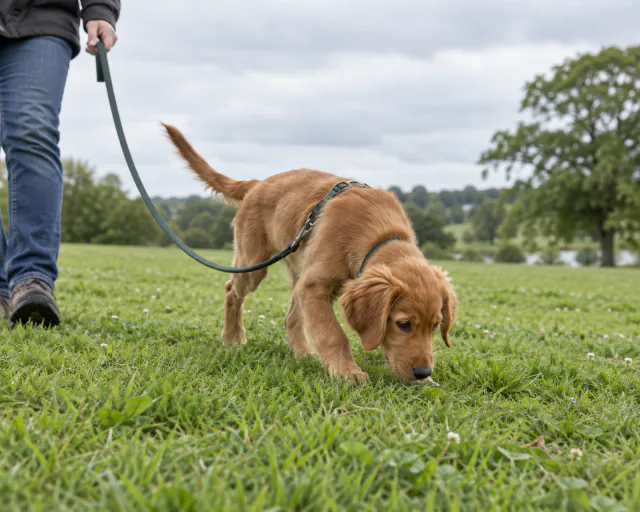
Loose, self-directed play, where a puppy chooses their own pace, changes direction freely and stops when they want to, is a far better model for early exercise than a structured walk covering a fixed route. Sniffing in particular is genuinely tiring for a puppy in a way that is easy to underestimate, engaging them mentally while asking relatively little of their joints compared with sustained walking. A short outing that allows plenty of sniffing, investigating and pottering at their own pace, is often more useful and more appropriate than a longer walk at a fixed human pace.
Breed size changes the timeline
Larger and giant breeds generally take longer to reach physical maturity than smaller breeds, and their growth plates typically stay open for longer as a result. This means the guidance to be cautious with high-impact, repetitive activity applies for a longer period in a large or giant breed puppy than it does in a small one. It does not mean large breed puppies should be exercised less overall, since they usually have plenty of energy to work through, but it does mean the type of exercise, low-impact, varied, and led by the puppy rather than forced, needs to stay that way for longer as they grow. A vet familiar with the individual puppy and breed is well placed to advise on when more structured exercise becomes appropriate.
Reading tiredness versus overexertion
Normal tiredness after a good outing looks like a puppy who settles readily afterwards, eats a reasonable meal, and wakes up moving normally. Overexertion looks different: limping or stiffness that appears during or after exercise, a marked reluctance to continue moving, excessive or prolonged panting well beyond what the activity would usually justify, or a puppy who seems sore or unwilling to bear weight properly the following day. Any of these signs are reasons to scale activity back and, if they persist or recur, to have the puppy checked by a vet rather than assuming it will resolve on its own.
Planning exercise as the puppy grows
Because appropriate exercise changes considerably as a puppy grows, from very short, gentle sessions early on through to longer and more varied activity as they mature, it helps to plan it deliberately rather than by instinct alone. The Dog Exercise Planner can help build a sensible weekly pattern suited to a puppy’s age and breed size as they develop. Once basic exercise habits are in place, teaching a reliable recall becomes one of the most useful skills for making off-lead time both safe and genuinely tiring, covered in puppy first recall.