- Session length
- 2 to 3 minutes, two or three times a day
- Skill
- Foundations
- Suits
- Puppy
What you need
- About twenty pieces of soft food the size of a pea, taken from the daily ration
- A non-slip mat, rug or carpeted area to work on
- A quiet room with the door shut
Sit and hand touch do the same job from opposite directions. A sit stops movement, and a hand touch creates it. Together they give you two polite ways to position a puppy for a lead clip, a door or a vet table, none of which involve grabbing a collar. Both are taught with food and a still hand, and both are kept deliberately short at this age, because holding a position works joints that are not finished growing.
Purpose
To teach a puppy to fold into a sit when you say the word, and to move a step or two to press their nose against your open palm. The finished versions are a sit within two seconds of a single cue, and a deliberate nose touch to a hand offered anywhere within about half a metre (about eighteen inches) of the puppy.
Prerequisites
Your puppy turns to their name in a quiet room, as covered in the first lesson, and will take food from your hand calmly. Nothing else is assumed. You do not need a lead, a clicker or a collar for either skill.
Equipment
Soft food from the measured daily ration, a non-slip surface and a quiet closed room. A slippery floor makes a puppy brace rather than sit, so a rug matters more than any equipment you could buy.
Method
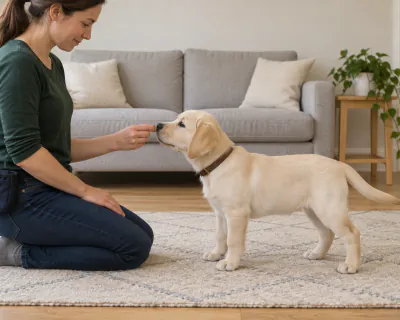
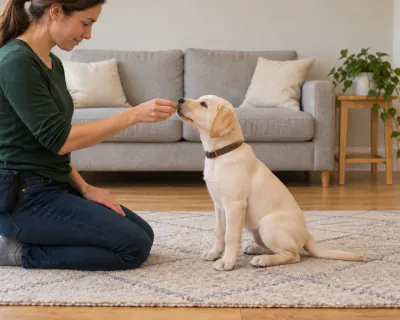
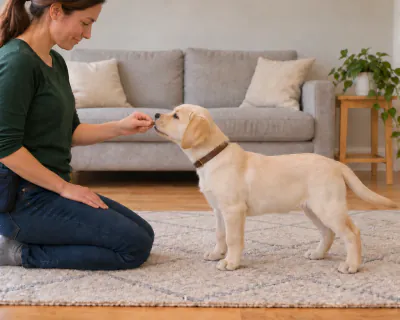
- Kneel or crouch on the mat with the puppy standing in front of you and one piece of food held between finger and thumb.
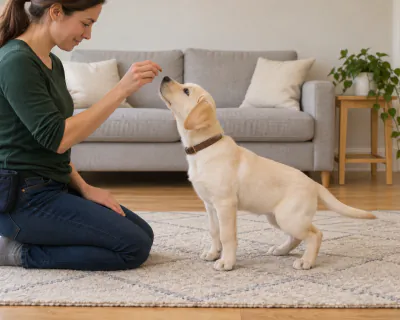
- Hold the food lightly against the puppy’s nose, then move your hand slowly up and slightly back over their head.
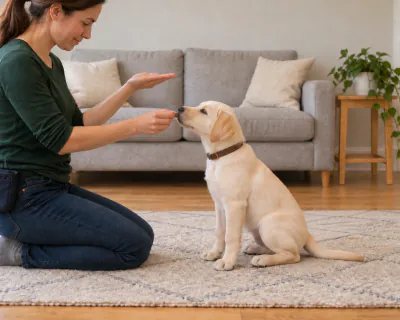
- As the nose follows upwards, the hindquarters usually fold. The instant the puppy’s bottom touches the floor, say yes and feed.
- Repeat three times with the food in your hand, then do the same movement with an empty hand and feed from the other hand afterwards.
- Once the empty hand works three times in a row, add the word sit as the puppy begins to fold, then fade the movement to a small lift of the fingers.
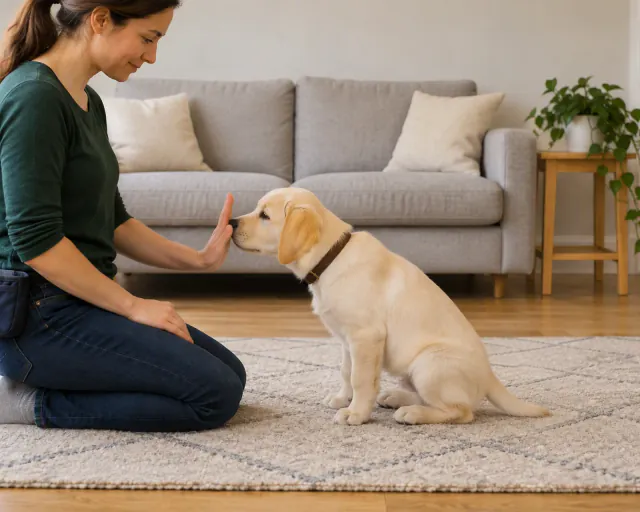
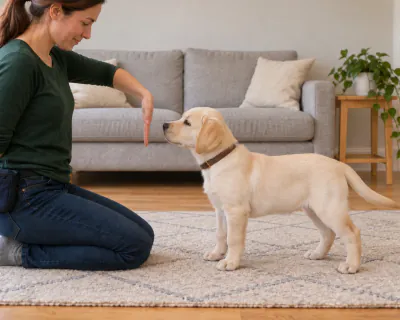
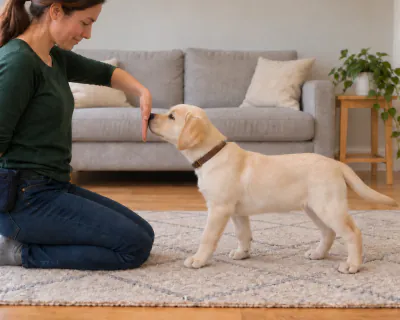
- For the hand touch, put the food behind your back and offer your other hand flat and open, palm towards the puppy, a few centimetres from their nose.
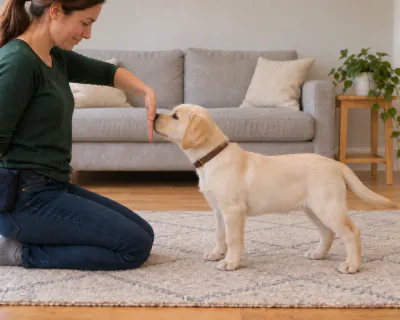
- The moment the nose makes contact, say yes and feed from the other hand. Take the target hand away between repetitions so it is offered fresh each time.
- Add the word touch once the puppy is making firm contact five times in a row, then present the hand slightly further away so the puppy takes one step to reach it.
Session length
Two to three minutes, two or three times a day. Work one skill per session, and stop at eight to ten repetitions. Short sessions spread through the day beat one long session at this age.
Progression criteria
Move on when your puppy sits within two seconds of a single spoken cue on eight out of ten attempts, across three separate sessions, with no food in the cueing hand. For the hand touch, look for eight firm nose touches out of ten with the hand offered at one step’s distance, again across three sessions. Then add difficulty one variable at a time: first a three second sit, then the same cue in a second room, then a mild household distraction. Do not add two at once.
Common mistakes
Pushing a puppy’s rear down is the most common error and the least useful, because it teaches the puppy to brace against pressure. Holding the lure too high tips the puppy onto their back feet instead of folding them. Saying the word before the behaviour exists means the word gets paired with guessing. Waving the target hand at the puppy turns a clear signal into a moving object to chase.
Troubleshooting
If the puppy backs up rather than sitting, work with their hindquarters near a wall. If they jump for the food, the hand is too high, so lower it until it is grazing the nose. If they bite at the target hand, offer it briefly and feed the instant the nose touches. Some heavier or longer-backed puppies find a tidy square sit uncomfortable, and a slightly sloppy sit is fine at this stage. If your puppy repeatedly sits crookedly, yelps as they fold or avoids sitting altogether, stop asking and speak to your vet, since discomfort can present as reluctance to take a position.
Safety and when to stop
Growing joints and soft growth plates mean repeated hard sits on a slick floor are not a neutral activity. Work on carpet or a mat, keep the number of repetitions low, and do not ask a young puppy to hold a sit for more than a few seconds. Stop the session before the puppy loses interest. Yawning, scratching, mouthing, sudden zooming about or simply walking away usually means over-tiredness, and the correct response is sleep rather than persistence. Never train a puppy who has just eaten a full meal or has just woken up.
Next lesson
With two positioning skills in place, move on to lying down, which builds a calmer, lower-effort position on top of the sit you have just taught.
Useful tool
Because these sessions use food from the daily ration, the dog food calculator is worth a few minutes, so training treats come out of the measured allowance rather than on top of it.