- Session length
- 2 to 3 minutes, two or three times a day
- Skill
- Foundations
- Suits
- Puppy
What you need
- About twenty pieces of soft food the size of a pea, taken from the daily ration
- A non-slip mat, rug or carpeted area to work on
- A low sofa, wall or step nearby to use as a fallback if your puppy pops back up
A reliable down gives you a lower-effort resting position than a sit, and it is the position most of the calmness work later in this pathway is built on. It is also one of the easiest cues to teach badly, because pushing on a puppy’s shoulders or rear looks like it should work and does real harm to the learning and, potentially, to a growing joint. This lesson builds the down entirely through food placement, so the puppy chooses to fold rather than being placed.
Purpose
To teach your puppy to lie down, chest and elbows on the floor, within a couple of seconds of a single spoken cue, without any physical pressure from your hands. This position matters because it is more physically restful than a sit, it is the base for the settling work in the next lesson, and it gives you a calm, low default to ask for around the house, at the vet or in a cafe later on.
Prerequisites
Your puppy holds a sit for a couple of seconds and will follow a piece of food with their nose down towards the floor, both covered in the previous lesson. Nothing else is assumed, and no lead or collar is used for this exercise.
Equipment
Soft food from the measured daily ration, a non-slip surface such as a rug or carpet, and a quiet room to start in. Keep a low sofa, a step or a wall corner within reach, since it becomes useful if your puppy tends to stand up rather than lie down.
Method
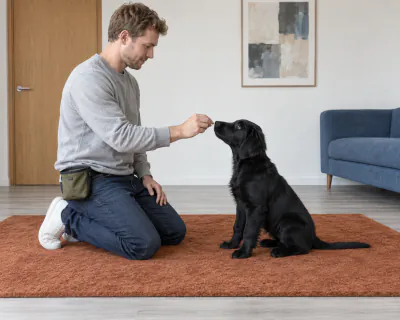
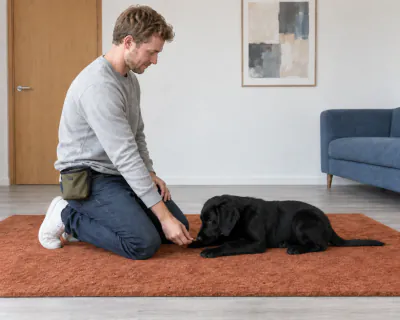
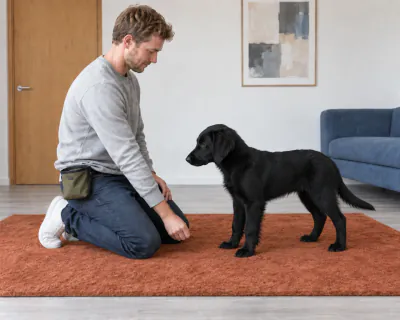
- Start with your puppy in a sit in front of you, kneeling or crouching so you are close to the floor.
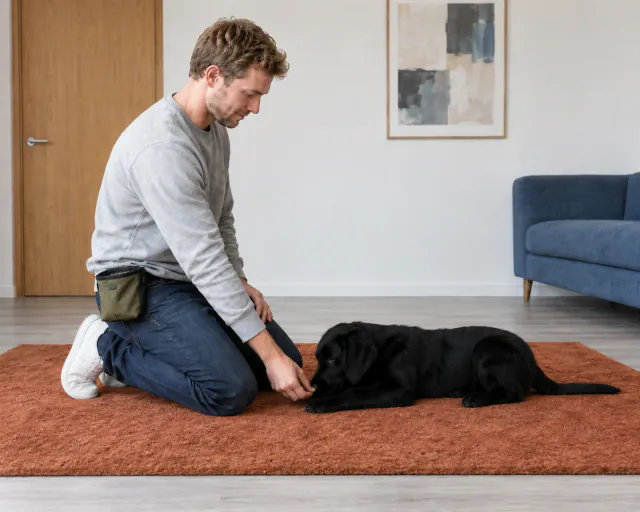
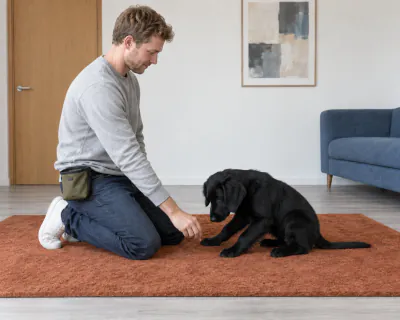
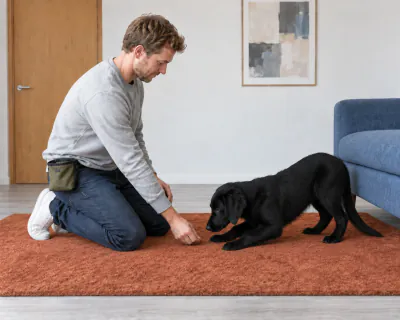
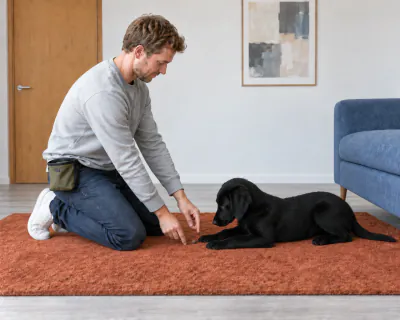
- Hold a piece of food at the puppy’s nose, then move it slowly straight down to the floor, then slightly back between the puppy’s front paws.
- As the nose follows the food down and back, most puppies fold their elbows and chest to the floor rather than standing to reach it. The instant the elbows touch down, mark and feed.
- If your puppy stands up instead of folding, you have likely moved the food forwards rather than back, or moved too quickly. Reset to the sit and slow the movement down.
- For a puppy who repeatedly pops back into a stand, try the same lure with their hindquarters close to a low sofa or a wall corner, so there is nowhere to shuffle backwards or sideways into.
- An alternative for puppies who find luring frustrating is to capture the behaviour instead: wait for a moment when the puppy naturally lies down on their own, mark the instant it happens and feed on the floor between their paws, without ever touching them.
- Once the food lure produces a down reliably, repeat the same hand movement with an empty hand, feeding from your other hand afterwards.
- Add the word down as the puppy begins to fold, once the empty-hand movement is working four or five times in a row, then gradually shrink the movement to a small point towards the floor.
Session length
Two to three minutes, two or three times a day. Six to eight repetitions is enough for a young puppy in one sitting, and cramming in more rarely speeds the process up.
Progression criteria
Move on when your puppy lies down within two seconds of a single spoken cue, with no lure in your hand, on eight out of ten attempts across three separate sessions on different days. Then add difficulty one variable at a time. First ask for a slightly longer hold, three to five seconds, before releasing. Once that is solid, try the same cue in a second room with the same flooring. Only then introduce a mild household distraction, such as someone walking past at a distance, rather than changing the room and adding distraction together.
Common mistakes
Pushing on the shoulders or the rear to force the puppy down is the single most common mistake, and it teaches the puppy to brace and resist rather than to fold voluntarily. Moving the food forwards instead of back turns the cue into a stand-and-stretch. Luring too fast makes some puppies flop straight onto their side rather than settling in a controlled way, which is fine occasionally but not a position to ask for. Repeating the cue word before the behaviour is reliable teaches the puppy that the first cue is optional. Asking for a long down before a short one is solid skips a step that matters.
Troubleshooting
If your puppy stands up the instant you start moving the food down, work beside a low sofa or in a corner so backing away is not an option, and slow the hand movement further. If your puppy lies down but immediately rolls onto their back for a belly rub, that is a different, equally charming behaviour, so simply mark and feed the moment the elbows are down before the roll happens. Heavier, longer-backed or short-legged puppies sometimes find a full down less comfortable on a hard surface, so work on extra padding and expect a slightly less tidy position. If your puppy yelps while folding down, seems reluctant to lower their hindquarters, or avoids the position altogether across several sessions, stop asking and speak to your vet, since joint or spinal discomfort can look identical to stubbornness at this age.
Safety and when to stop
Never place a hand on a puppy’s shoulders or hindquarters to press them into a down; growing joints do not need extra load, and this also teaches the wrong lesson about your hands. Work on a padded, non-slip surface rather than a hard or slippery floor, since a puppy folding quickly on tile can slip awkwardly. Stop the session while your puppy is still interested rather than persisting once they are distracted or tired. Sudden zooming about, mouthing at your hands or wandering off usually signals over-tiredness rather than a training problem, and the right response is a rest, not another repetition.
Next lesson
With a settled down in place, move on to teaching a puppy to settle on a mat, which stretches this position into longer, calmer duration.
Useful tool
Since every repetition here comes out of the day’s food allowance, the dog food calculator is worth checking, so training treats are accounted for rather than added on top of a full ration.