- Session length
- 2 to 3 minutes, two or three times a day
- Skill
- Foundations
- Suits
- Puppy
What you need
- About twenty pieces of soft food the size of a pea, taken from the daily ration
- A quiet room with the door shut and no other pets or people moving about
- A pouch or shallow bowl on a worktop so your hands stay free
A name is not a command, and a puppy does not arrive knowing theirs. It becomes useful only when it has been paired, many times, with something the puppy wants. Every other lesson on this pathway depends on it, because you cannot ask for a sit, a settle or a recall from a puppy whose attention you cannot get first. This is the shortest lesson in the sequence and the one most worth doing properly.
Purpose
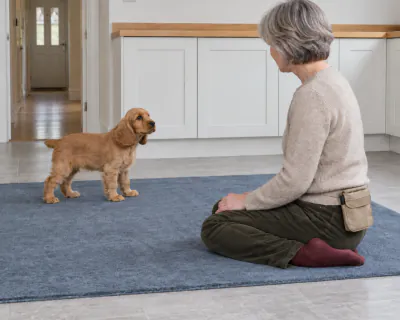
To build a single sound that makes your puppy stop what they are doing and look at your face. The finished behaviour is a head turn towards you within about two seconds of hearing the name, offered without a second call, a hand wave or a rustled bag.
Prerequisites
Ideally, a puppy who already has a charged marker word from marker word and clicker foundations, though this lesson still works with a plain “yes” if you would rather start here. Your puppy needs only to be awake, settled into the home for a few days, and willing to take food from your hand. If the puppy will not eat in your presence, they are either too full or too worried, and both are worth fixing before you train.
Equipment
Soft food the puppy can swallow quickly, so the pace does not stall while they chew. Take it from the daily measured ration rather than adding to it. You also want a quiet room, a closed door and no toys on the floor. Nothing else is needed, and no collar, lead or training aid belongs in this lesson.
Method
- Weigh out about twenty pieces of food and keep them in a pouch or a bowl on the worktop, not in your fist where the puppy can smell them.
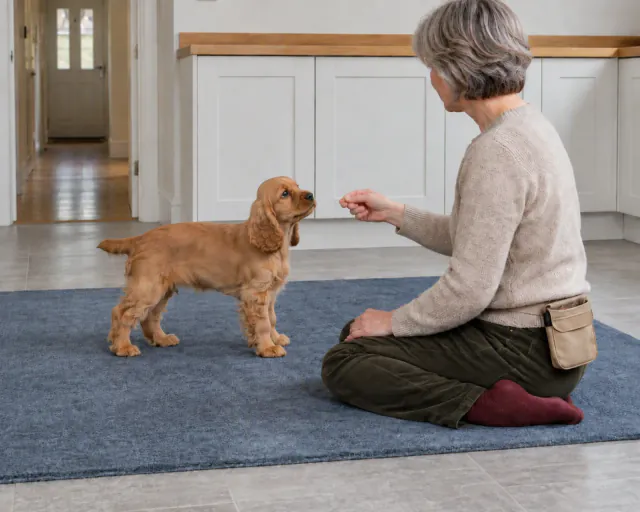
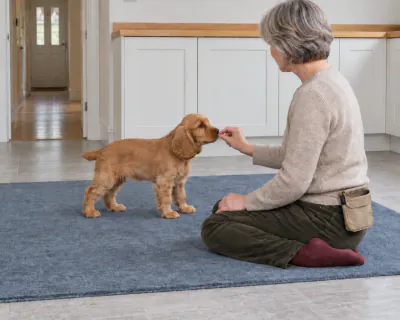
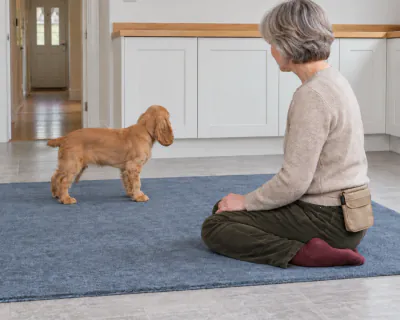
- Sit on the floor a metre (about three feet) from the puppy at a moment when they are awake, calm and not already staring at you.
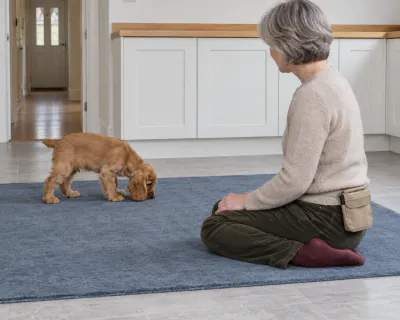
- Wait until the puppy is looking away from you.
- Say the name once, in a normal, pleasant voice. Do not repeat it, pat your leg or make a kissing noise.
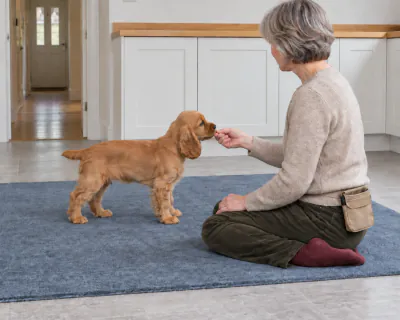
- The instant the puppy’s head turns towards you, say a short marker word such as yes.
- Deliver one piece of food to the puppy’s mouth, then let them look away again.
- Repeat five times, then stand up and end the session even if the puppy is still keen.
- After three or four successful sessions, start saying the name when the puppy is one room away and can hear but not see you, and pay generously when they arrive.
Session length
Two to three minutes, two or three times a day, with at least an hour between sessions. Five to eight repetitions is a full session for a young puppy. More repetitions do not speed this up and usually make the name less interesting.
Progression criteria
Move on when your puppy turns their head towards you within two seconds on eight out of ten calls, across three separate sessions on different days, with no repeated name and no extra noise. Then increase difficulty by one variable only: keep the room the same and add mild distraction, such as a person quietly reading in the corner, before you try the name in the garden.
Common mistakes
Saying the name repeatedly until the puppy responds teaches that the first call is optional. Using the name to interrupt something the puppy enjoys, or before nail trimming and bath time, teaches that the name predicts a loss. Holding food out in front of the puppy turns the exercise into following a lure rather than answering a sound. Training when the puppy is overtired produces frustration on both sides.
Troubleshooting
If the puppy does not turn at all, the food is probably not valuable enough or the room is too interesting. Try a softer, stronger-smelling food and shut the door. If the puppy turns only when you move, you have been leaning in or gesturing without noticing; sit still and let the sound do the work. If the name has already been worn out by shouting or repetition, retire it for training and pair a fresh word instead. Some puppies bred for close handler contact orient sooner than independent working types, but this is a tendency across individuals rather than a rule about any breed.
Safety and when to stop
Keep sessions on carpet or a non-slip mat. A growing puppy has soft, immature joints and growth plates, so avoid anything that involves repeated spinning, jumping or skidding to reach you. Stop the session while the puppy is still interested. Trailing off, wandering away, mouthing your hands or getting frantic usually signals over-tiredness rather than stubbornness, and the answer is sleep, not another repetition. If your puppy consistently fails to respond to sound, startles at ordinary noises, or seems flat and uninterested in food across several days, speak to your vet, since hearing problems and illness can look like poor attention.
Next lesson
Once the name is reliable in a quiet room, move on to sit and hand target, which gives you two ways to position your puppy without touching them.
Useful tool
If you are still deciding what to call your puppy, our dog name generator is a practical starting point, because a short name with clear consonants and a distinct ending is easier for a puppy to pick out of household chatter than a long one.