- Session length
- 2 to 3 minutes, two or three times a day
- Skill
- Foundations
- Suits
- Puppy
What you need
- About twenty pieces of soft food the size of a pea, taken from the daily ration
- A clicker, or a single short spoken word such as yes, chosen before you start
- A quiet room with the door shut and nothing else competing for attention
Every lesson that follows this one depends on a single idea: a sound that tells your puppy, with no ambiguity, exactly which instant of behaviour is being paid for. A spoken “good boy” varies in tone, length and timing from one repetition to the next, which blurs the message. A clicker or a short chosen word does not vary, so it can mark a moment as brief as a paw touching the floor or a head turning half a centimetre. This lesson does not teach a specific behaviour at all. It teaches the tool you will use to teach every behaviour after it.
Purpose
To build a marker signal, either a mechanical clicker or a single spoken word, that reliably predicts food and can therefore be used to pinpoint the exact moment your puppy does something worth repeating. The point is precision rather than praise. A marker that is properly “charged” makes a puppy’s head snap towards the reward the instant they hear it, before any food is visible, which is the test you will use to know it is working.
Prerequisites
None. This is the first lesson on the pathway. Your puppy needs only to be a little hungry, calm enough to stay in one place for a minute or two, and willing to take food from your hand. If your puppy will not eat near you at all, that is worth resolving with quiet handling and a calmer setting before any formal training starts.
Equipment
Soft, quick-to-swallow food taken from the measured daily ration, so the pace does not stall on chewing and treats do not stack on top of normal meals. You also need to choose one marker before you begin: a mechanical clicker, or a short spoken word used for nothing else. Neither is correct for every household, so weigh the choice honestly. A clicker makes exactly the same sound every time, which matters when you are marking something fast, such as a paw lift or a head turn mid-movement, and it cannot be confused with ordinary conversation. A spoken word needs no extra equipment, works when your hands are full or a lead is involved, and is easier for children and other family members to use consistently. Many households end up using both, a clicker for precision work and a word for everyday life, but you only need one to start this lesson.
Method
- Choose your marker and commit to it. If it is a word, agree the exact word with everyone in the household so it never changes.
- If using a clicker, hold it inside a closed hand or in a pocket for the first few sessions to soften the sound, since an exposed click can be startling at close range.
- Sit in a quiet room with your puppy nearby and food ready in a treat pouch or bowl, not in your fist.
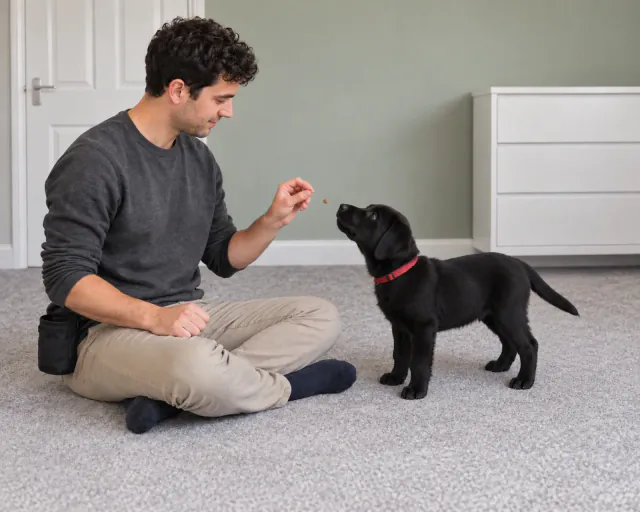
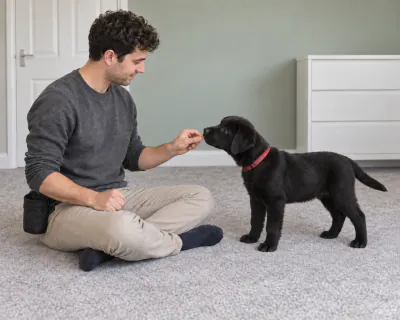
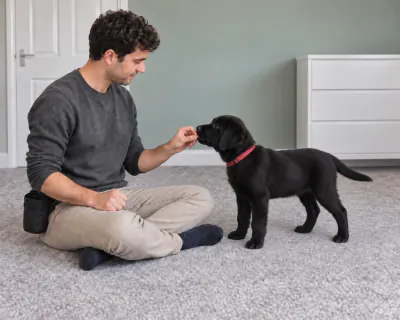
- Click, or say your word, then deliver one piece of food to the puppy’s mouth within about half a second. The food always follows the sound, never the other way round.
- Repeat this pairing ten to fifteen times in a row. At this stage you are not asking for any behaviour or waiting for anything in particular; you are simply building the association between the sound and the food.
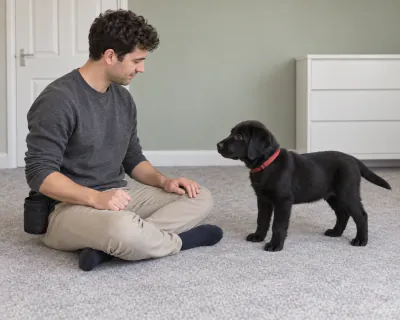
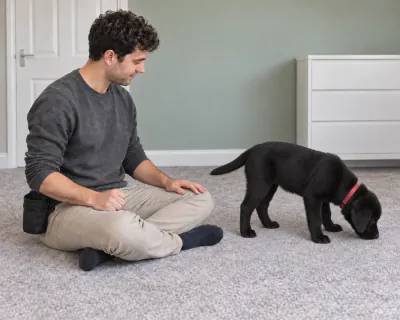
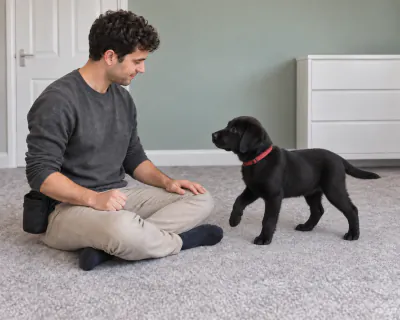
- After a short break, test the pairing. With your hands resting and no food visible, click or say the word once. A charged marker produces an immediate, visible reaction, commonly a head turn or a step towards you, before you move at all.
- If the test works, start using the marker to catch moments you like in daily life, such as four paws on the floor or a calm moment on the mat, marking the instant it happens and feeding straight after.
- Keep the marker exclusive to training. Do not use the same word as a greeting, a name or a general exclamation, or its meaning will blur.
Session length
Two to three minutes, two or three times a day. Ten to fifteen pairings is a complete charging session for a young puppy, and there is no benefit to running longer once the puppy is engaged and taking food readily.
Progression criteria
Move on when the marker produces a clear, immediate orienting response, a head turn or a step towards you, on eight out of ten tests, across three separate sessions on different days, with the puppy not already looking at you or the food. Then raise the challenge one variable at a time. First test the marker after a longer gap since the last use, such as first thing after a nap. Then test it from a small distance, a pace or two rather than sitting directly in front of the puppy. Only once both of those hold should you test it with a mild distraction in the room, such as another person moving quietly, rather than combining any of these changes at once.
Common mistakes
Clicking or saying the marker more than once for a single moment blurs which instant is being rewarded. A long pause between the sound and the food weakens the association, so keep the gap to a fraction of a second while you are charging the marker. Using the marker as a way to get the puppy’s attention, rather than to mark something that already happened, turns it into a second name rather than a precision tool. Switching between different words from session to session, or letting family members use their own versions, dilutes the whole point of choosing one signal.
Troubleshooting
If the puppy does not react to the test click at all, the pairing probably needs more repetitions, or the food is not valuable enough to notice. Go back to plain pairing for another session before testing again. If a clicker makes the puppy flinch, freeze or try to leave the room, stop using it entirely for now and switch to a spoken word instead; forcing exposure to a sound that frightens a puppy will not fix the association. If you are using a verbal marker and the puppy seems unmoved by it, check that it is not a word already used constantly around the house, since an overused word carries no special information. Puppies who have come from a noisy litter environment sometimes take a few extra sessions to notice a new, quiet spoken word, which is a matter of individual exposure rather than anything wrong with the method.
Safety and when to stop
Keep sessions short and end them while the puppy is still keen rather than pushing for one more repetition. A puppy who suddenly avoids a room where a clicker has been used, or shows lasting wariness of the sound across several days rather than settling with muffling, may have more general sound sensitivity worth mentioning to your vet, since this can also show up around other everyday noises. There is no safety concern with a spoken marker beyond the ordinary rules of any short training session: watch for a puppy who is tiring, and stop before they lose interest rather than after.
Next lesson
With a working marker in place, move to teaching your puppy to respond to their name, which uses the same click-or-word-then-food pattern to build the first behaviour on the pathway.
Useful tool
If you have not settled on a name yet, it is worth doing before the next lesson, and our dog name generator is a quick way to find something short and distinct enough to stand out from ordinary household chatter.