
- Session length
- 3 to 4 minutes, two or three times a day
- Skill
- Settle and calmness
- Suits
- Puppy
What you need
- A flat, non-slip mat or folded towel large enough for the puppy to lie on with room to spare
- About twenty pieces of soft food the size of a pea, taken from the daily ration
- A chair positioned beside the mat so you can sit rather than loom
Most puppy training teaches a puppy to do something. This lesson teaches a puppy to do nothing, which is harder and more useful. The behaviour is built by paying calmness in small pieces, extending the gap between payments gradually, and resisting the urge to talk the puppy into staying.
Purpose
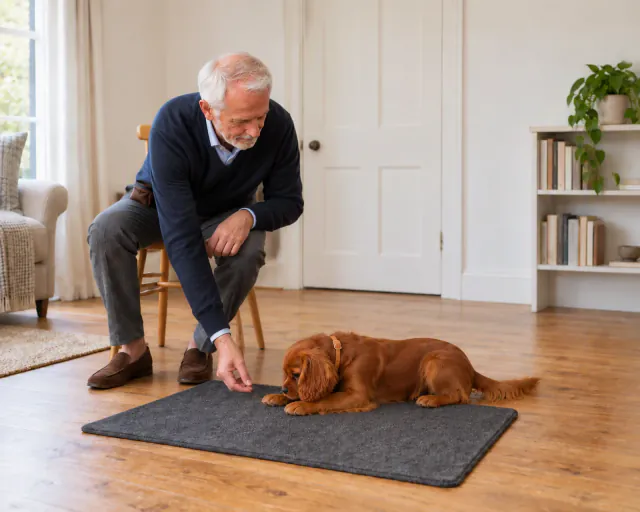
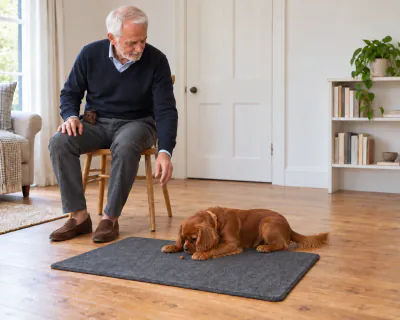
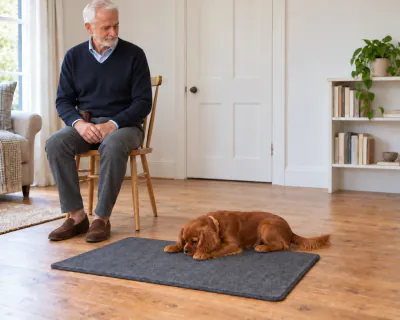
To teach a puppy that lying on a specific mat is comfortable and rewarding, and to build that into a quiet down of a minute or two while ordinary household activity carries on. This is a resting position, not a formal stay.
Prerequisites
Your puppy sits to a single cue in a quiet room and takes food calmly from your hand. They should already have a sleeping place that is left alone, because a puppy who never gets uninterrupted sleep will not settle on cue either.
Equipment
A flat mat or folded towel that stays put and is distinct enough that the puppy can tell it apart from a rug. Soft food from the measured daily ration, and a chair so you can sit beside the mat rather than standing over it.
Method
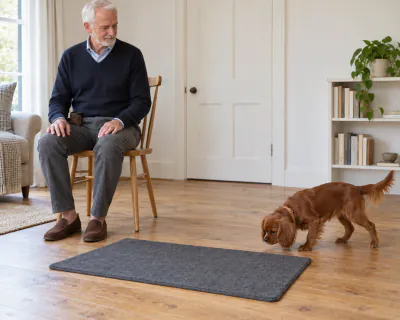
- Put the mat down in a quiet room and sit in a chair beside it with food in a closed hand or pouch.
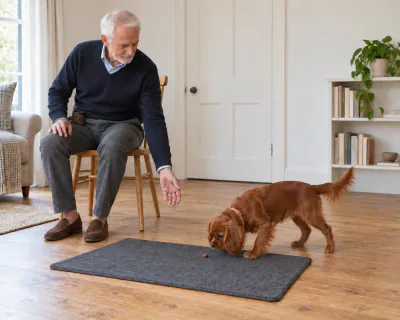
- Say nothing. Wait. When the puppy puts one paw on the mat, drop a piece of food onto the mat.
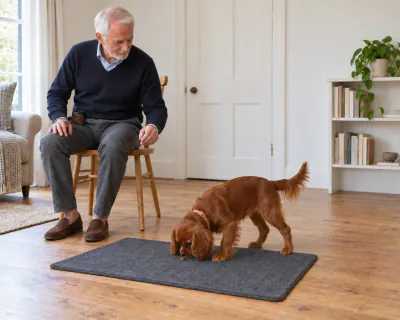
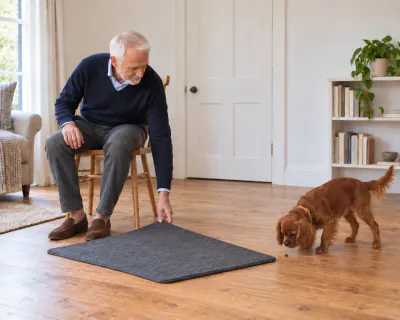
- Keep dropping food onto the mat every time the puppy interacts with it. Do not lure them on or point.
- When the puppy stands with all four feet on the mat, feed two or three pieces one at a time, onto the mat between their feet.
- Wait for the puppy to lie down of their own accord. The moment they do, feed once, low and between the front paws.
- Feed again after two seconds, then three, then five, always placing the food between the front paws so the puppy has no reason to get up.
- Vary the gaps rather than only lengthening them: three seconds, then eight, then four, then twelve.
- To finish, say a release word such as off, toss one piece of food away from the mat, and pick the mat up.
- Once the puppy lies down within about ten seconds of the mat appearing, add the word settle as they are lowering themselves.
Session length
Three to four minutes, two or three times a day. A young puppy will often fall asleep on the mat, which is a good outcome rather than a failed one. Leave them and end quietly.
Progression criteria
Move on when your puppy lies down on the mat within ten seconds of it being put down, and holds a relaxed down for sixty seconds on no more than three pieces of food, on eight out of ten attempts across three separate sessions. Only then add difficulty, one variable at a time. Extend duration first, to two minutes in the same quiet room. Then add distance, standing up and taking one step away before returning. Then add mild distraction, such as a family member walking through. Never lengthen the time and move away in the same session.
Common mistakes
Repeating the settle cue while the puppy fidgets teaches that the word means nothing. Feeding from your hand at head height lifts the puppy off the mat. Only ever extending the duration leaves no easy repetitions, so the puppy gives up. Sending the puppy to the mat when they are being a nuisance turns it into a punishment spot. Asking for a settle in a busy kitchen before it works in a silent room guarantees failure.
Troubleshooting
If the puppy will not lie down at all, they are probably too excited to work, so try again after a nap. If they leave the mat repeatedly, your gaps are too long, so go back to feeding every two seconds. If the puppy chews the mat, that is likely teething, so swap to a thinner towel and end sooner. Puppies from lines bred for sustained activity often need more repetitions before switching off, though that is a tendency in some individuals rather than a rule about any breed. A puppy who cannot settle anywhere, or becomes distressed when left alone even briefly, needs veterinary advice first and support from a qualified behaviourist working with your vet rather than a training exercise.
Safety and when to stop
Sleep is part of the training plan rather than an interruption to it, and most puppies need far more of it than owners expect. Work on a padded, non-slip surface, since growing joints do not benefit from long periods on a cold hard floor. Never physically hold a puppy on the mat, and never use it to keep a frightened puppy still. Stop the session while the puppy is still relaxed rather than waiting for them to get up and wander. Fidgeting, whining and sudden bursts of activity usually mean the puppy is over-tired. If your puppy struggles to lie down comfortably or cries as they lower themselves, stop and speak to your vet.
Next lesson
With a puppy who can rest on cue, move on to introducing the crate, which uses the same calm settling skill in a smaller, enclosed space.
Useful tool
Settling comes far more easily to a puppy whose physical and mental needs are already met, so the dog exercise planner helps you set an age-appropriate daily amount rather than guessing.